What Is NGSS? a Plain Guide for Students
What is NGSS? See the three dimensions, how a performance expectation works, and what these science standards do and do not decide for your class.

Topics: what is ngss, NGSS standards, three-dimensional learning, performance expectations, science education
NGSS is a voluntary set of U.S. K–12 science standards, published in April 2013, that asks students to use practices, core ideas, and crosscutting concepts together instead of memorizing facts alone. They describe what you should understand and be able to do. They aren't a federal textbook or a script for every lesson.
If you can define a word, are you ready for the question on the page? Plenty of study guides still treat science like a glossary. You copy "force" or "ecosystem," you feel finished, and the task still asks why a ball and a crumpled sheet of paper leave your hand together and don't hit the floor together. That gap is where grades 7–12 students get stuck. What is NGSS, in a normal class period, is a way to pack an idea, a thinking tool, and evidence into one response.
Table of Contents
- What NGSS is and why it matters
- The three dimensions inside every standard
- How to read one performance expectation
- How the standards are organized
- A Study Loop for One Science Phenomenon
- How far NGSS spread after 2013
- What NGSS does not decide for you
- Check your standard before you study
What NGSS is and why it matters
Say your teacher drops a tennis ball and a loose sheet of paper from the same height. You already know the word gravity. The useful question is what you can do with that idea when the two objects don't land together.
The Next Generation Science Standards (NGSS) are U.S. K–12 science education standards built to join scientific knowledge with the practices scientists and engineers use. Development started from the National Research Council's Framework for K–12 Science Education, released in July 2011. A consortium of 26 states then worked with Achieve, the National Science Teachers Association, the American Association for the Advancement of Science, and the NRC so the standards would be coherent across grades and disciplines and internationally benchmarked. A 41-member writing team, expert reviews, and two public draft stages produced preliminary drafts in May 2012 and January 2013, and the completed standards in April 2013, as the National Academies' account of the Framework records.
NGSS wasn't one organization's curriculum or textbook. It was a state-led standards initiative. Three-dimensional learning connects disciplinary core ideas, science and engineering practices, and crosscutting concepts, instead of treating science as memorization alone. For you, a prompt more often asks you to explain something you observe or to design a solution. The standards reach life science, physical science, Earth and space science, and engineering. States and districts still choose adoption, courses, instruction, and tests. You'll use the three dimensions together, read one standard as a goal, and turn that goal into a short study routine.
The three dimensions inside every standard
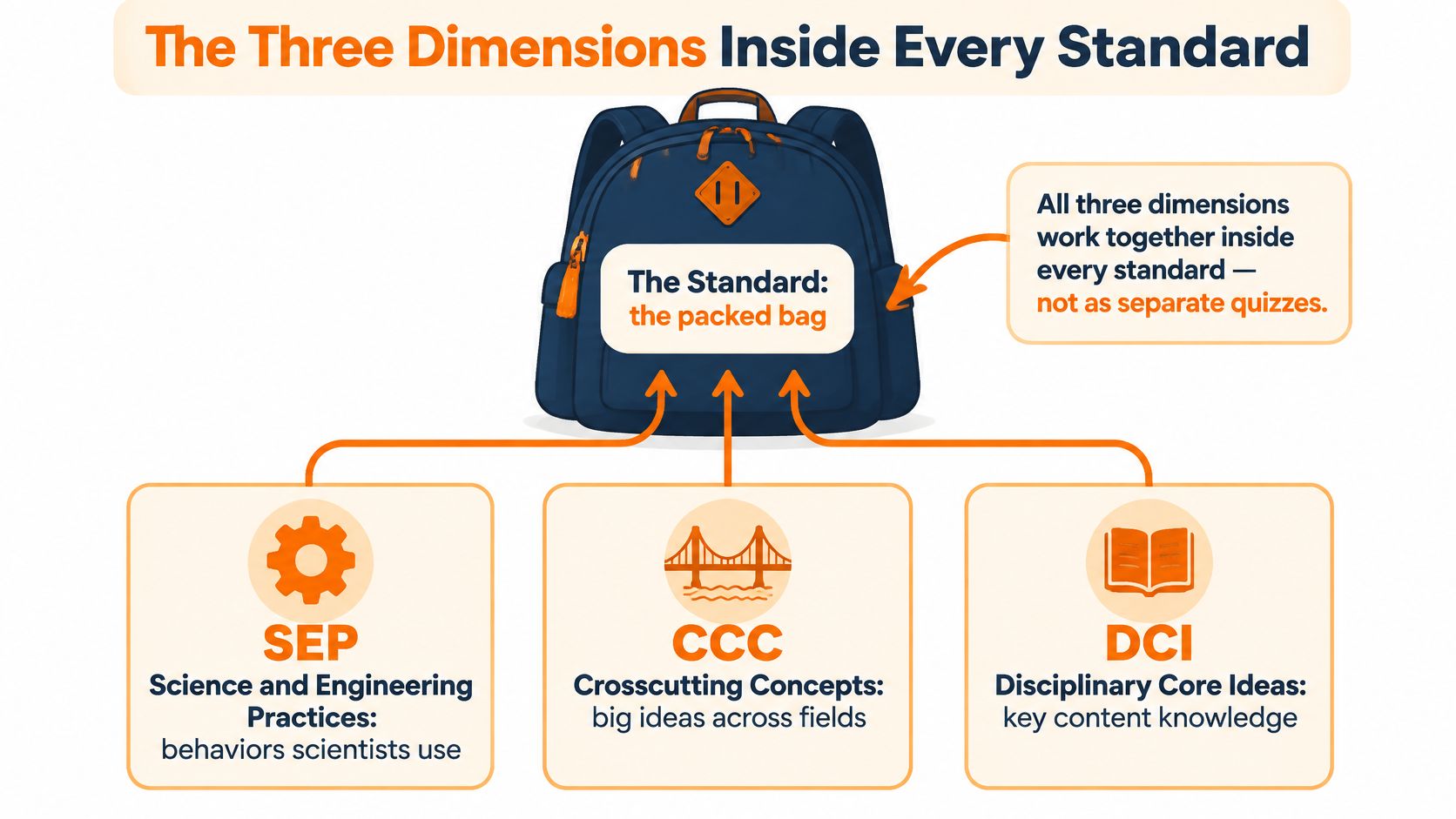
Think of a standard as a packed backpack. The three dimensions are items you use on the same trip, not three separate quizzes you can finish one at a time.
| Dimension | What you do | Examples you will see |
|---|---|---|
| Science and Engineering Practices | Investigate, model, analyze, explain, argue, or design | Ask a question, plan a fair test, read a data table, build a model, design a solution |
| Disciplinary Core Ideas | Use a foundational science or engineering idea | Forces, chemical reactions, ecosystems, heredity, weather, Earth systems, energy in design |
| Crosscutting Concepts | Connect ideas across science fields | Patterns, cause and effect, systems, scale, energy and matter, structure and function, stability and change |
Performance Expectations (PE) are the outcomes you should be able to show. Disciplinary Core Ideas (DCI) are the lasting ideas. Crosscutting Concepts (CCC) are thinking tools that travel from one science class to another. You'll see those abbreviations on standards pages and sometimes on study sheets.
Science and Engineering Practices are what scientists and engineers do. That includes asking questions, planning investigations, analyzing data, using models, constructing explanations, arguing from evidence, and designing solutions. Disciplinary Core Ideas are the important ideas in physical science, life science, Earth and space science, and engineering. Crosscutting Concepts include patterns, cause and effect, scale, systems, energy and matter, structure and function, and stability and change.
The NGSS state pages describe these as three equally important dimensions. Practices, core ideas, and connecting concepts aren't separate lists you memorize and then set aside. A strong answer uses them in one response.
One ecosystems response
Suppose a class tank starts with clear water, a few plants, and a growing film of algae. A question that only asks "define ecosystem" stops too early. You might use evidence from a simple data table of plant growth and algae cover, apply systems thinking to the plants, light, and nutrients, and explain a life-science core idea about how matter moves among organisms. One paragraph can carry all three. Before you study a class question, label it with the practice, the core idea, and the connecting concept from the table.
Practical rule: If a practice question never asks you to use evidence, a model, or a design, it isn't finished yet, even when the definition is correct.
How to read one performance expectation
A performance expectation is an assessable outcome. It states what you should be able to do after instruction. It isn't a lesson plan, a chapter order, or a complete list of every fact in the unit.
The California Department of Education's guide to reading the standards is a clear pattern. One expectation can join a practice such as supporting an argument, a core idea such as gravitational force, and a crosscutting concept that frames the reasoning. Proficiency means performing those dimensions together. A vocabulary-only quiz misses the action the sentence asks for.
Walk down the page in this order.
- Performance expectation. Read the assessable sentence first. It usually combines a practice, a core idea, and a crosscutting concept. Circle the verb. "Support an argument" is a different job from "develop a model."
- Foundation boxes. These unpack the practices, core ideas, and crosscutting concepts underneath that sentence. Use them to label which dimension each study question practices.
- Connection boxes. These show links to related science standards and to other subjects. They tell you what earlier or later ideas the topic builds on. They don't turn the page into a math or English guide.
- Clarification statement and assessment boundary. These narrow the examples, the depth, and what is fair to assess. If a boundary says a calculation isn't expected, don't turn your practice into a formula drill.
| Part | What it shows | How you use it |
|---|---|---|
| Performance expectation | The assessable outcome combining all three dimensions | Treat this sentence as the goal of your study |
| Foundation boxes | The practices, core ideas, and crosscutting concepts underneath | Label which dimension each study question practices |
| Connection boxes | Links to related science standards and other subjects | See what earlier or later ideas this topic builds on |
| Clarification and assessment boundary | Limits on scope, examples, or what is fair to assess | Check that your practice matches the intended depth |
Why the boxes matter on a test day
Prompts that match this design start from a phenomenon, data, a model, or a design problem, then ask for an explanation with evidence. That is harder than a definition, and it is also clearer. You know the action you have to perform.
Putting this into classrooms depends on teacher learning, instructional supports, and local conditions. An Institute of Education Sciences literature search, summarized in that same California guide, reports barriers that include time constraints and misalignment with high-stakes exams. That is a search of the literature, not a single classroom experiment, so it describes patterns schools run into rather than a guaranteed result for your school.
Copy the action verb and the phenomenon from the expectation before you make flashcards. If the verb is "argue from evidence" about gravitational force, a card that only says "gravity pulls down" won't match the goal. A set of physics multiple-choice questions can help you practice reading a prompt, as long as you still check the boundary on your own standard.
How the standards are organized
NGSS draws on four disciplinary areas: physical science, life science, Earth and space science, and engineering, technology, and applications of science. Those areas are the map. A single standard still sits inside a grade and a local document, so the map isn't the same booklet in every state.
Performance expectations are grouped for different grades rather than dumped into one master list. Your middle school course and a high school course can share a big idea, such as energy or ecosystems, while asking for a different action and a different depth. Start with the grade that matches your class, not with the first PDF that appears in a search.
States may group expectations by topic or by Disciplinary Core Idea, and they may build their own arrangement when they adopt standards. That choice changes where you look, not the need to read the expectation itself.
Same idea, different heading
An ecosystems expectation might sit under a topic heading such as "matter and energy in organisms" in one state's document. Another state might file a similar expectation under a life-science core idea. The heading is a filing label. The sentence you must perform is still the expectation, plus its clarification and boundary.
Before you study one standard, do three quick checks.
- Match the grade. Use the expectations written for your course, not a younger or older band that happens to share a keyword.
- Match the arrangement. Notice whether your state files by topic or by core idea so you don't think a missing heading means a missing idea.
- Match the course. Your syllabus, not a random national page, tells you which expectations this class teaches.
A Study Loop for One Science Phenomenon
A performance expectation isn't a topic or a fact to memorize. Each one combines dimensions so you can explain a phenomenon or design a solution. The NGSS three-dimensional learning page separates the assessable expectation from the foundation boxes and connection boxes under it. You still need a way to study that sentence.
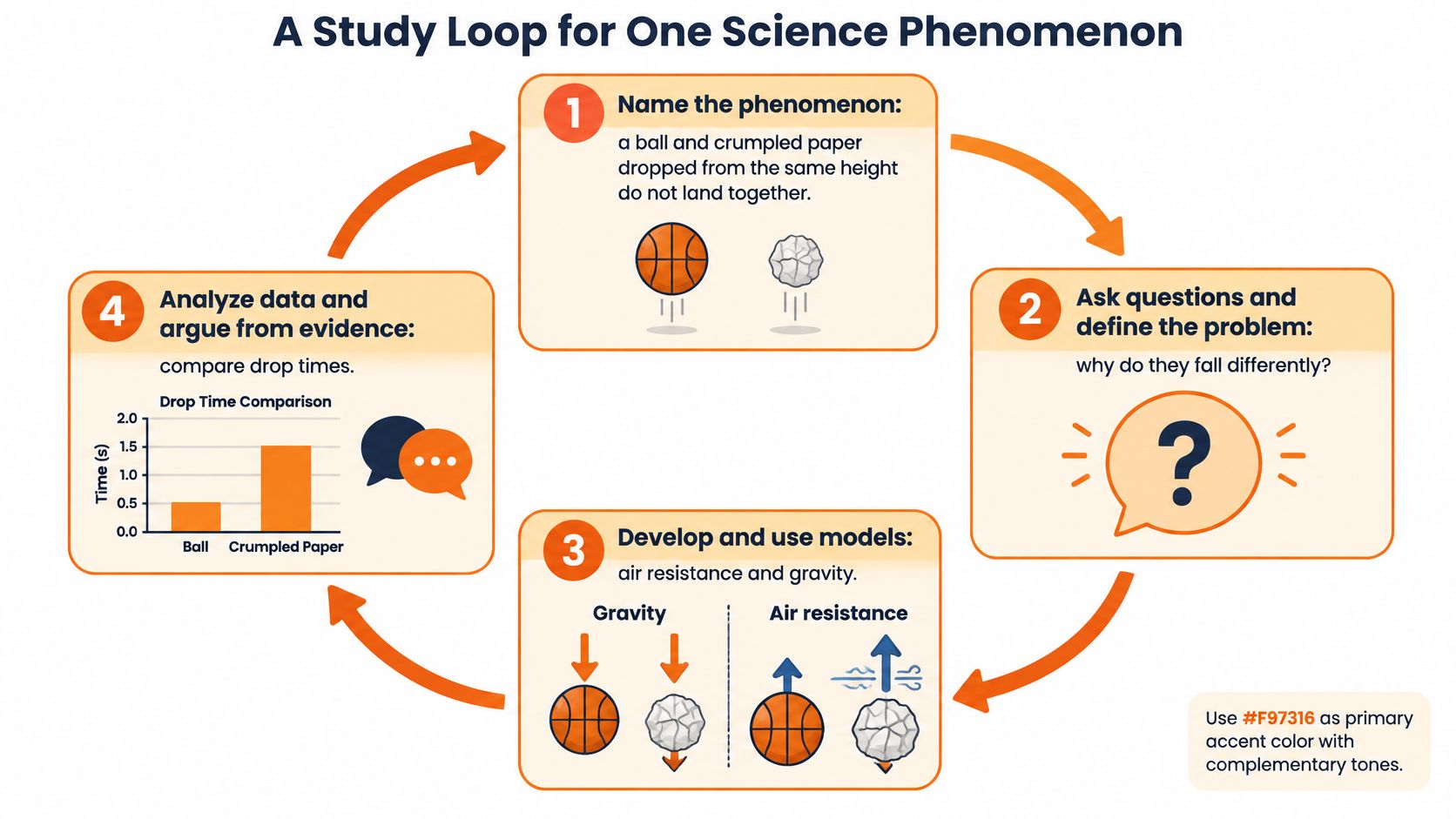
Use one familiar case. A ball and a crumpled sheet of paper drop from the same height and don't land together.
- Name the phenomenon or design problem in your own words. "Released together, the ball reaches the floor before the paper."
- Recall the relevant core idea. Gravitational force acts on mass. If your class uses the formula, write it as (F_g = mg), with (g \approx 9.8,\text{N/kg}) near Earth's surface. The paper's later landing still needs air resistance. Gravity alone doesn't explain the difference.
- Choose a crosscutting concept. Cause and effect fits. The shape changes the air's push, and that push changes the motion.
- Use a practice. Analyze a simple table of drop times, draw a force model with arrows for gravity and air resistance, or compare two trials with the paper open and then crushed tighter.
- Communicate an explanation or a solution with evidence. "The ball has a smaller effect from air resistance, so it keeps a higher speed. The table shows the open paper took longer." That is an explanation. "Gravity is a force" is only a definition.
Try the same loop on a plant
A classroom plant wilts by Friday. Name that phenomenon. Recall a life-science idea about water moving into a plant. Pick systems or cause and effect. Use evidence such as dry soil, a closed window, or leaves that recover after watering. Then say what changed and why. The loop is the same even though the science isn't forces.
Flashcards help with terms like mass, resistance, and wilt. An NGSS task also needs evidence, a model, an explanation, or a design. If you can only recite a vocabulary word, you aren't done. For more prompts in this style, look at 7th grade science questions and sort each one into phenomenon, idea, connecting concept, and evidence.
A short video can make the three-dimensional idea easier to picture before you try the loop on your own notes.
If your answer could be copied onto any science topic without changing the evidence, it isn't tied to the phenomenon yet.
How far NGSS spread after 2013
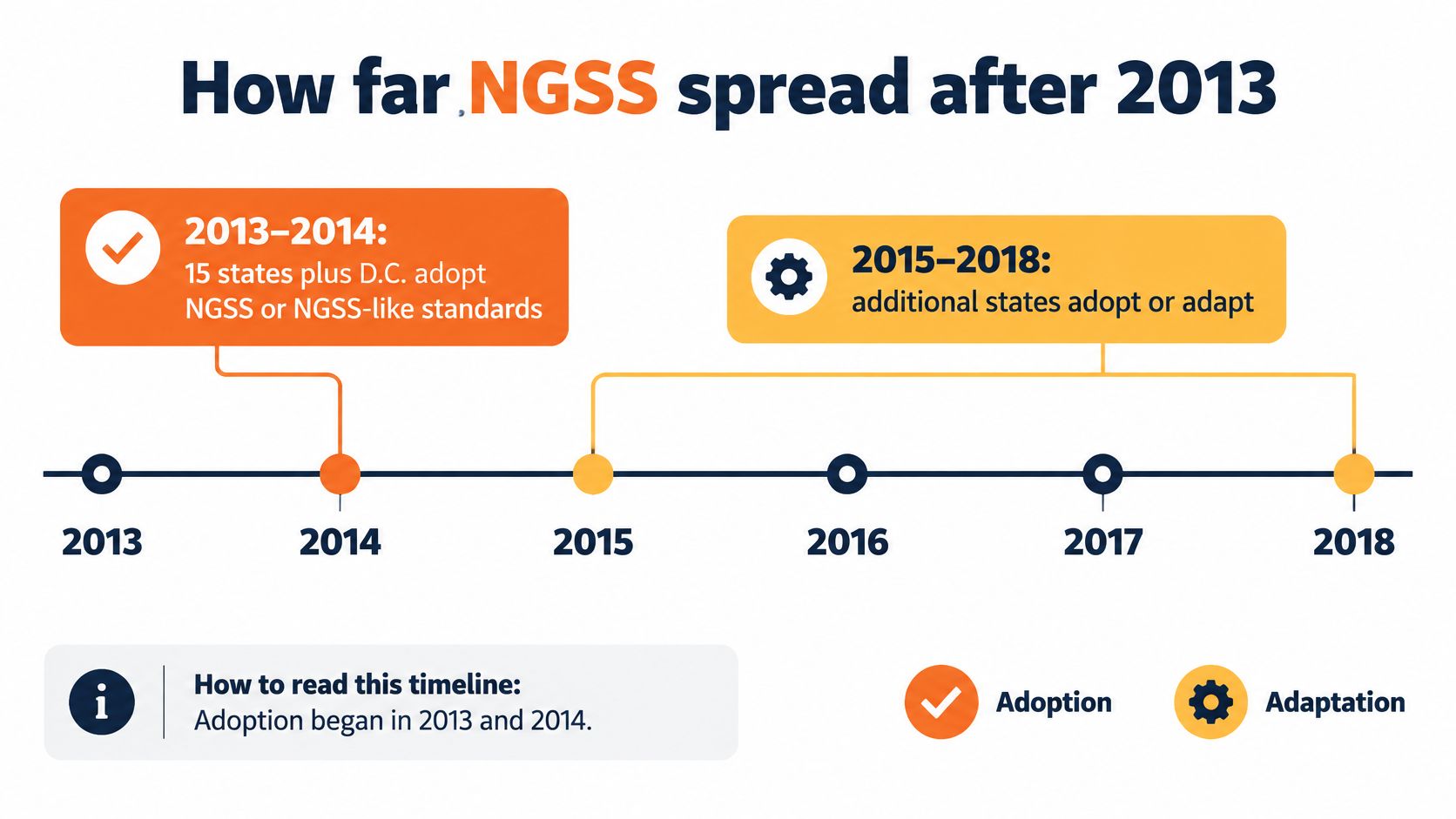
Two states can both say "we adopted NGSS" and mean different things. One took the published standards as written. Another wrote its own version built on the same Framework, the way two bread recipes can share ingredients and still come out of the oven differently. That is why the counts below come from different cuts and shouldn't be stacked into one total.
| Period or source | Figure reported | What it counts |
|---|---|---|
| 2013–2014 | 15 states plus the District of Columbia | Adopted NGSS or NGSS-like standards |
| 2015–2018 | 24 additional states | Adopted comparable standards |
| By 2018 | About two-thirds of U.S. students | Students in the adopting states |
| National Academies historical summary | 48 states, nearly 90% of students | Adopted Framework-based standards since the 2013 release |
| Tighter count of direct adopters | Lower than the Framework-based total | Adopted the published NGSS wording itself |
Read the counts as different cuts
A National Academies historical summary lays out the early spread. In 2013 and 2014, 15 states plus the District of Columbia adopted NGSS or standards described as NGSS-like. From 2015 through 2018, 24 additional states adopted comparable standards. By 2018, those adopting states represented about two-thirds of U.S. students. The same summary reports that 48 states, representing nearly 90% of students nationally, had adopted standards based on the Framework and were working toward implementation.
Those percentages aren't the same claim. NGSS adoption can mean taking the published standards word for word. NGSS-like or Framework-based adoption means a state wrote its own standards with similar principles. Count only the states that took the published wording and the total lands lower than the Framework-based figure. Early on, that gap was easy to see. When Delaware signed on, it was just the seventh state to adopt NGSS.
States may also arrange expectations by topic or by core idea, so two "adopting" documents won't look identical on the page. For your study loop, the useful question is which dimensions your state's version spells out at your grade. The adoption milestone makes NGSS a widely used reference across the science disciplines. It was never a federal order, and it doesn't mean every classroom teaches the same lessons.
What NGSS does not decide for you
No. An NGSS-aligned resource can't predict what shows up on your test.
NGSS sets expectations for what students should know and be able to do. Adoption, course sequence, and assessment stay with states and local districts. The official NGSS site describes those expectations and notes that implementation takes coordination among states, districts, schools, teachers, and students. Twenty-six states helped develop the standards. That fact doesn't mean every state adopted the published wording or uses the same exam.
A resource can match the three dimensions and still miss your state's wording, grade order, clarification statements, assessment boundaries, or the emphasis of a local test. "Aligned" is a planning claim. It isn't a promise about Friday's quiz.
- NGSS isn't a curriculum you finish cover to cover. It doesn't hand you the readings, labs, or the order of units.
- It doesn't guarantee that tonight's worksheet matches a state test. Your state may share the idea and still assess it differently.
- It doesn't replace a teacher's judgment. Your teacher knows the course, the lab equipment, and the boundary for your grade.
- "Aligned" isn't an endorsement by the organizations that published the standards.
Families and homeschool educators should check the state education agency's current science standards and the course syllabus. Use NGSS as a three-dimensional planning frame, not as a universal exam blueprint. If a study set never names your state or your course, treat it as practice with the ideas, then compare it with the local document before you trust it for a test.
A resource can be conceptually aligned and still miss the sentence your state actually adopted.
Check your standard before you study
Start with the exact expectation your teacher named, because one line can hide several jobs. A standard may ask you to explain why a puddle shrinks on a warm day, but the strong answer moves through a loop: phenomenon, core idea, crosscutting concept, then evidence or a model that supports the explanation.
- Find the named standard. Copy the performance expectation or state standard from your syllabus, not the first NGSS page a search returns.
- Mark the study loop. Underline the phenomenon, circle the practice, and box the core idea and crosscutting concept. Those pieces tell you what a complete answer has to include.
- Write two kinds of prompts. Make a few recall prompts for terms. Then add one prompt that asks for evidence, a model, or an explanation of the phenomenon.
- Check the answers. Compare them with your notes, your teacher, or a parent. Generated study material can be wrong, so have a teacher or parent verify educational content.
- Retry only the hard prompts later. When one explanation is the part you missed, practice that miss again on another day instead of rereading the whole chapter.
If you use Knobee AI, treat it as practice for grades 7 through 12 that supports class rather than replacing it. You can paste notes, describe a topic, or upload a document to build a study set. Science study sets for Biology, Chemistry, and Physics are aligned to NGSS when a grade level is selected. Alignment helps aim practice at the expectation; your state page and syllabus still decide wording and emphasis. For another example of turning a chapter into recall prompts, use these biology flashcards built from your own notes. When the standard is checked, build the set with Knobee AI and retry the misses.