10 Multiple Choice Questions Physics with Explanations
Practice 10 multiple choice questions physics students face in grades 7–12, with worked answers, short explanations, and tips for checking your work.

Topics: physics multiple choice, physics practice questions, high school physics, physics study tips, physics problem solving
You've read the answer key. The letter you picked matches, so you flip the page and move on. A week later a slightly different question shows up on a quiz, and your pencil hovers between two choices you can't separate.
That gap between recognizing an answer and building one is where most physics study time gets lost. Multiple choice questions in physics only pay off when you treat every option as a claim you have to test.
The routine is short. Read the question, cover the answers, predict the result, then check. When you miss one, the useful question isn't which letter was right. It's which wrong idea pulled you in.
The ten questions below cover the core of a standard high school course. Forces and motion come first, then circuits, energy, waves, density, and light. Each one gives you a worked solution, the reasoning trap hidden in the wrong answers, and a fast way to check your result with units or a reasonableness test.
Answer each question before you read the explanation. Write your choice and one sentence of reasoning, then compare. That sentence is where the learning happens, because it shows whether you understood the idea or just recognized the shape of the problem.
Table of Contents
- 1. Net force and mass set the acceleration
- 2. Speed is distance divided by time, and the units prove it
- 3. Ohm's law connects push, resistance, and flow
- 4. Kinetic energy grows with the square of speed
- 5. A dropped object covers more ground each second
- 6. Wave speed is frequency times wavelength
- 7. Density identifies a material, not a size
- 8. Action and reaction act on different objects
- 9. Light bends toward the normal when it slows down
- 10. Power is work divided by time, so do it in two steps
- How the ten physics questions compare
- Turn your missed questions into your next practice set
1. Net force and mass set the acceleration
The question. A 5 kg box has a net force of 20 N applied to it. What is its acceleration?
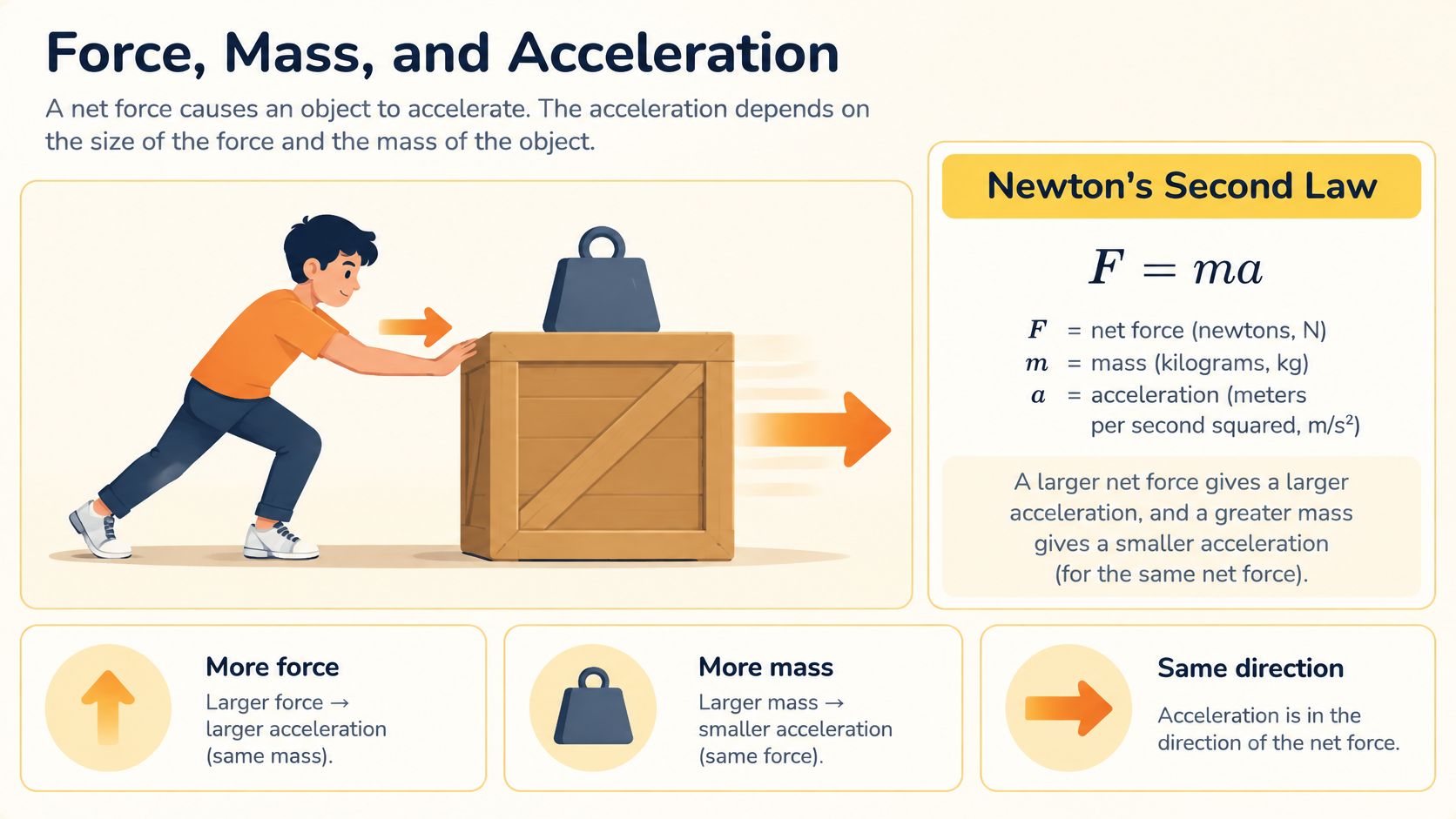
Newton's second law ties the three quantities together as (a = F_{\text{net}} / m). Divide 20 N by 5 kg and you get 4 m/s². Mass divides the force, so a heavier box under the same push accelerates less. The units confirm it, because a newton is a kilogram meter per second squared and (\text{N}/\text{kg}) reduces to (\text{m/s}^2).
Where the tempting wrong answers come from
- 100 m/s²: the result of multiplying 20 by 5. Both numbers are in the question, and multiplying feels like doing work.
- 0.25 m/s²: the result of dividing mass by force, which flips the formula upside down.
- 4 m/s: numerically right, dimensionally wrong. Acceleration needs meters per second squared, not meters per second.
Before you calculate anything, predict the size of the answer. A bigger mass should give a smaller acceleration, so any option larger than the force number deserves suspicion.
That focus on concepts over symbol pushing is exactly what the Force Concept Inventory was built for. Its 30-question 1995 version grew out of student interviews and trials with more than 1,000 students, and the PhysPort record of the FCI describes how it tests understanding of force and motion rather than equation recall.
If free body diagrams are still the hard part, this walkthrough of physics unit 1 starts there before the algebra.
2. Speed is distance divided by time, and the units prove it
The question. A car travels 150 m in 10 s at a steady speed. What is its speed?
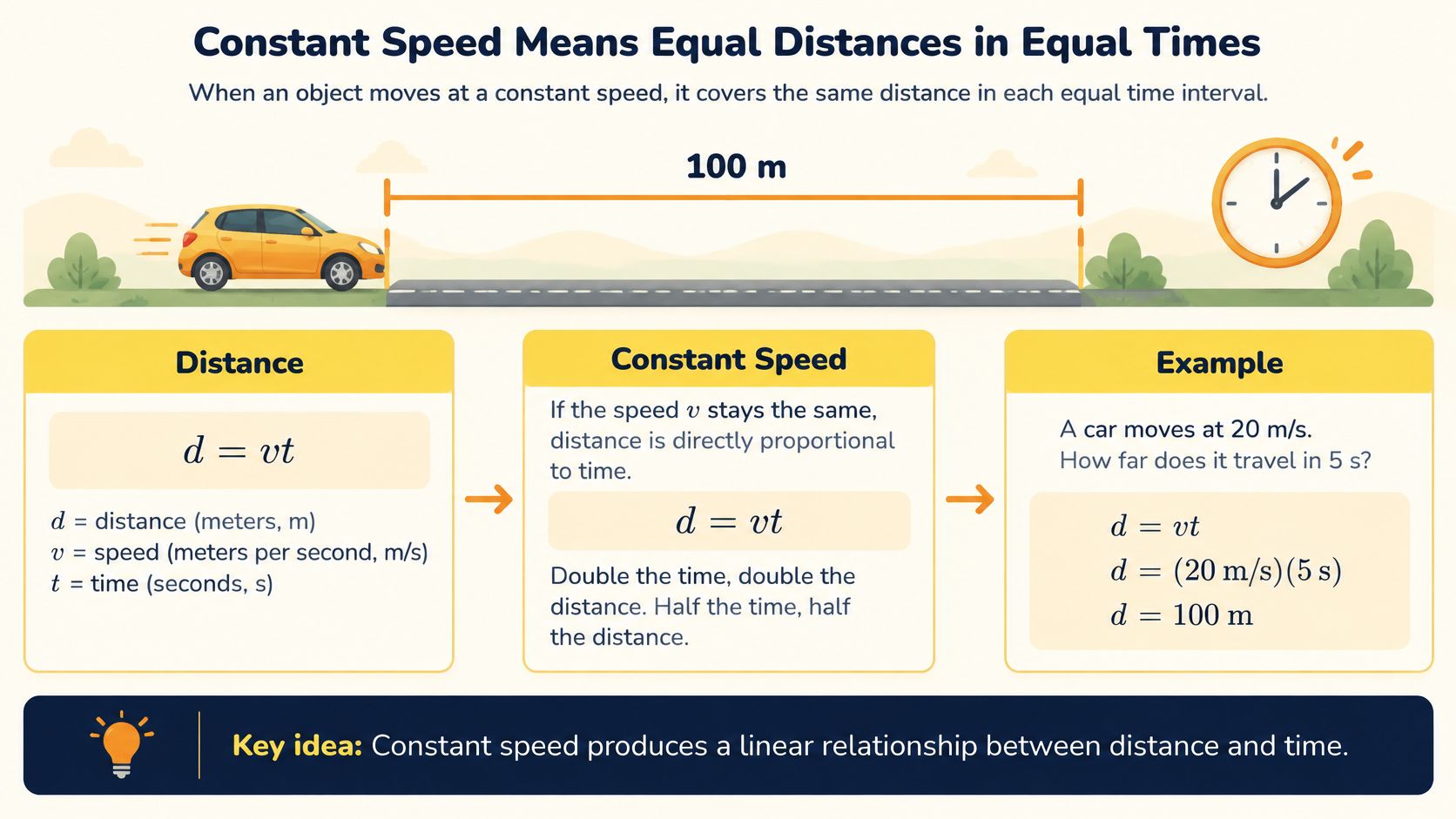
Speed is a rate, meaning distance per unit of time. Divide 150 m by 10 s and you get 15 m/s. The word "steady" matters, because it tells you that average speed and instantaneous speed are the same number, which is what makes one division legal here.
Reject the wrong options by size rather than by re-deriving. 1500 m/s comes from multiplying distance by time, and that is faster than sound, so no car on a road manages it. 0.067 m/s comes from dividing time by distance, and that would mean the car barely moved during a full ten seconds, which contradicts the 150 m in the question.
Convert units before you divide. A right formula with mismatched units produces a wrong number that looks exactly like a wrong formula.
Suppose the question said 150 m in half a minute. Convert 30 s first, then divide for 5 m/s.
- Say the formula with its units attached: speed equals meters divided by seconds, so the answer must be meters per second.
- Convert early: minutes to seconds, kilometers to meters, before any division happens.
- Read the qualifier: "steady" and "constant" change what the question is asking.
3. Ohm's law connects push, resistance, and flow
Picture a battery as a pump. Voltage is the push it gives each unit of charge, resistance is how hard the pipe fights the flow, and current is the flow that results. Ohm's law writes that relationship as (V = IR).
The question. A 12 V battery is connected across a 4 Ω resistor. What current flows?
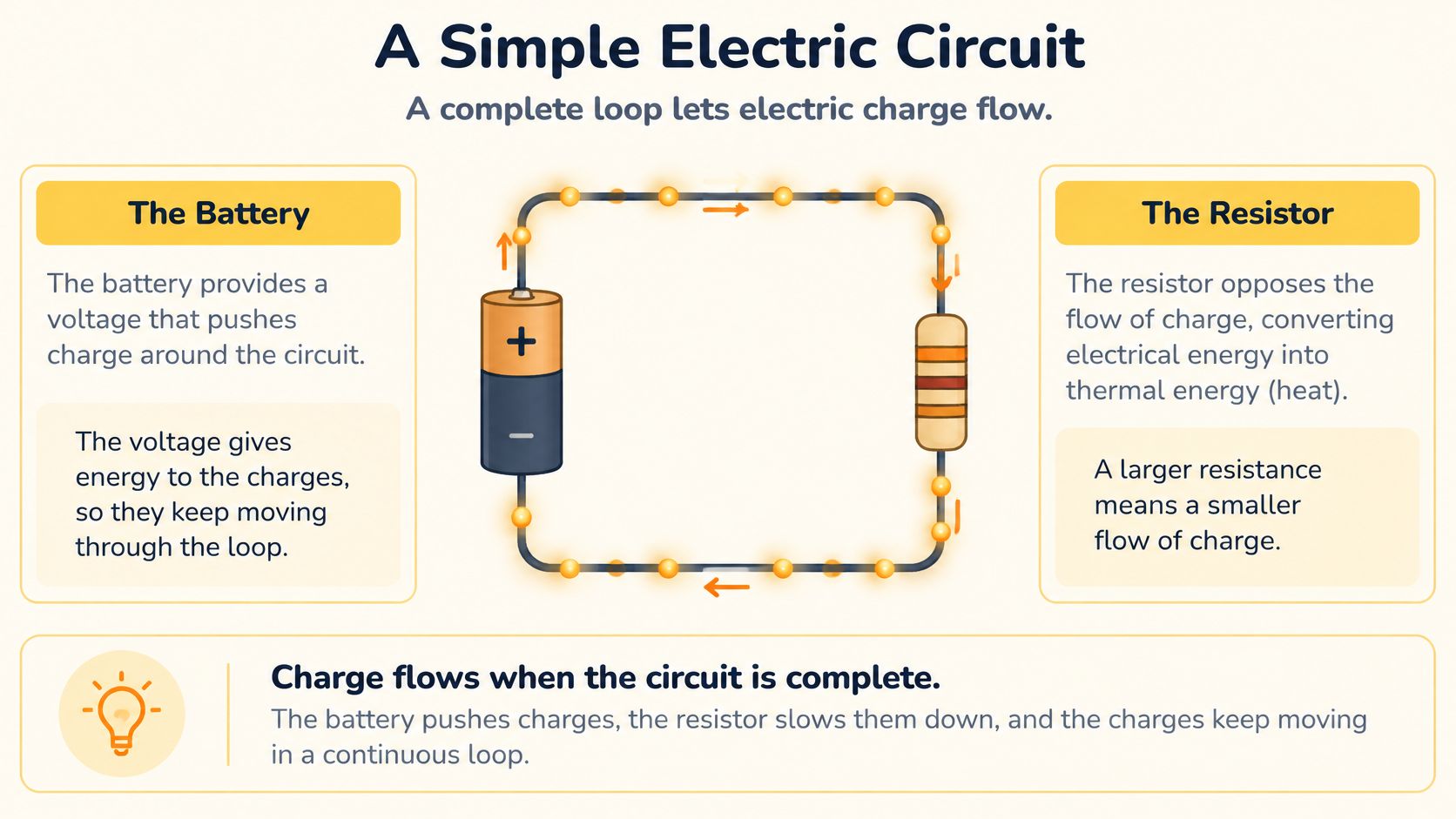
Solve for current before you touch the numbers: (I = V/R = 12/4), which is 3 A. Rearranging first stops you from dividing the wrong quantity, the slip that produces 0.33 A. Multiplying instead gives 48 A, and that fails a sanity check, since a resistor in a school circuit isn't carrying tens of amps.
The diagram habit that pays off
Draw the loop. Label V at the battery, I on the wire, and R at the resistor. Any missing value can usually be found from the other two, so a labeled sketch doubles as your plan and your check.
A dimmer switch is the same idea in your living room. Turning it raises resistance in the circuit, current drops, and the lamp dims. Once you can explain that in one sentence, Ohm's law stops being a formula and becomes a description of something real.
These physics topics with worked examples go through series and parallel circuits in the same order, one resistor at a time.
4. Kinetic energy grows with the square of speed
Half the students who miss this question get it wrong in the same two ways. Some drop the ½. Others square the mass instead of the speed. Both produce a tidy number, which is why the error survives a quick glance.
The question. A 2 kg object moves at 3 m/s. What is its kinetic energy?
Work through the formula (KE = \frac{1}{2}mv^2) in order. Square the speed first: (3^2 = 9). Then multiply by mass and one half: (\frac{1}{2} \times 2 \times 9), which gives 9 J. Doing the squaring first keeps the arithmetic clean and keeps you from squaring a number that shouldn't be squared.
Predict before you punch numbers
The squared term is not decoration. Doubling speed from 3 m/s to 6 m/s takes the energy from 9 J to 36 J, four times more, not twice. That single fact explains why highway speed limits matter so much in crash physics, and why braking distance grows faster than drivers expect.
Check the units when you finish. A joule is a kilogram meter squared per second squared, so (\text{kg} \cdot (\text{m/s})^2) lands on joules with nothing left over. If your answer carries (\text{kg} \cdot \text{m/s}), you squared nothing and the value is a momentum, not an energy.
- Write the formula first, then substitute, so you can see which term gets squared.
- Ask what changes if speed doubles, and answer in words before you answer in numbers.
5. A dropped object covers more ground each second
Practical rule: in free fall from rest, distance grows with the square of time. Double the time and the distance quadruples.
The question. An object is dropped from rest and falls freely for 2 s, ignoring air resistance. How far does it fall?
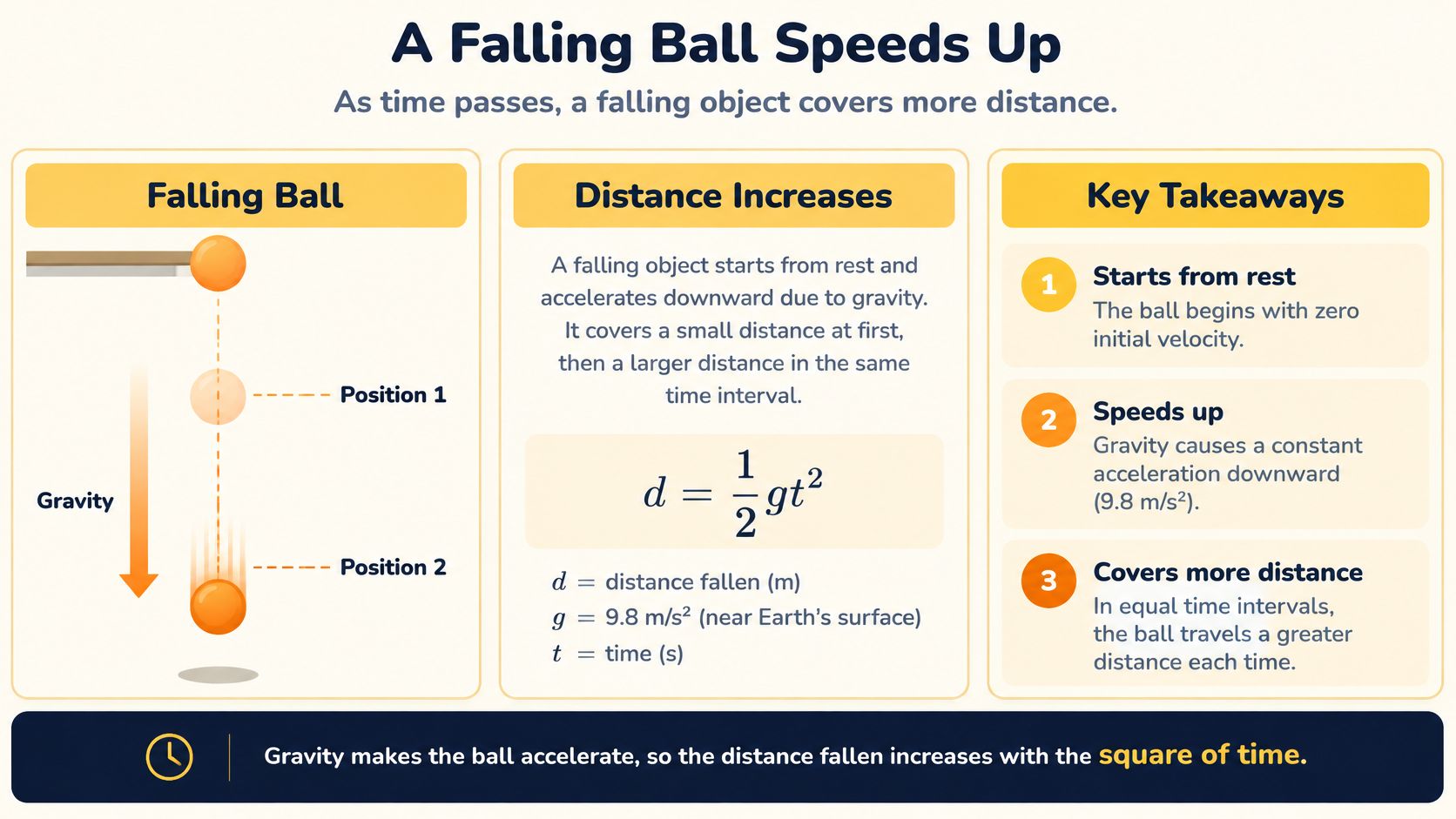
Use (d = \frac{1}{2}gt^2) with (g = 10\ \text{m/s}^2). That gives (d = \frac{1}{2} \times 10 \times 4), so the ball falls 20 m. Drop the ½ and you get 40 m, which is the most common wrong answer on this item.
Here's the trap that makes it tricky. The ball's speed after 2 s is 20 m/s, and the distance is 20 m. Same digits, different units. Students who solve for speed and then grab the number without checking the unit hand in a velocity where a distance was asked for.
Check which value of g your course uses
Many textbooks use (9.8\ \text{m/s}^2), which gives about 19.6 m instead. Read the question stem or your formula sheet before you answer, since a multiple choice item usually expects the value you've been taught.
The belief that heavy objects fall faster than light ones is one of the most stubborn misconceptions in the subject. Research-designed assessments have mapped 22 partly overlapping misconception dimensions in Newtonian mechanics across roughly 34,000 administrations, and this review of physics problem solving and misconceptions lists heavier-falls-faster among the documented common-sense beliefs that survive instruction.
6. Wave speed is frequency times wavelength
Start with a sketch, not a formula. Draw a wave, mark one crest to the next crest, and label that span as the wavelength. Now the question has a picture you can reason from.
The question. A wave has a frequency of 5 Hz and a wavelength of 2 m. What is its speed?
The wave equation is (v = f\lambda). Multiply 5 Hz by 2 m for 10 m/s. The units carry the meaning: a hertz is one cycle per second, so cycles per second times meters per cycle leaves meters per second.
Why dividing gives nonsense
Some students divide 5 by 2 for 2.5 m/s, or 2 by 5 for 0.4 m/s. Both feel orderly and both are wrong, because a frequency tells you how often a cycle repeats and a wavelength tells you how long each cycle is. Speed is what you get when you multiply one by the other, not when you compare them.
Here's the example worth memorizing. Sound travels at roughly 343 m/s in air at room temperature, so a sound wave with a 1 m wavelength has a frequency near 343 Hz. When light passes from air into glass, its wavelength changes but its frequency stays the same, because the source hasn't changed. Speed and wavelength belong to the material; frequency belongs to the source.
7. Density identifies a material, not a size
The question. A block has a mass of 40 g and a volume of 8 cm³. What is its density?
Density is mass divided by volume: (\rho = m/V = 40/8), which is 5 g/cm³. Dividing the other way gives 0.2, a number so small it should feel wrong the moment you write it.
The unit trap that costs more marks than the math
Grams per cubic centimeter and kilograms per cubic meter differ by a factor of 1,000. So 5 g/cm³ equals 5,000 kg/m³, and mixing those two systems is a common way to be right about the physics and wrong about the answer.
For a reasonableness check, compare against water at about 1 g/cm³. A result of 5 g/cm³ means the block is five times denser than water, which fits a heavy mineral and rules out most woods and plastics. Geometry gives you the same confidence: if you doubled the block's size without changing the material, mass and volume would both double and density would stay at 5.
- Ask what density measures: how much mass sits in a given space, not how big the object is.
- Test yourself with one change: if mass doubles and volume stays the same, density doubles.
8. Action and reaction act on different objects
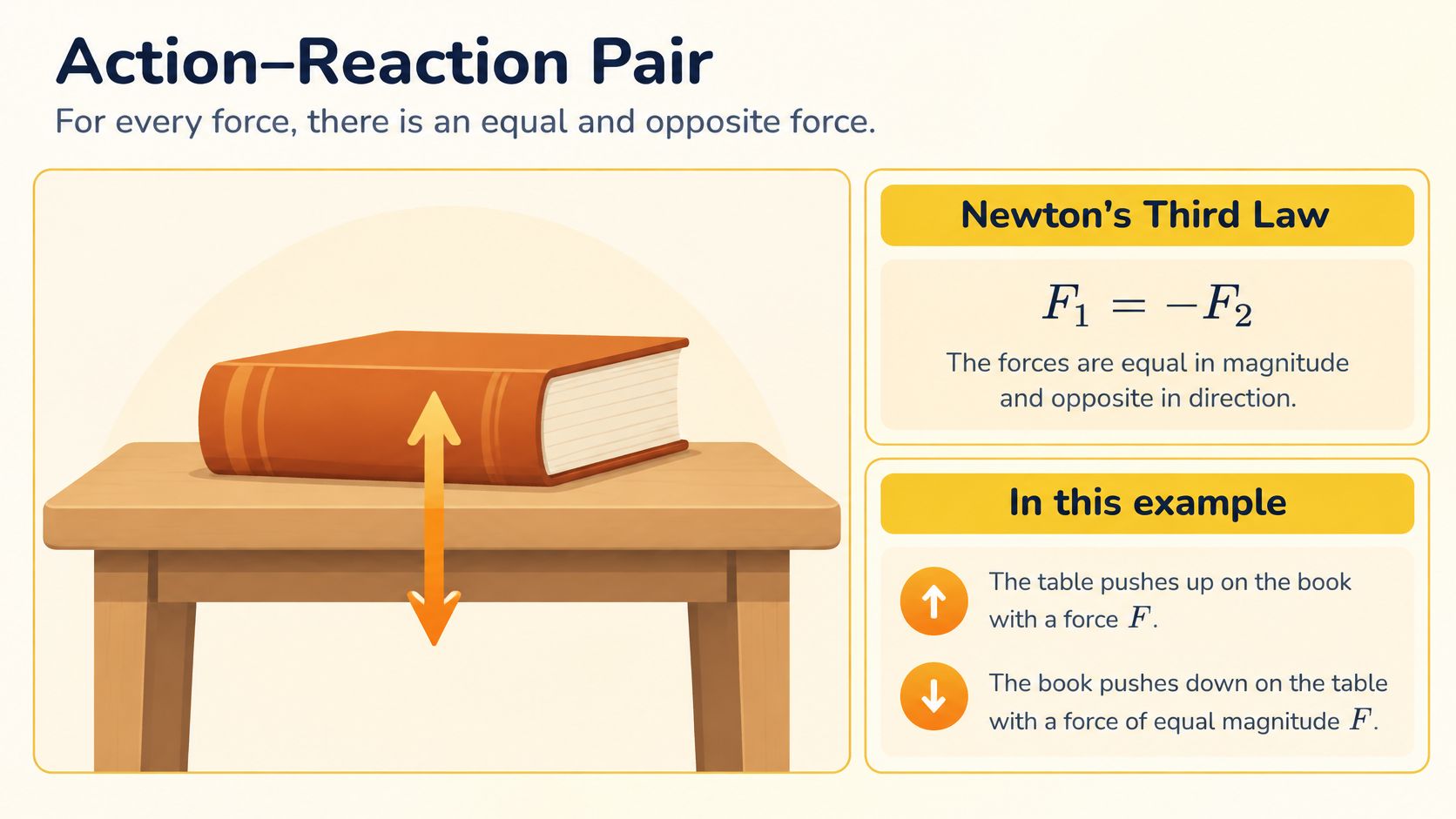
The question. A book rests on a table. The table pushes up on the book with a force equal and opposite to the book's weight. Which law explains why the book pushes down on the table?
The answer is Newton's third law. Forces come in pairs. When object A pushes on object B, B pushes back on A with the same size force in the opposite direction, and that pairing is what the third law describes.
The cancellation confusion
The seductive wrong answer is that the two forces cancel out. They don't, and the reason is worth saying slowly: the book's downward push acts on the table, and the table's upward push acts on the book. A pair of forces can only cancel when both act on the same object.
Draw two diagrams, not one
Sketch the book and the table separately. On the book, you get gravity down and the table's push up. On the table, you get the book's push down and the floor's push up. Once the diagrams are separate, the pairing becomes obvious and the cancellation idea looks like what it is, a mix-up about which object feels which force.
Explaining the pair out loud to someone at home is active recall in its simplest form, and it exposes this exact confusion faster than rereading notes does.
9. Light bends toward the normal when it slows down
A straw in a glass of water looks broken at the surface. The straw hasn't moved. Light from the submerged part changes direction as it leaves the water, and your eye traces that bent path back to a shifted position.
The question. Light travels from air into water at an angle. Which direction does the light bend?
The answer is toward the normal line, the imaginary line perpendicular to the surface. Water has a higher index of refraction than air, so light slows when it enters, and slowing light bends toward the normal. Snell's law states the relationship as (n_1 \sin\theta_1 = n_2 \sin\theta_2).
Measure angles from the normal, always
Protractors tempt you to measure from the surface. Every refraction formula measures from the normal, so a diagram with the normal drawn first prevents the error before it happens. The memory hook is short: slower means toward, faster means away.
Watch out for a second trap that has nothing to do with physics. With only two directions to choose from, a correct answer can come from elimination or a coin flip. That's why paired formats and reason prompts earn their place, since selecting several answers with partial credit can keep an assessment valid while revealing more reasoning than a single answer does, as this review of coupled multiple-response assessment explains.
10. Power is work divided by time, so do it in two steps
This one catches students who know both formulas. Power isn't force divided by time, and it isn't distance divided by time. It's work divided by time, and you have to find the work first.
The question. A 50 N force pushes a cart 4 m in the direction of the force, taking 5 s. What is the power?
- Find the work: (W = Fd = 50 \times 4 = 200\ \text{J}).
- Divide by time: (P = W/t = 200/5).
- State the answer with units: 40 W, and a watt is one joule per second.
The sanity check on direction
Before you multiply force by distance, confirm they point the same way. If the push came in at an angle, only the component along the motion does work, so the honest calculation uses (F\cos\theta). A question that says "in the direction of the force" is telling you the angle is zero and the full force counts.
Wrong answers here are predictable. Dividing 50 by 5 gives 10, which has the right feel and the wrong physics. Dividing 4 by 5 gives 0.8, which is a speed, not a power. Both come from skipping the work step.
How the ten physics questions compare
| Item | Topic | Key Formula | Answer |
|---|---|---|---|
| Q1 | Newton's second law | a = F_net / m | 4 m/s² |
| Q2 | Speed | v = d / t | 15 m/s |
| Q3 | Ohm's law | I = V / R | 3 A |
| Q4 | Kinetic energy | KE = ½mv² | 9 J |
| Q5 | Free fall from rest | d = ½gt² | 20 m using g = 10 m/s² |
| Q6 | Wave speed | v = fλ | 10 m/s |
| Q7 | Density | ρ = m / V | 5 g/cm³ |
| Q8 | Newton's third law | Forces are equal in magnitude and opposite in direction, acting on different objects | Newton's third law |
| Q9 | Refraction | n₁ sin θ₁ = n₂ sin θ₂ | Toward the normal line |
| Q10 | Power | P = W / t; W = Fd | 40 W |
Turn your missed questions into your next practice set
Pick the two questions above that took you longest. Close the page and explain each solution out loud, in your own words, without looking. If you stall, you've found the idea to review, and it's usually a concept rather than an arithmetic slip.
Then run the two checks that catch most errors. First, units: carry them through every step and see whether the final unit matches what the question asked for. Second, size: does the answer fit the situation? A car is not supersonic, a 5 kg box does not accelerate at 100 m/s² from a 20 N push, and light does not speed up when it enters water.
Score spreads show how much distance sits between recognizing a problem type and solving it under time pressure. On the 2025 AP Physics 1 exam, 18% of students earned a 5 and 20% earned a 1, with 25% at a 4, 23% at a 3, and 14% at a 2, according to the score figures Trevor Packer of the AP Program published.
Practice format matters as well. When researchers compared paper and screen versions of the same multiple-response physics items, students picked significantly more answer choices on screen, with differences significant at p<.001 and rank-biserial effect sizes from about -0.08 to -0.26, which is why the study of online delivery of physics assessment items recommends fresh validity checks for unproctored digital practice. If you practice on a phone, watch how you answer, not only what you score.
One more habit is worth building. After each miss, write the wrong idea in a single sentence, such as "I treated the action and reaction forces as acting on the same object." A named error is much easier to catch next time than a vague sense of having rushed.
Knobee's Daily Boost gives you five fresh questions a day in about five minutes, weighted toward the sets where your mastery is lowest, and Kno, the Socratic tutor, asks guiding questions instead of handing over answers. All study materials are AI-generated and may contain errors, so check anything that looks off against your textbook or your teacher.
Physics rewards students who can explain a result, not just select it. Knobee AI turns your notes, textbook pages, or a topic like forces and circuits into study sets with multiple choice quizzes, worked examples, and explanations that name the reasoning error behind each wrong option. When a graded test comes back marked up, the Test Analyzer reads it question by question and builds practice around the mistakes it finds. Visit Knobee AI to build a set for your next unit and answer one question at a time.