10 7th Grade Science Questions: Practice with Answers
Practice 10 7th grade science questions on variables, density, cells, and plate tectonics, with answers, explanations, and study tips for independent review.
Topics: 7th grade science, science practice questions, middle school science, science study guide, NGSS practice
Why do some students get a 7th grade science question right on a worksheet and miss it on the test? You memorized the line on the page, not the reason it was true. Change the numbers, the diagram, or the story, and that memorized line stops helping.
Middle school science asks you to use evidence. The 2024 NAEP science report found that 38% of eighth graders performed below NAEP Basic, while 31% performed at or above NAEP Proficient. Proficient means the knowledge and skills expected for the grade. It is not a national pass rate, and it is not your seventh-grade score. It does show the target: explain a system, and use the idea in a new situation.
These ten 7th grade science questions are skills, not facts to store. Each one names a common mistake, gives you a self-check, and ends with something you can do before you close this page. Life science, physical science, and Earth science all show up. Pick one skill, write your reasoning first, and say it aloud before you look at any answer key.
Table of Contents
- 1. Identify independent, dependent, and controlled variables
- 2. Convert between metric units of length, mass, and volume
- 3. Calculate density using mass and volume
- 4. Distinguish physical changes from chemical changes
- 5. Apply conservation of mass in chemical reactions
- 6. Describe the parts of a cell and their functions
- 7. Explain photosynthesis and cellular respiration
- 8. Analyze food webs and energy flow in ecosystems
- 9. Explain the rock cycle and identify rock types
- 10. Explain plate tectonics and the evidence for moving continents
- How the 10 practice questions compare
- Turn these questions into a daily practice habit
1. Identify independent, dependent, and controlled variables
Say your class compares paper towel brands. Every group uses the same volume of water and the same size sheet. The brand is the independent variable, the factor you change on purpose. Water absorbed is the dependent variable, the result you measure. Water volume and sheet size are controlled variables, the factors you keep the same so the test stays fair.
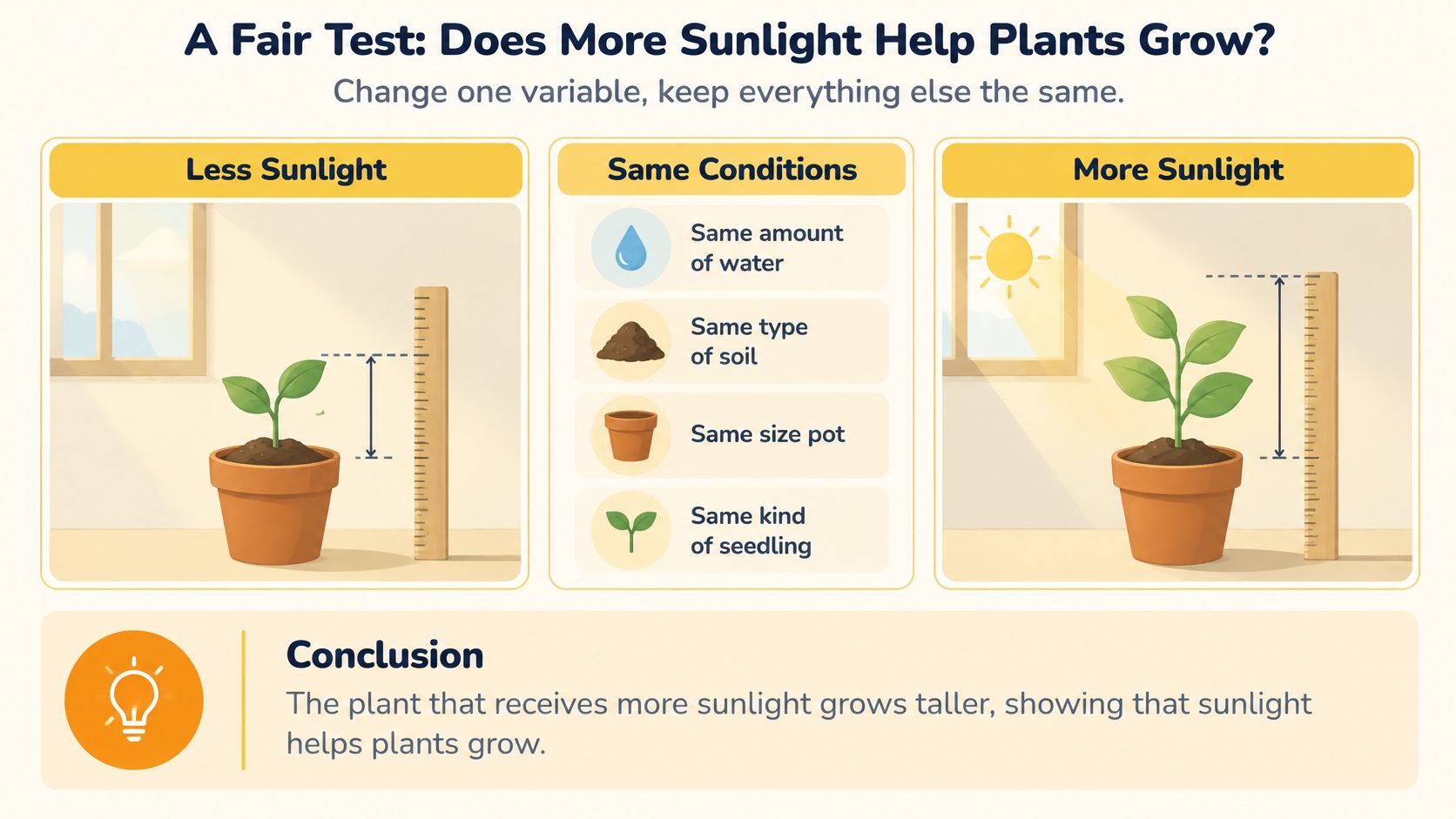
A common mistake is calling every number dependent. If nobody changed the water temperature, temperature is controlled.
Ask what changed on purpose, what was measured, and what stayed the same.
Try a second setup. You warm water and time how fast sugar dissolves. Temperature is independent. Time is dependent. Sugar amount and stirring stay controlled. A full inquiry moves from a question to a plan, evidence, an answer, and a report, as the National Academies describe scientific inquiry. "The towel got heavier" is a description. An explanation names the cause and cites the measurements.
Rewrite one lab in your own words, label the three variable types in the margin, and explain them out loud without the sheet.
2. Convert between metric units of length, mass, and volume
Metric units step by powers of ten. Each step moves the decimal by one place. You need that fluency for density, speed, and almost every lab table.
2.5 kilometers is 2,500 meters, because you move from kilo toward the base unit and the number gets larger. 340 milliliters is 0.34 liters, because a milliliter is a smaller unit, so the number gets smaller when you report liters.
Use the prefix ladder
- Write the ladder: kilo, hecto, deka, base, deci, centi, milli.
- Count the steps: each step left or right is one decimal place.
- Estimate first: a kilogram is much heavier than a gram, so grams converted to kilograms should look smaller.
The usual miss is moving the decimal the right number of places in the wrong direction. If your estimate and your answer disagree, trust the estimate and redo the move.
Physics labs lean on this same decimal habit, which is why a short unit conversion practice set helps before you mix length, mass, and time. Do five conversions from memory tonight, check each one, and explain one aloud, including why the number grew or shrank.
3. Calculate density using mass and volume
Density is mass divided by volume. In symbols, ( d = \frac{m}{V} ). It is a property of the substance, not of how big your sample is. A bigger chunk of the same metal has more mass and more volume, and the ratio stays the same.
A 50 g block with a volume of 10 cm³ has a density of 5 g/cm³. Write the units beside the numbers before you divide. Grams divided by cubic centimeters stay grams per cubic centimeter. If you drop the units, you cannot tell whether the answer is even possible.
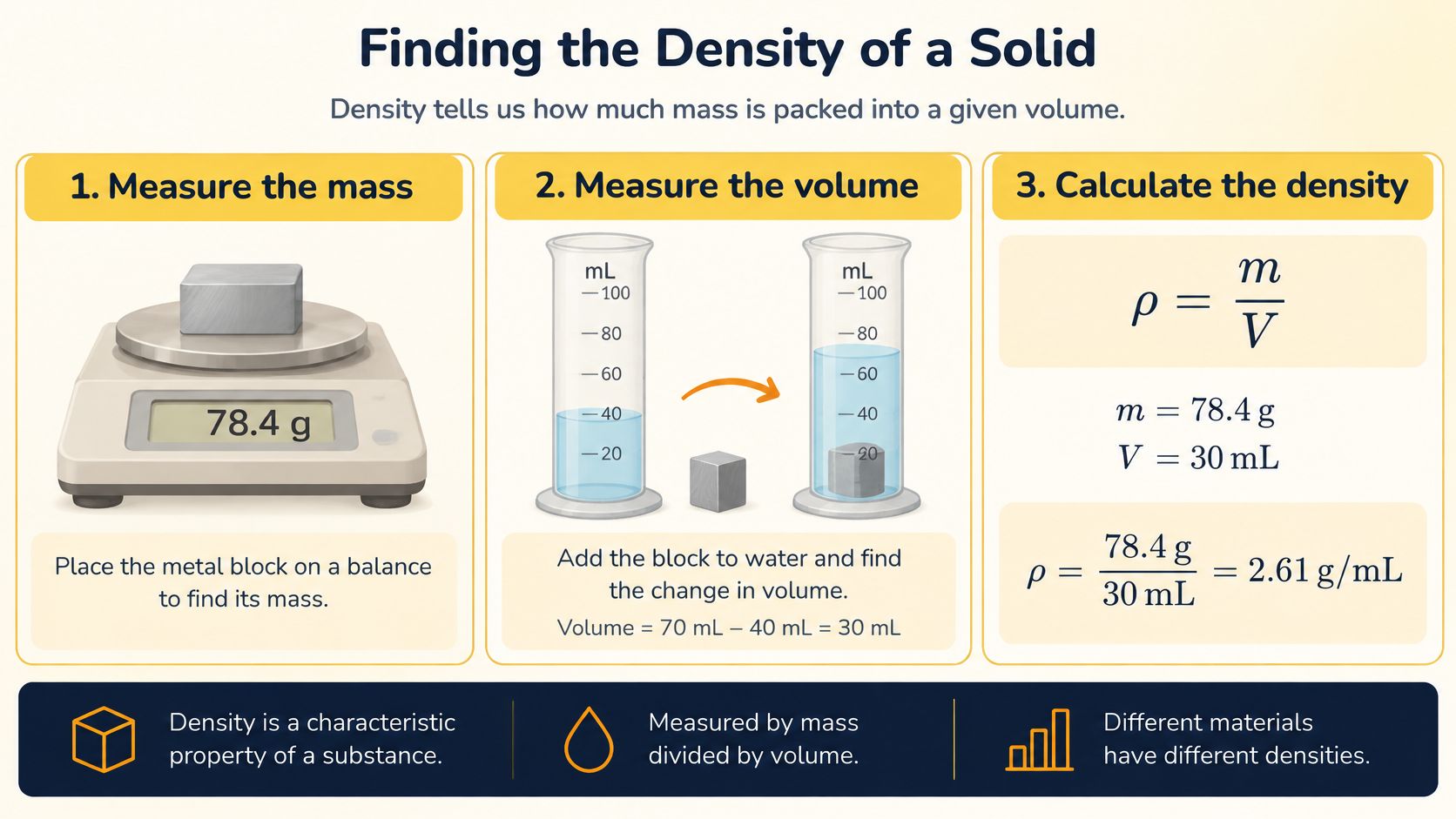
Students often multiply mass by volume, or they treat a larger object as automatically denser. Compare your result with water, about 1 g/cm³. Ice floats on liquid water because ice is less dense, not because it is colder. If your metal answer is far below water, recheck the division.
Say the sentence out loud: "Density stays the same for the same substance because mass and volume change together." Then solve one new pair of numbers without looking back.
4. Distinguish physical changes from chemical changes
A physical change alters form, size, or state, and the substance is still the same kind of matter. A chemical change makes a new substance. Melting wax is physical, because the wax can harden again as wax. Rusting iron is chemical, because a new substance forms and you cannot pick the rust off and get the original iron back by a simple physical step.
List the evidence before you name the change.
Useful evidence includes a new color that stays, a gas that was not there, a temperature change you did not add with a burner, or a solid that appears from two liquids. Dissolving salt in water is usually physical, because you can evaporate the water and recover the salt. Burning wood is chemical, because ash, smoke, and new gases are not wood.
Guessing from the drama of the event is the common miss. Boiling looks violent and is still physical. A quiet color change can be chemical. In one seventh-grade acid-base study, 67.49% of students held misconceptions, while 18.68% showed good understanding, according to the ERIC report on seventh-grade misconceptions. Chemistry items punish a lucky label.
Sort four examples from class into pairs, write the evidence under each, and justify every label out loud. A chemistry unit walkthrough is a useful place to grab extra pairs if your notes are thin.
5. Apply conservation of mass in chemical reactions
In a closed system, nothing enters or leaves. The total mass of the reactants equals the total mass of the products. Atoms are rearranged. They are not created, and they are not destroyed.
Picture baking soda and vinegar in a sealed bag. The bag inflates, and the total mass on the balance stays the same. The gas is still inside. Open the bag, and the mass reading drops because gas leaves. That missing mass did not vanish. It went into the air. A log burning in an enclosed space works the same way. Smoke and other gases carry mass.
Count atoms, then check the container
- Draw reactants and products as simple particles, and count each type before and after.
- Ask where mass could hide if the scale reading falls. Usually it is a gas.
- Say the claim in one sentence to a family member, with the sealed bag as your example.
The common mistake is trusting the open-beaker reading and concluding that mass disappeared. Self-check by asking whether the container was closed. Explain one reaction from class out loud, including where every product goes.
6. Describe the parts of a cell and their functions
Name the job, not just the shape. The nucleus holds the instructions. Mitochondria release energy from food, which is why people call them the powerhouse of the cell. The cell membrane controls what enters and leaves. Chloroplasts are in plant cells, and they capture light for photosynthesis. Animal cells do not have chloroplasts, and they do not have a cell wall.
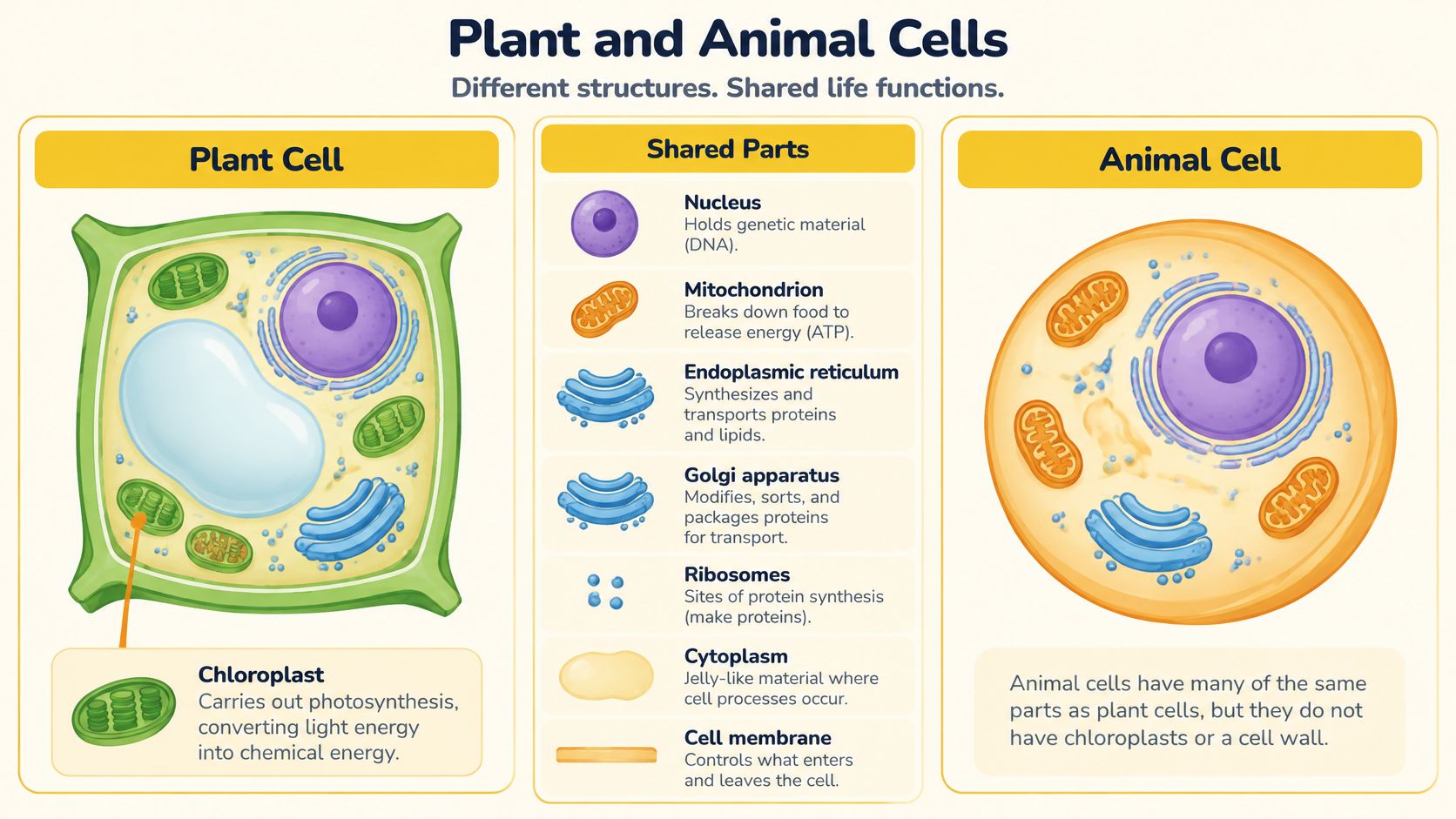
Middle school life science expects models and evidence, not a word list. NASA's learning-standards overview of the NGSS treats grades 6–8 as one band, so a seventh-grade item may ask you to interpret a cell model or support a claim. Matching a name to a cartoon without the job is the usual miss.
Sketch a plant cell and an animal cell from memory. Label only the parts you can also define. Then ask, "What fails if this part is missing?" If you want more cell items in the same style, use a biology study page built around function, not labels alone. Explain one organelle aloud as if a younger student asked why it exists.
7. Explain photosynthesis and cellular respiration
Photosynthesis stores light energy in glucose. A plant uses carbon dioxide and water, and it releases oxygen. Cellular respiration runs the other direction for energy the cell can use. Cells use glucose and oxygen, and they release carbon dioxide and water.
A plant on a windowsill is doing the first process in the light. Your muscles do the second while you run. The carbon does not disappear between them. You can trace one carbon atom from carbon dioxide into sugar, then back out as carbon dioxide when the sugar is used.
The NSTA middle school life science topics include matter and energy in organisms and ecosystems, so this pair is not two separate vocabulary cards. Students often swap the gases, or they treat respiration as "breathing" only. Breathing moves gases. Respiration is the chemical release of energy inside cells.
Make two columns, inputs and outputs, and cover them. Explain both processes to a friend with the book shut. If you stall on a gas, uncover one word only, then finish the sentence yourself.
8. Analyze food webs and energy flow in ecosystems
Start with the Sun. Producers, such as grass, capture light and build food. A rabbit is a consumer. A fox that eats the rabbit is another consumer. Decomposers break down dead leaves and return nutrients to the soil. Arrows show energy moving toward the eater.
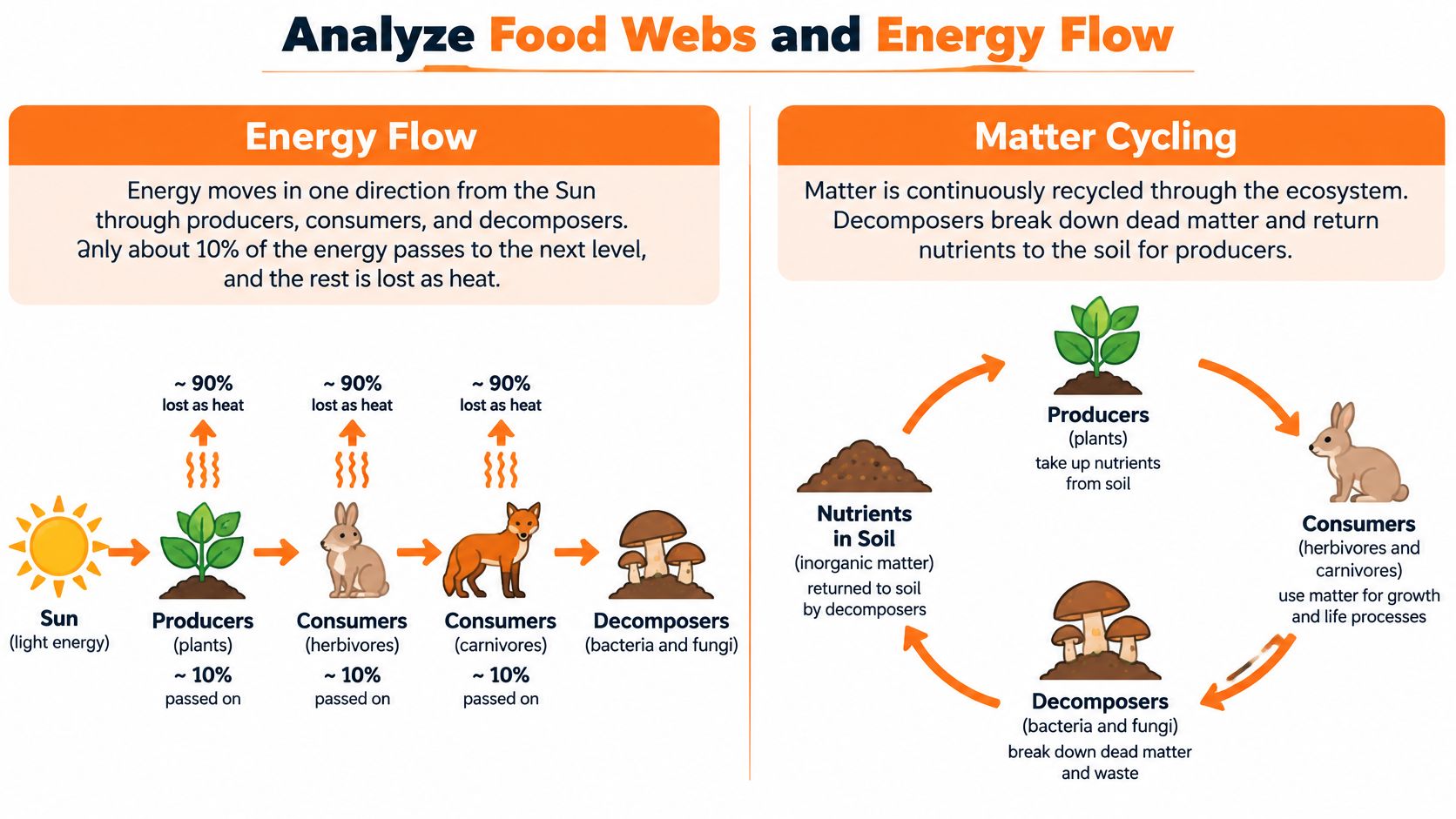
Energy moves one way and leaves the chain as heat at each step, so you rarely see as many top predators as prey. Matter cycles. The same atoms can return through decomposers. Mixing those two paths is the common mistake. Another miss is drawing the arrow from the fox to the rabbit, which reverses who gets the energy.
A 2024 review of 104 framework-aligned middle school tasks found that most tasks included a phenomenon, but many were not tied to students' lives. Use a local web if you can, such as a park, a farm, or a tide pool, with the same roles.
Label every organism as producer, consumer, or decomposer before you talk. Then explain aloud why the top of the web has fewer animals, without reading your notes.
9. Explain the rock cycle and identify rock types
Rocks change. They do not sit in one category forever. Igneous rock forms when melted rock cools. Sedimentary rock forms when bits settle, get compacted, and stick together. Sandstone from sand grains is the clear example. Metamorphic rock forms when heat and pressure change a rock without fully melting it. Marble from heated, squeezed limestone is the matching example.
Weathering and erosion break rock and move the pieces. Melting returns material to magma. Compaction and cementation build sedimentary layers. You should be able to walk one rock both directions around that loop.
Crystal size, layers, and signs of intense heat are clues, not decorations.
Students memorize three names and then freeze when the prompt describes a process instead of a rock. Read the clue first. Layers and cemented grains point to sedimentary. Interlocking crystals from a melt point to igneous. A parent rock changed by heat and pressure points to metamorphic.
Trace sandstone all the way to magma and back in a spoken story. Then flip a flashcard that shows only the process, and name an example before you turn it over.
10. Explain plate tectonics and the evidence for moving continents
Earth's lithosphere is broken into plates that move. That motion helps explain earthquakes, volcanoes, and many mountain ranges. At a divergent boundary, plates pull apart. The Mid-Atlantic Ridge is a place where new seafloor forms. At a convergent boundary, plates collide. The Himalayas rose where continental plates pushed together. At a transform boundary, plates slide past each other.
Separate evidence from the conclusion. Matching fossils and matching coastlines are evidence. "The continents moved" is the conclusion you argue from that evidence. Strong answers do not blend those two sentences into one guess.
A common mistake is saying plates float like boats with no mechanism, or citing a volcano as proof without saying which boundary produced it. Sketch each boundary with arrows. Under the sketch, write one feature it builds, such as a ridge, a trench, or a mountain range.
This short clip shows the motion, so watch once, then look away and retell it.
Write one evidence sentence and one conclusion sentence for a boundary in your notes. Say both aloud. If you cannot, the idea is not secure yet.
How the 10 practice questions compare
| Item | Typical Format | Common Mistake |
|---|---|---|
| Identify independent, dependent, and controlled variables | Short experiment scenario asking what changes, what is measured, and what stays the same | Mixing up the independent and dependent variables |
| Convert between metric units of length, mass, and volume | Convert measurements using metric prefixes and powers of ten | Moving the decimal in the wrong direction |
| Calculate density using mass and volume | Use density = mass ÷ volume, sometimes with water displacement | Dividing in the wrong order or mixing up units |
| Distinguish physical changes from chemical changes | Classify everyday events and support the choice with evidence | Guessing without checking whether a new substance formed |
| Apply conservation of mass in chemical reactions | Explain why reactants and products have equal total mass in a closed system | Thinking mass disappears when gas is produced |
| Describe the parts of a cell and their functions | Label cell diagrams, match organelles to functions, or compare plant and animal cells | Memorizing organelle names without knowing their functions |
| Explain photosynthesis and cellular respiration | Compare the inputs and outputs of both processes and trace matter or energy | Mixing up the inputs and outputs |
| Analyze food webs and energy flow in ecosystems | Trace energy through producers, consumers, and decomposers in a diagram | Thinking energy cycles like matter |
| Explain the rock cycle and identify rock types | Use a cycle diagram or descriptions to identify rock types and formation processes | Assuming rocks follow one fixed path through the cycle |
| Explain plate tectonics and the evidence for moving continents | Describe plate movement, boundary types, resulting features, and supporting evidence | Confusing boundary types or mixing evidence with the explanation |
Turn these questions into a daily practice habit
Pick two or three of these question types for this week. Use short sessions instead of one long cram. Answer from memory, check the explanation, fix the error, and come back a few days later. A retrieval practice guide recommends recalling often and spacing that recall, including days or weeks after the lesson, because the harder recall can strengthen later memory.
Foundations come first. In the 2015 TIMSS grade 8 science results, an average of 84% of students across participating countries reached at least the Low benchmark, which stands for a basic level of science achievement, as reported in the TIMSS 2015 international science report. That figure is not a seventh-grade pass rate, and country results differ. It still supports a simple order. Secure the basic idea, then practice applying it to new data.
A short session you can repeat
- Attempt before you peek: write the variable, the unit, the organelle job, or the boundary type from memory.
- Name the miss: decide whether you lacked a word, mixed up a concept, or could not transfer the idea.
- Speak the correction: one clean explanation, with an example, beats rereading the paragraph.
You can paste class notes into Knobee and make a Study Set of flashcards and short quizzes on just these skills. Daily Boost gives five fresh questions in about five minutes, weighted toward what you have not secured. AI-generated content can contain errors, so cross-check important facts with your teacher or textbook. Say each answer aloud until you can teach it without the card in front of you.
Knobee AI builds flashcards, quizzes, and short daily review from your own science notes, so you practice variables, density, cells, and ecosystems at your grade level before the answer is shown. Use it to turn this week's labs into questions you have to explain, not just recognize. Visit Knobee AI and start a set from one chapter you are studying now.