Flashcards for Biology: 10 Sets and Tools Worth Trying
A curated guide to flashcards for biology: 10 tools and ready-made sets for grades 7–12, plus tips for turning notes into cards that stick.
Topics: flashcards for biology, biology study tools, biology flashcards, study apps for students, spaced repetition
Your biology test covers cells, genetics, and ecology. You recognize the words in your notes, but when you close the book, explaining how a membrane works or why a trait appears in offspring feels harder. Flashcards for biology work best when you answer from memory, check your explanation, and revisit the material over time.
That first step is called active recall. Instead of reading “mitochondrion” and nodding, you explain its role before revealing the answer. A review of effective learning techniques rates practice testing as a high-utility approach and emphasizes checking answers after attempting recall.
- Choose ready-made decks when you need a quick start with vocabulary such as organelle, allele, or population.
- Build from class materials when your teacher emphasizes particular diagrams, lab observations, or explanations.
- Mix recall with reasoning so you can explain a process, not just recognize its name.
Spaced review means returning to cards across separate study sessions rather than repeating everything in one sitting. Neither method makes a questionable deck accurate, though. Your textbook, teacher's explanations, and corrected work should remain your reference points.
The tools below suit different study habits, from browsing shared decks to turning your own notes into questions. Choose something you'll use, then check that its cards match what you're learning.
Table of Contents
- 1. Knobee AI
- 2. Quizlet
- 3. Knowt
- 4. Anki
- 5. Brainscape
- 6. StudyStack
- 7. Gizmo
- 8. Cram
- 9. Blitz
- 10. Biomania
- Comparing biology flashcard tools at a glance
- Turning your own biology notes into cards that stick
1. Knobee AI
You have cell-transport slides, handwritten notes, and a corrected worksheet. Knobee AI can turn pasted notes, uploaded documents, or a topic description into a biology study set with flashcards and multiple-choice quizzes. Explore the biology study tool to see how it works.
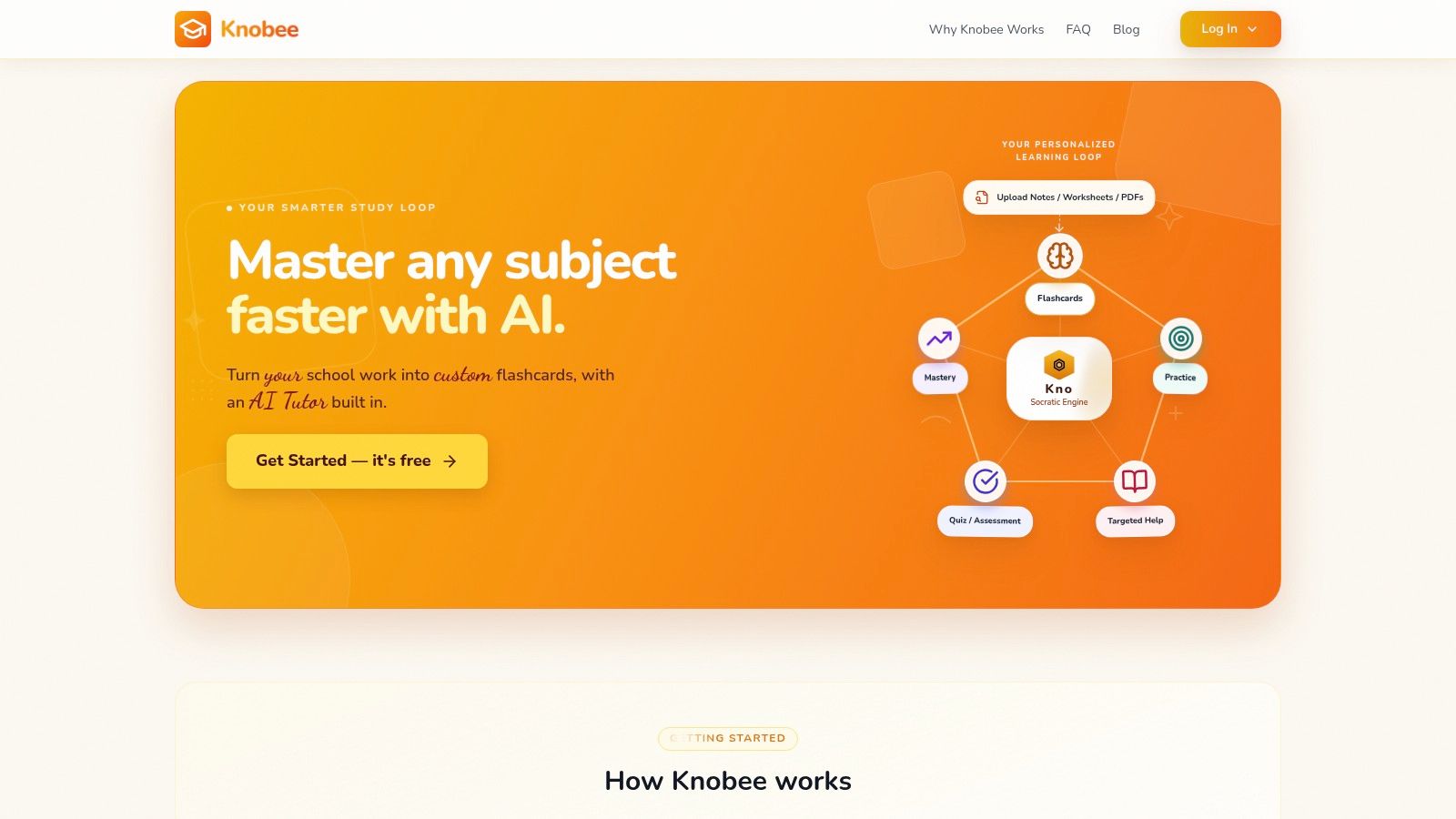
You can upload PDFs, PowerPoint files, or Word documents, then select a grade and subject. Biology prompts use NGSS-aligned content when you choose a grade level. Alignment can help connect practice to your course, but you should still check generated cards against your class materials.
From class materials to guided practice
Every flashcard session asks you to attempt an answer before revealing it. You can flip a card, type your answer, or use voice. Kno guides you through a set card by card with questions, hints, and explanations.
- Daily review: Daily Boost draws questions from your study sets and gives more attention to material that needs review.
- Targeted corrections: Upload a graded test or worksheet to identify mistakes and generate focused practice. Check the AI's interpretation against your teacher's corrections.
- Understanding support: Worked examples, intuition tips, and biology diagrams can help you reason through a process, not just memorize a definition.
- Progress signals: Seeing an answer alone does not establish mastery. A card is marked Mastered after you answer its quiz question correctly or score at least 80% in a Mastery Check.
For example, after missing an osmosis question, practice explaining how water moves across a membrane rather than memorizing the term alone. You can also share study sets with classmates.
Knobee is designed for students in grades 7–12 and is intended for ages 13 and older. Generated materials can contain errors, so compare them with your textbook, class notes, and corrected work. Check current pricing and any paid features before subscribing.
2. Quizlet
Quizlet suits the student who wants a ready-made starting point. Search for the topic you're studying, such as cell structures, genetics, or ecology, then compare the results with your class notes before committing to a set.
Quizlet offers student- and teacher-created sets, custom card creation, sharing, and study modes beyond basic flipping. Web and mobile access make it practical to revisit a deck wherever you normally study.
Check the deck before learning it
A deck titled “cell biology” might include material your class hasn't covered or leave out your teacher's preferred diagrams. Check the definitions, scope, and examples rather than assuming a familiar title means a good match.
- Useful for: Starting vocabulary practice quickly and sharing course-specific sets with classmates.
- Main limitation: User-created cards can contain mistakes, unclear wording, or answers that are too brief.
- Paid-feature caution: Some learning and test features require a paid plan. Check access before planning your routine around them.
Say you find a card that defines diffusion as movement from high to low concentration. Keep that basic prompt, but add a question asking why particles spread out without the cell supplying energy.
The practical advice in how to memorize something fast can help you turn a quick review into an answer-first routine. Don't spend the whole session searching for a perfect deck when a checked, edited set will do.
3. Knowt
If your notes already explain photosynthesis clearly, retyping every sentence into cards can feel like extra homework. Knowt combines public study sets with manual and AI-assisted card creation, so you can start from existing materials and edit the result.
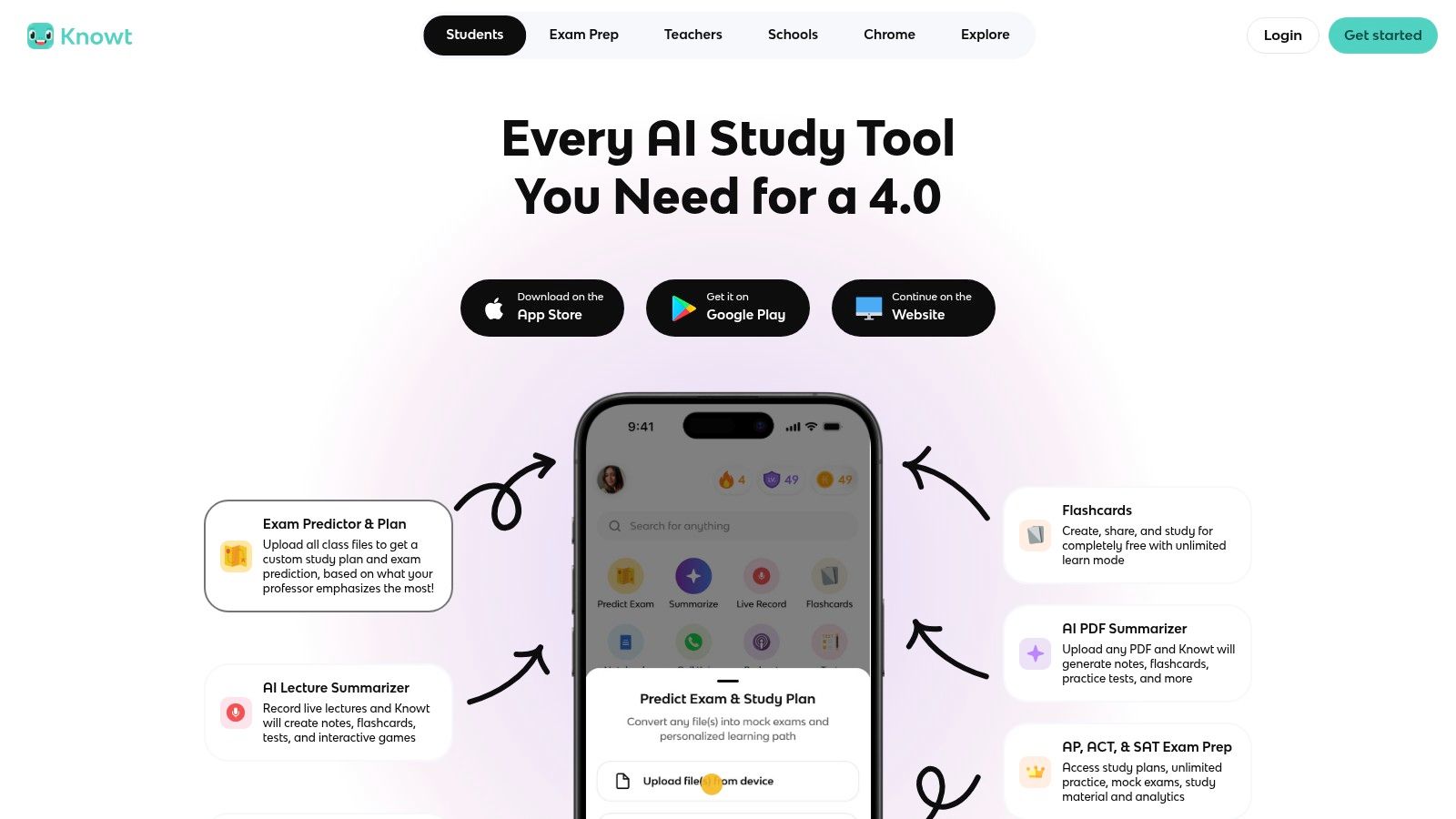
Its tools can turn notes and supported files into draft study materials. Quizzes and games offer additional practice formats, while public sets provide another starting point when your own notes are incomplete.
Editing rule: Treat generated cards as a draft to check, not a finished answer key.
For a genetics unit, inspect whether the cards distinguish gene, allele, and chromosome. If the answers blur those terms together, rewrite them using your textbook and the examples your teacher used.
Keep your own thinking in the process
- Strong fit: Students who want both ready-made cards and a way to build from their own course materials.
- Useful control: Generated cards can be edited, allowing you to shorten answers and correct misleading questions.
- Trade-off: AI output needs fact-checking, and free and paid feature availability may differ.
Don't accept a long paragraph because it sounds scientific. Split a broad question about photosynthesis into focused prompts about inputs, outputs, and the role of light, then add an explanation question connecting them.
4. Anki
For material you need to remember beyond the next test, Anki offers customizable cards and scheduled reviews. It's a strong option if you're willing to spend time organizing a deck and learning the review controls.
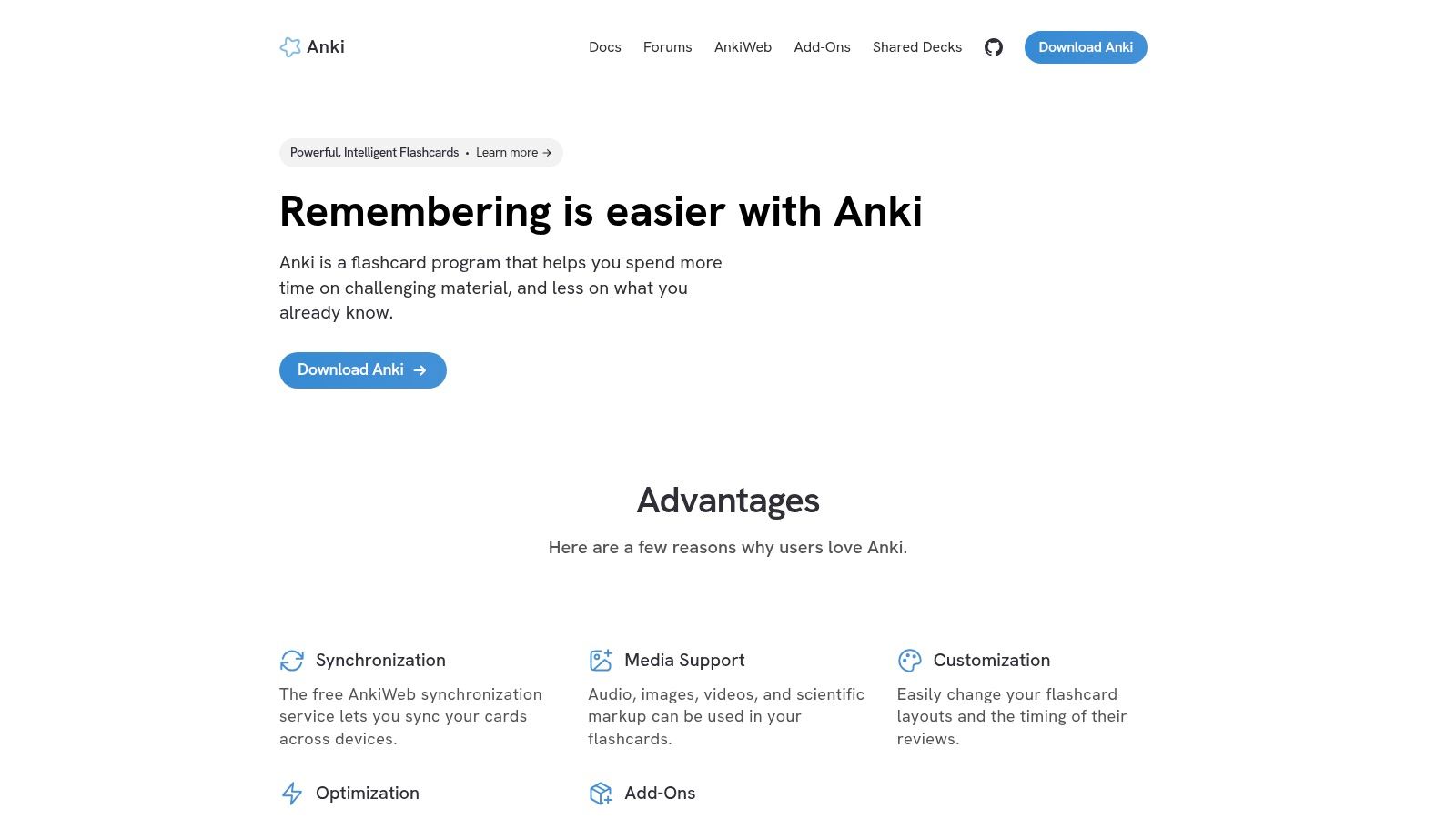
Anki brings cards back over time and supports multimedia and community-shared decks. The core desktop software is free, but downloading, editing, and syncing shared material can involve more setup than a simpler flashcard website.
Best when you'll maintain the deck
A study of senior-level microbiology courses found that spacing and self-testing were positively related to learning. That university finding supports the study approach, not a claim that Anki itself causes higher school grades.
- Strength: You can adapt cards, images, and organization closely to your course.
- Challenge: Shared decks vary in accuracy, coverage, and how clearly their questions are written.
- Good habit: Remove irrelevant cards instead of trying to complete an oversized college-level deck.
For a mitosis card, describe what happens to chromosomes before checking the answer. If you only recognize the stage name, you haven't yet tested the explanation.
This guide to active recall learning explains the answer-first habit behind that approach. Anki's scheduling is useful only if you judge your answers accurately.
5. Brainscape
How sure are you that you can explain natural selection without looking? Brainscape's biology collections pair flashcards with confidence-based review, making that judgment part of the study process.
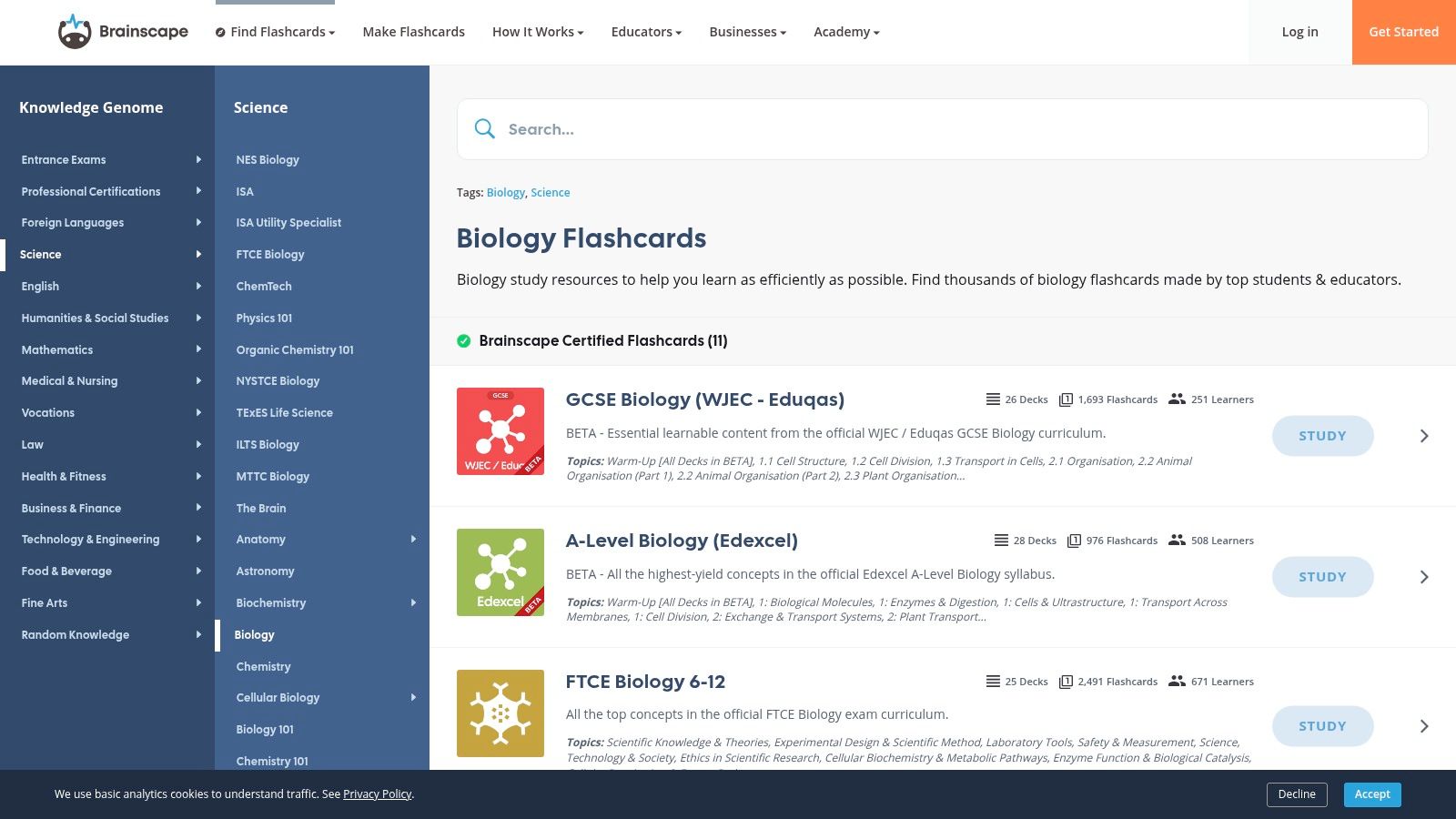
The catalog includes user-created and certified collections across areas such as genetics, ecology, cell biology, and human biology. You can also create and share your own cards when a catalog deck doesn't fit your class.
Rate the explanation you actually gave
Confidence ratings are most useful when you answer fully before rating yourself. Seeing an answer and thinking “I knew that” isn't the same as producing it from memory.
- Useful distinction: Certified collections are separated from user-created material, giving you another signal when browsing.
- Course-fit limit: A structured collection can still use different terminology or cover different material from your teacher.
- Access limit: Some content and study features may require a subscription.
For example, don't give yourself a strong rating for naming natural selection if the question asks how a population changes across generations. Explain the role of inherited variation and differences in reproductive success.
Brainscape suits students who like organized collections and are comfortable evaluating their own responses. If you tend to mark everything as familiar, ask a parent or study partner to listen occasionally and compare your explanation with the card.
6. StudyStack
Sometimes you want a straightforward question-and-answer set, a printable version, and a change of activity. StudyStack offers community-created stacks, custom cards, games, and printing options without requiring you to build a complicated study system.
It's a practical option for terms such as producer, consumer, decomposer, and habitat. Free search and flashcard use are available, although some features require an account.
A matching game can help you check vocabulary. Follow it by explaining a food web without the answer choices.
The traditional interface may appeal to families who want simple practice rather than AI-generated materials. Its limitation is familiar: community-created sets need checking, and a vocabulary activity won't automatically prepare you to explain ecological relationships.
Use printouts for explanation practice
- Try this: Print a checked stack and have someone read the questions aloud while you answer without seeing the backs.
- Add connections: After defining decomposer, explain what decomposers contribute to an ecosystem.
- Check coverage: Compare the stack with your study guide so less obvious topics aren't missed.
StudyStack is less suitable if your main need is importing a slide deck and automatically generating questions. It works better when you already know which terms and short explanations deserve practice and want several ways to rehearse them.
7. Gizmo
Your biology materials might include slides, a PDF handout, and a recording of a lesson. Gizmo offers several import routes, including notes, PDFs, slides, recordings, and web links, to create flashcards and quizzes.
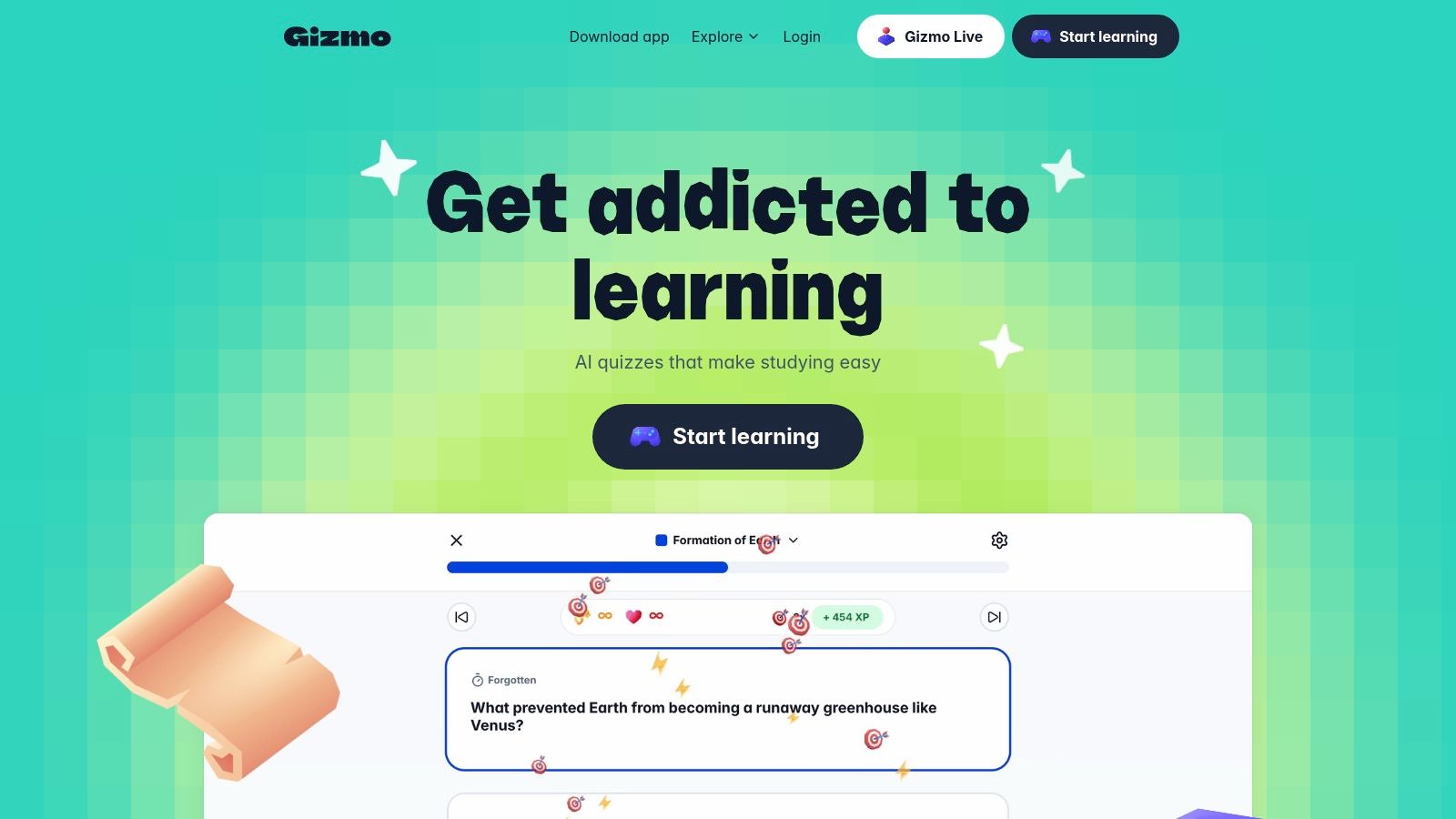
Public decks provide extra material, while spaced repetition, active recall, an AI tutor, and gamified features support ongoing practice. That combination suits students whose class resources arrive in different formats.
Check the science after importing
A generated question can sound clear while leaving out an important condition. For membrane transport, check whether the card distinguishes movement down a concentration gradient from transport that requires energy.
- Main advantage: Flexible imports reduce the need to manually rebuild scattered course materials.
- Learning option: Cards and quizzes let you vary how you practice the same topic.
- Main caution: Generated content needs verification, and free-plan limits or paid terms should be checked.
A systematic review in the Journal of Medical Internet Research found better post-intervention knowledge with spaced online instruction than massed instruction among health professionals. That supports spacing as a learning principle, not a claim that Gizmo has been shown to improve secondary-school biology grades.
Use the app's reminders as prompts to study, not as evidence that you understand. After answering a card about enzymes, try explaining how changing temperature could affect enzyme activity.
8. Cram
If you want a personal deck built around an upcoming test, Cram's biology app focuses on generating question-and-answer cards from your materials. Inputs include notes, PDFs, textbook sections, web links, and topic prompts.
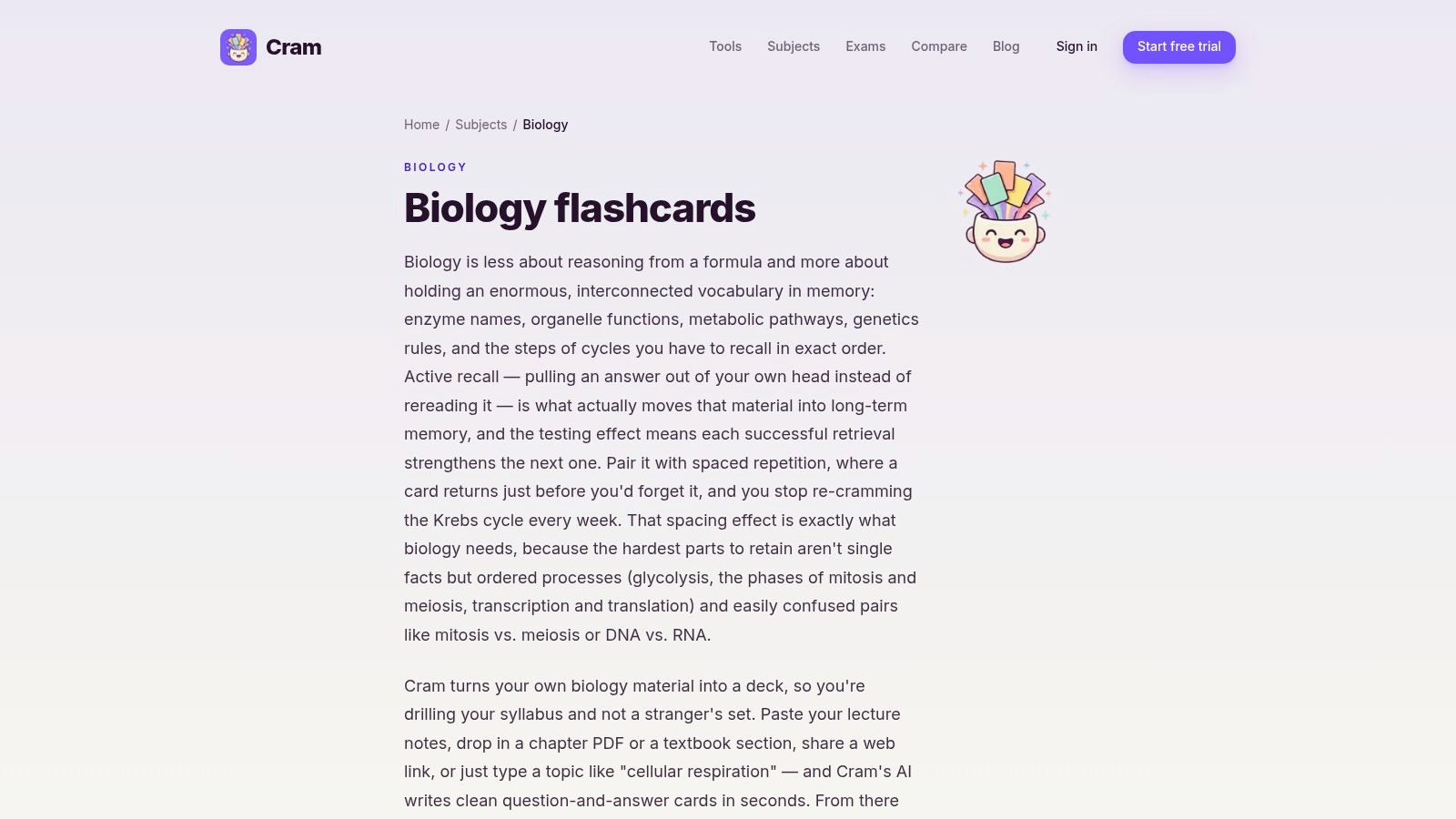
Spaced review, an exam countdown, and offline deck access are advertised features. The emphasis is on creating a deck rather than searching a broad shared library, so it's worth distinguishing this app by its website when searching.
Give it a focused source
A chapter section on cellular respiration is a clearer starting point than a broad prompt such as “everything about cells.” Check that generated cards reflect your class's expected depth rather than adding unfamiliar details.
- Good fit: Students who want course-specific cards and a visible exam-date planning aid.
- Practical benefit: Advertised offline access may help when your internet connection is unreliable.
- Before subscribing: Review trial terms, subscription conditions, and how offline access works on your device.
For a respiration deck, separate location questions from explanation questions. Naming the mitochondrion and explaining how cells transfer energy into usable forms are different tasks.
The countdown should help you spread out practice, not encourage you to postpone studying until the deadline feels close. If a card keeps going wrong, revisit the class explanation before repeating it again.
9. Blitz
Blitz is the more focused choice for AP Biology students, rather than someone taking a general life-science class. Blitz organizes AP Biology cards by units and offers swipeable cards with spaced review.
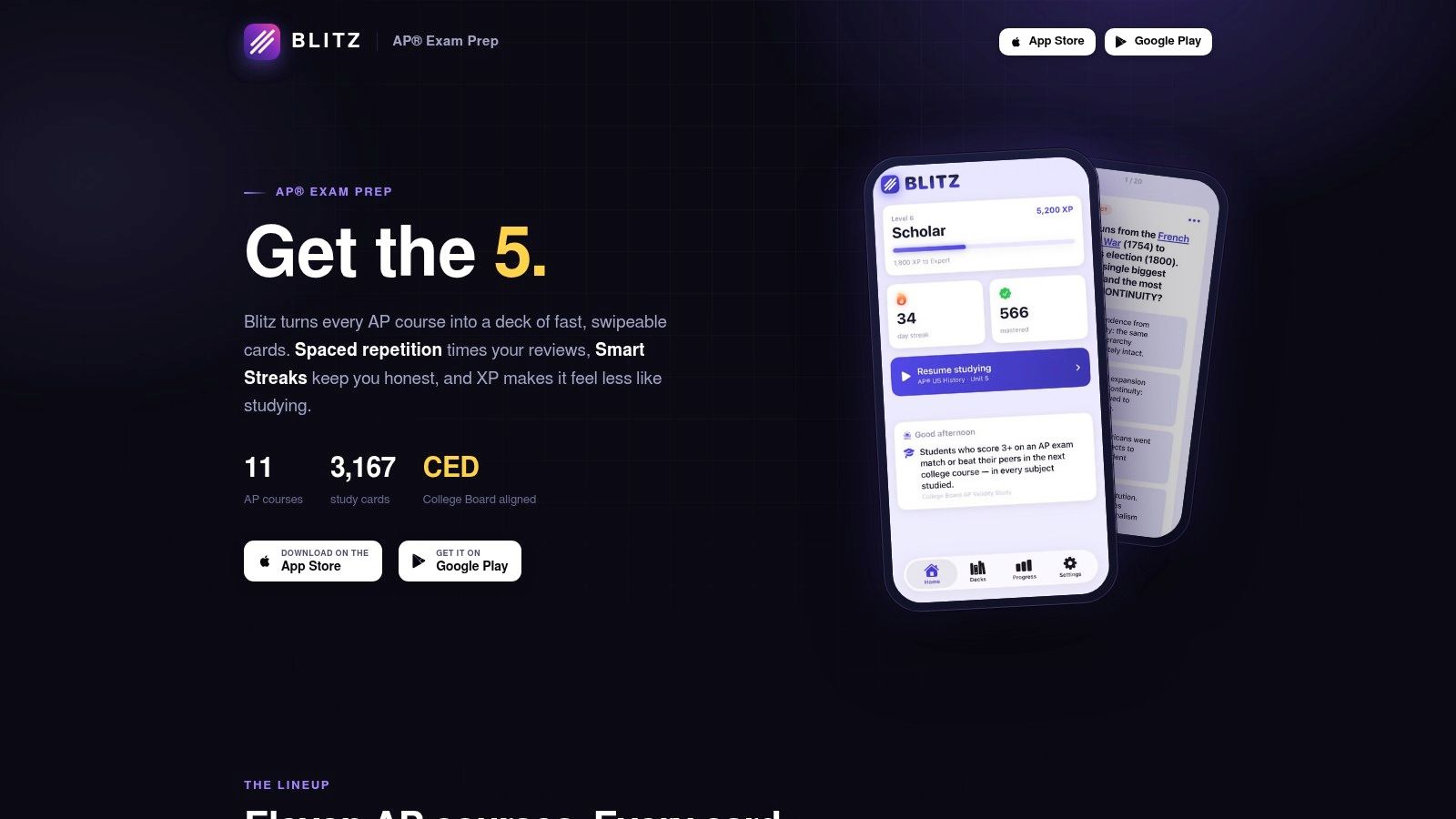
Its website and apps also cover other AP courses. Study streaks and XP may suit students who enjoy short, repeatable review sessions, although those rewards shouldn't determine what you study.
Match unit organization to your class
Your teacher may teach related concepts in a different order or emphasize particular lab investigations. Compare the deck's coverage with the current course framework and your teacher's plan before relying on it.
- Useful structure: AP-specific organization can make relevant material easier to locate than in a general biology library.
- Audience limit: Middle-school students and non-AP biology students may find the content unnecessarily advanced.
- Purchase check: Verify current app availability, pricing, and access before choosing it.
Flashcards still need to support explanation and evidence. The Next Generation Science Standards life-science expectations include constructing explanations connecting DNA structure, protein structure, and specialized cell function.
For a gene-expression card, go beyond defining transcription. Explain how a change in DNA could affect a protein and why that might matter to a cell, while recognizing that not every change has the same outcome.
10. Biomania
Flashcards may be only part of what you need for AP Biology preparation. Biomania bundles them with interactive multiple-choice practice, videos, games, and listed AI-supported free-response coaching.
Its app description presents material across the AP Biology units and identifies the creator as an AP Biology teacher and exam reader. That background is relevant, but it doesn't guarantee that every explanation will match your teacher's approach or your particular needs.
Reality check: If you can define a term but can't use it to explain an unfamiliar example, add application practice rather than more definition cards.
Use the different formats deliberately
Start with a flashcard to retrieve a concept, then try a question that requires you to use it. For example, recall what limits population growth before interpreting a graph showing a population leveling off.
- Strong fit: AP Biology students seeking a bundled study resource rather than a general-purpose card maker.
- Useful variety: Videos can provide another explanation, while questions let you check what you can apply afterward.
- Device caution: The cited app listing is for Apple devices. Check other-device availability and current paid features.
The broader caution about recall is supported by a Hamilton College account of introductory biology assessment research, which describes weaknesses on cognitively complex questions despite passing performance overall. Knowing enough facts to pass some questions isn't the same as being able to reason through all of them.
Comparing biology flashcard tools at a glance
A biology student might use one tool to find a starter deck, another to turn class notes into cards, and a third to practise for an exam. This table compares those options by their biology coverage and how they support ready-made or custom cards.
| Tool | Best for | Biology coverage | Ready-made decks | Custom cards from notes |
|---|---|---|---|---|
| Knobee AI | Turning course materials into guided study practice | Middle and high school biology, with science study sets using NGSS-aligned prompts when a grade level is selected | Built from your own materials; study sets can be shared with classmates | Yes, from notes, uploaded documents, or a topic description |
| Quizlet | Finding and sharing biology flashcards | Broad topic coverage, including cells, genetics, and ecology | Yes, searchable student- and teacher-created sets | Yes, create custom sets |
| Knowt | Combining public sets with AI-assisted card creation | Biology sets and personal course materials | Yes, public study sets | Yes, from notes and supported files |
| Anki | Customizable long-term review | School and college biology topics | Yes, community-shared decks | Yes, create and edit cards |
| Brainscape | Browsing structured biology collections | Cell biology, genetics, ecology, and human biology | Yes, certified and user-created collections | Yes, create custom cards |
| StudyStack | Practicing biology terms with cards and games | School-level biology resources | Yes, community-created sets | Yes, build question-and-answer stacks |
| Gizmo | Creating study practice from varied materials | Biology class content and public decks | Yes, public decks | Yes, from notes, PDFs, slides, recordings, and links |
| Cram | Building a personal biology deck | Examples include cell structures, genetics, and cellular processes | Limited focus on shared decks | Yes, from notes, PDFs, links, or prompts |
| Blitz | AP Biology exam preparation | AP Biology, organized by units | Yes, AP Biology course deck | Not described in this comparison |
| Biomania | AP Biology exam practice | All eight AP Biology units | Yes, AP Biology flashcards | Not described in this comparison |
Turning your own biology notes into cards that stick
Start with a ready-made deck if you need quick vocabulary practice, but don't let someone else's card collection define your whole course. Your teacher's notes, assigned diagrams, lab questions, and corrected tests tell you which explanations deserve attention.
For most students, the useful combination is a checked starter deck plus cards built from class materials. You don't need to move everything into an app. Choose content that you need to recall, explain, compare, or apply.
Turn notes into answerable questions
- Choose one idea per card. Split a page about cells into focused prompts about structures, functions, and relationships.
- Write a question on the front. Ask what the cell membrane does rather than placing “cell membrane” above a copied paragraph.
- Use your own words on the back. Keep the answer accurate and complete enough to check, without reproducing the whole textbook.
- Add a reasoning prompt. After defining osmosis, predict what could happen to a cell placed in a different surrounding solution.
- Include useful visuals. Cover a diagram's labels, then identify the structure and explain its role. For a process, reconstruct the sequence and explain what changes.
- Check against class materials. Correct vague answers and remove anything outside your course's scope.
Return to the cards across separate days, giving difficult questions more attention and leaving longer gaps for answers you can explain confidently. A review of distributed practice found that spacing generally supports learning better than massed study, while noting that suitable intervals depend on the task and how long learning must last.
Keep sessions short enough that you'll return willingly. When you miss a question, check the answer, explain what you misunderstood, and try again later rather than immediately repeating the wording until it feels familiar.
Your next study session
- Pick a current topic: Use the unit you're learning now, not an enormous general biology collection.
- Check the cards: Compare their answers with your textbook, notes, and teacher's corrections.
- Answer before revealing: Speak, type, or write your response without peeking.
- Test understanding: Finish with a diagram, lab explanation, or unfamiliar application question.
- Plan your return: Decide when you'll revisit the material before closing the session.
You're aiming for a deck that helps you explain biology independently. A smaller collection of accurate, purposeful questions is more useful than a large collection you only recognize.
Knobee AI turns pasted notes, uploaded slides and documents, topic descriptions, and graded-test mistakes into curriculum-aligned biology Study Sets, with Daily Boost review built in. For students in grades 7–12 who meet the minimum age requirement, every flashcard session requires an answer attempt before the answer appears. Visit Knobee AI to build a set from your current biology unit, then check it against your class materials before studying.