How to Study for a Quiz the Night Before: 5 Steps
Learn how to study for a quiz the night before with a prioritized plan built on active recall, error fixes, short rounds and protected sleep.
Topics: night before quiz, quiz study plan, active recall, last-minute studying, exam prep tips
It's the night before a quiz, your notes are open, and you're not sure where to start. That feeling is normal, and one evening can still help if you use it well. The plan below shows how to study for a quiz the night before in short, timed rounds. You'll test yourself first, fix what you miss, and stop at a set time. It won't replace weeks of learning, and it can't promise a grade. It can show you what you know tonight.
Table of Contents
- Build a Timed Plan for Tonight
- Start With Recall, Not Rereading
- Match Your Practice to the Quiz Format
- Fix Mistakes With a Short Correction Loop
- Decide Whether Sleep Beats One More Round
- Check Your Plan and Walk In Ready
Build a Timed Plan for Tonight
One night gives you hours, not weeks. So don't spend it in one long cram block where you read the same page until it looks familiar. Work in short rounds instead, and return to the same ideas more than once.
First, count your real time. Write down when the quiz is, when you can start, and when you must stop. Set your bedtime before you begin, and treat it as the one limit that doesn't move. If you have about two and a half hours, use the timeline below as your default.
Your night-before timeline
| Time from start | Focus | What to do | Output |
|---|---|---|---|
| 0:00-0:10 | Scope the quiz | List every topic on the quiz and write 10-15 questions per topic in the format the quiz uses | Question list |
| 0:10-0:40 | Closed-book round | Answer each question from memory before checking notes, then mark each answer correct, partial or incorrect | Error list |
| 0:40-1:10 | Break, then correct misses | Take a 5-minute break, then write one sentence that fills each gap and answer one parallel question for each error | Corrected notes |
| 1:10-1:40 | Mixed retest | Shuffle the missed items with new questions and answer them closed-book | Hit rate by topic |
| 1:40-2:10 | Reteach weak spots | Study only topics missed twice, using your corrected explanations | Two-line summary per topic |
| 2:10-2:25 | Final mixed quiz | Closed-book, 10-15 questions across all topics with no notes | Go or stop decision |
The revisits are the point. You meet the material near the start, again about an hour in, and again near the end. Separated practice holds up better than one uninterrupted block, because each return asks you to pull the answer back instead of just seeing it again. Shuffling the order also stops you from remembering answers only because they followed a certain question.
If time is short: shrink every block in proportion. Don't cut the closed-book round, because it tells you what to fix.
If you have more time, add a third round at about three hours rather than making one block longer. Keep breaks short and screen-free if you can, get water, and stand up. You're aiming for alert rounds, not a marathon.
Check two signs as you go. Your hit rate, the share you answer correctly, should rise between rounds. You should also know your stop time before you start, not decide it when you're already tired. If the hit rate isn't rising on a topic, that's useful information. It means that topic needs the correction work, not more rereading.
Start With Recall, Not Rereading
The core move is simple. Answer before you look. This is called retrieval practice, which means trying to recall an answer from memory instead of only reading it again. Rereading feels productive because the words look familiar fast. Familiar isn't the same as being able to produce an answer on a blank quiz page.
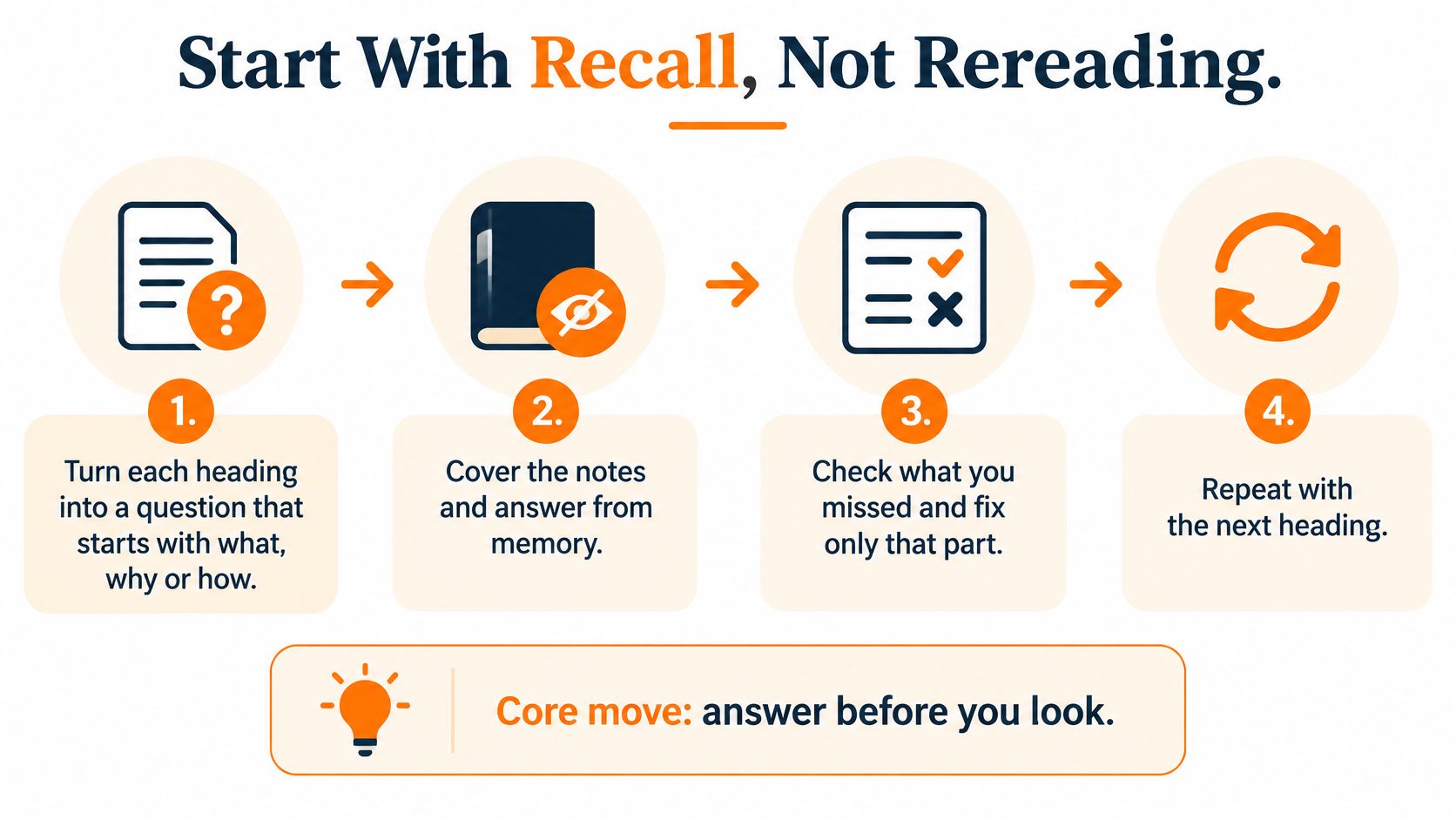
Use this five-step loop with your notes closed beside you.
- Turn each heading into a question. Start it with what, why, or how. A heading like "Causes of the Civil War" becomes "Why did tensions over slavery grow in the 1850s?" A specific question gives you something real to answer.
- Write your answer on paper before opening the notes. Writing stops you from saying "yeah, I knew that" when you only recognize it. If you're stuck, write what you do know and leave a gap. A partial answer still counts as information.
- Mark it correct, partial, or incorrect. Be honest here. Partial means part of the idea is there but a key piece is missing. That mark decides what comes back in the next round.
- Check the source and write one sentence that fills the gap. Don't copy a paragraph. Write the missing piece in your own words, like "Osmosis moves water, not the dissolved particles." One clear sentence is easier to recall tomorrow.
- Put every miss back into the next round. Correct answers can rest. Misses and partials return, shuffled with new questions, so you practice pulling them back when they're not fresh.
The visual below shows the same loop in four steps, so you can keep it in view while you work.
Why this works better than rereading
In the 2008 experiment described by the American Psychological Association summary of Karpicke and Roediger's testing research, students learned 40 Swahili-English word pairs. One week later, groups that repeatedly practiced retrieving the full set recalled approximately 80% of the pairs. Groups that repeatedly studied but didn't continue practicing retrieval recalled only about 35%. That's a roughly 45-percentage-point advantage for repeated testing in that experiment.
Read that result carefully. The task was vocabulary pairs, not every school subject, and it doesn't promise a specific score for you. It does show why practice that matches the quiz, producing an answer, beats extra exposure that only builds familiarity. If you want the deeper method behind this habit, read about practicing active recall step by step.
Tools can support the habit if they make you attempt first. In Knobee's Study Sets, every study session requires the student to attempt an answer before the answer is revealed on flashcards. Paper works the same way if you keep the answer covered.
A good round ends with a short error list, not a perfect score. You should have a few misses you can now explain in your own words. If everything felt easy, your questions were probably too easy. Add why and how questions, and go again.
Match Your Practice to the Quiz Format
The same drill doesn't fit every quiz. A vocabulary quiz asks you to produce a definition. A math quiz asks you to generate steps. An essay quiz asks you to build a short argument. Practice the move the quiz will require.
The chart below is a quick lookup you can scan before you write your questions.
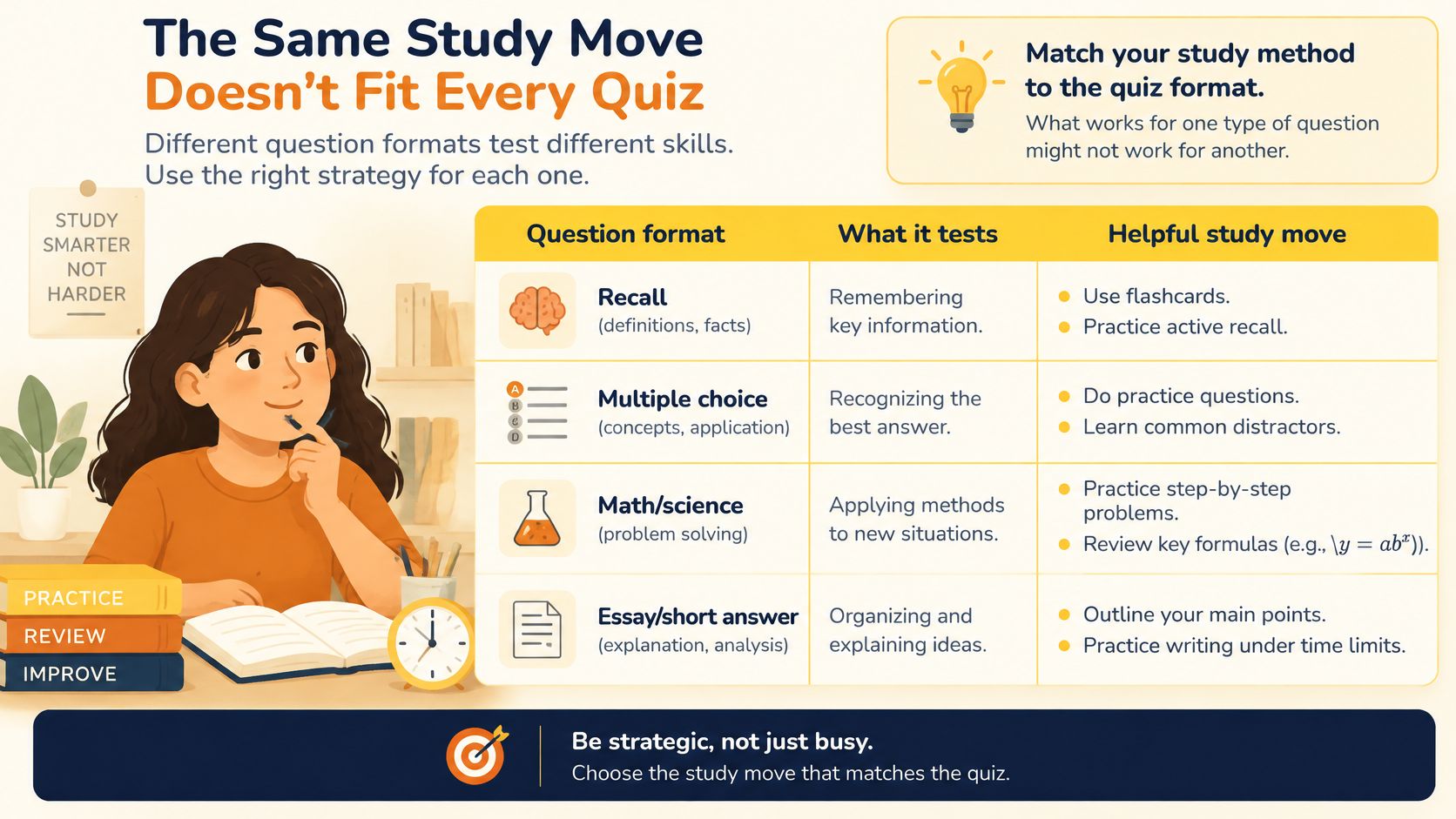
| Quiz format | Best practice tonight | Example prompt |
|---|---|---|
| Vocabulary or facts | Define each term from memory before checking the glossary | Define osmosis without looking |
| Multiple choice | Explain why each wrong option is wrong, not only why the right one is right | Why is option B wrong even though it sounds familiar? |
| Math or science problems | Solve a new problem with different numbers, then diagnose any error step by step | Solve a similar equation with new coefficients |
| Essay or short answer | Say the main claim and two pieces of evidence aloud in under a minute | Explain the theme of the chapter in three sentences |
| Dates and sequences | Write the timeline from memory, then check the order against notes | Order five events from the unit |
| Labeled diagrams | Draw the diagram blank and label each part from memory | Draw a cell and label six structures |
Multiple choice needs extra care because the answer is sitting in front of you. It can feel easy to recognize, then hard to choose between two familiar options. Explaining why each wrong option is wrong forces you to know the detail that separates them. For a history quiz, that might mean explaining why a date belongs to a different event, much like the timeline work in a unit review for a history test.
For math and science, don't reread a worked example and nod along. Change the numbers and solve it yourself, because the steps must come from you. If you get stuck, look at only the next step, cover it again, and continue.
The short video below walks through matching your practice to the question type, so watch it if you're unsure which row fits your quiz.
For a mixed quiz, spend the most time on the format your teacher uses most. Check past tests, the study guide, or class practice for that pattern. If most points come from short answers, most of tonight should be short answers.
Fix Mistakes With a Short Correction Loop
A missed question isn't just a wrong answer. It's a clue about what kind of fix you need. Most misses tonight will fall into one of four types, and each type has a different repair.
| Error type | What it looks like | Fix before the next round |
|---|---|---|
| Missing knowledge | You cannot produce the idea at all | Reread only that source section, then answer the question again from memory |
| Confusing similar ideas | You mix up two terms, causes or events | Write a short side-by-side contrast of the two ideas |
| Process or calculation error | You know the idea but the steps go wrong | Solve a parallel problem, first with steps visible, then without them |
| Misreading | You answered a different question than the one asked | Underline the command word and the scope, then retry the question |
Use the same order every time. Name the error type first, apply its fix, then answer one parallel question. A parallel question tests the same idea with different wording or numbers. It checks whether the fix worked, instead of letting you repeat a sentence you just read.
Say you mix up mitosis and meiosis. That's confusing similar ideas, so don't restart the whole chapter. Write two columns, one for each process, and note the purpose and the number of cells made. Then answer a new question that asks which process fits a fresh example.
Why checking and correcting matters
Skipping the check is a common trap. In the review summarized by the Sage research article on retrieval practice and feedback, a review of 435 studies found a medium positive effect of corrective feedback on learning, (d = 0.48). The same source reports that repeated testing produced 21% greater delayed recall than repeated studying after a week. In plain terms, answering, checking, and fixing beats answering alone, especially when your first answers are often wrong.
Don't drop a missed item after one fix. Revisit every miss twice before you let it go.
That rule fits the timeline you already set. The correction window comes right after the closed-book round, while the errors are clear. If an item is still missed after two rounds, mark it for your final review and for the morning. For extra ways to make a corrected idea stick under time pressure, see these fast memorization techniques that still use recall.
Decide Whether Sleep Beats One More Round
Late in the evening, you'll face a real question. Should you do one more round, or go to sleep? The honest answer depends on what you already know, not on a blanket rule.
The comparison below lays out the two cases, so you can place yourself before you decide.
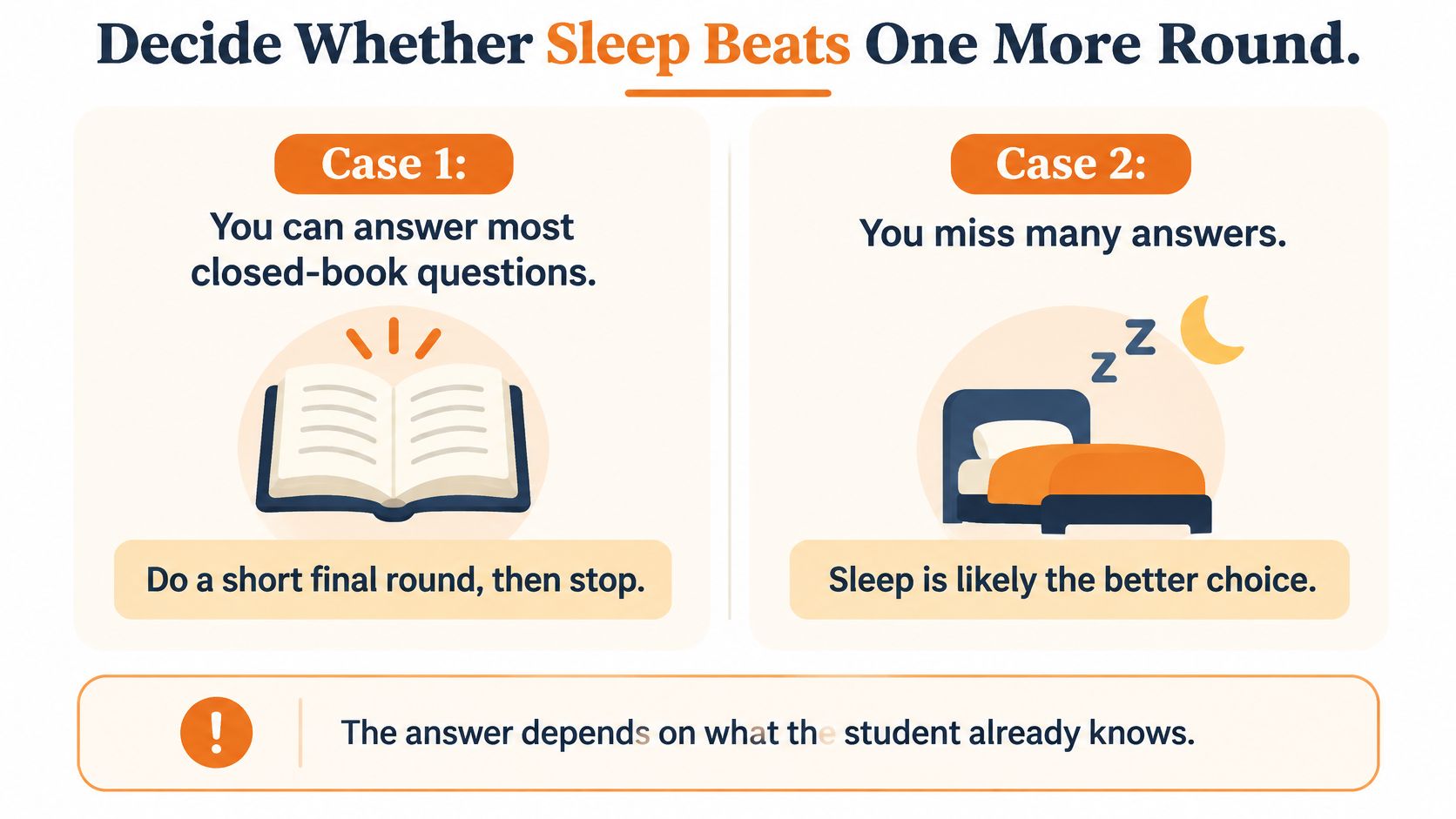
- Case 1, you can answer most closed-book questions: Do a short final round on the remaining misses, then stop and sleep. Extra rereading adds little when you can already produce the answers.
- Case 2, you miss many answers: Don't try to cover everything. Pick the smallest set of high-value concepts most likely to appear, fix those errors, and stop at your set time. Sacrificing the whole night is still a poor plan.
Use this short protocol when you're unsure.
- Check recall: Take a quick closed-book quiz across the main topics.
- Pick the high-value set: Choose concepts from the study guide, past quizzes, and topics your teacher repeated in class.
- Review the errors: Fix those misses with one sentence each, then retest them once.
- Set a stop time: Write it down and keep it, even if a low-value topic stays unfinished.
Read the sleep evidence with care. In the study of 88 introductory chemistry students described by McGill's Office for Science and Society article on cramming and sleep, sleep quality, duration, and consistency across the preceding month predicted grades, while sleep obtained only on the night before an exam did not correlate with next-day performance. Longer-term sleep habits could explain nearly 25% of variation in academic performance in that analysis. That's a correlation over weeks. It isn't proof that one night of sleep, or one lost night, decides tomorrow's quiz.
The same source notes that students who slept between vocabulary-learning sessions showed better later mastery than students who studied for the same total time without a sleep interval. So a short review, then sleep, then a brief morning retest is a real option. An all-nighter is a poor default because tired students monitor their errors less well. If you're rereading the same line three times, you've reached your limit.
Check Your Plan and Walk In Ready
Finish the night with small, practical steps. They cost little time and remove morning stress that can crowd out what you studied.
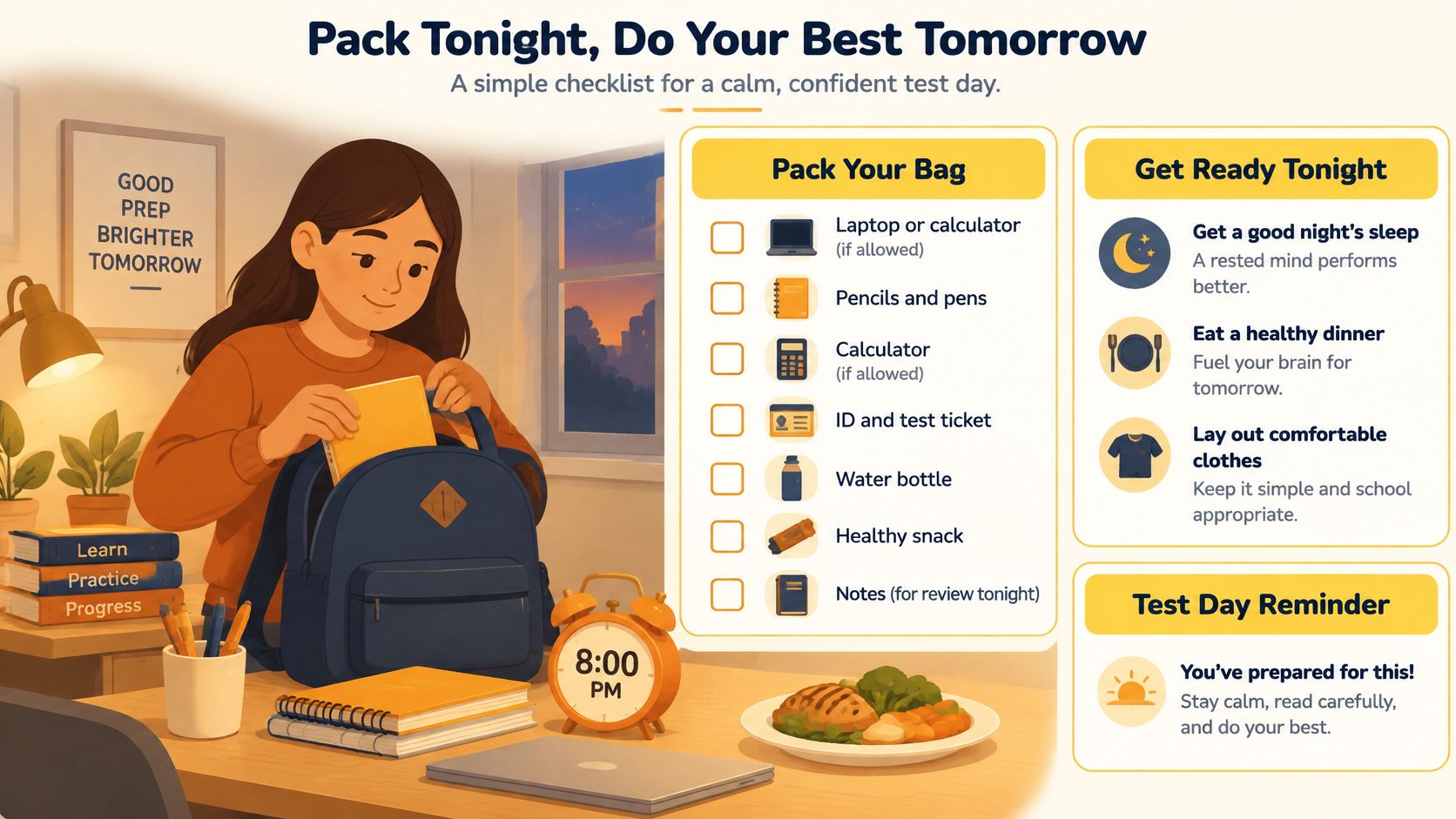
Tonight before bed
- Confirm the basics: Check the quiz time and room, and set an alarm with a small buffer.
- Pack your bag: Put in pencils, a calculator if it's allowed, and anything else you'll need.
- Eat a normal dinner: Don't experiment with a huge or skipped meal tonight.
- Leave new topics alone: A brand new topic at the last minute usually displaces review of ideas you almost know.
On quiz morning
Read every instruction first, including how long answers should be. Answer the questions you know, flag the hard ones, and return to them with the time that's left. Before you hand in the paper, check any answer you changed and make sure you didn't skip a question by accident.
Keep your expectations honest. The systematic review indexed by the ERIC record for the classroom retrieval practice review included 50 experiments with 5,374 participants. In 57% of the experiments, retrieval practice produced medium or large learning benefits, across different ages, subjects, and test formats. That doesn't mean every student improves by the same amount. Retrieval works best when you check feedback and correct mistakes, rather than repeating a wrong answer.
Confidence should come from evidence you created tonight, the questions you answered closed-book, not from how familiar the page looks.
Before bed, take one 10-question closed-book quiz on tonight's topics. Write down what you missed on a small card or note. In the morning, start there, answer those items once from memory, and then put the notes away. You've done the work one night can do.
Turn tonight's notes into a Study Set you can quiz yourself on, with flashcards that make you answer before you peek and short checks that show what's Mastered and what still needs work. Visit Knobee AI to paste your notes or describe your topic and build your first set before your next quiz.