Active Recall Learning: A Guide to Testing Yourself
Master active recall learning to improve memory and retention. Discover how self-testing boosts study results and helps you learn faster.
Topics: active recall learning, active recall study, spaced repetition, study techniques, retrieval practice
Table of Contents
You've probably had this happen. You reread your notes, highlight the important lines, and feel pretty good about them that night. Then a week later, the same topic shows up on a quiz, and your brain goes blank.
That gap is the problem active recall learning is meant to fix. It isn't just a study trick for memorizing facts. Done well, it turns studying into a real learning event, where trying to remember, checking what you missed, and coming back later all work together.
Introduction What Active Recall Learning Changes About Studying
A lot of students study in a way that feels safe. They read, reread, and recognize the material, which can create a false sense of control. The page looks familiar, so it feels learned, but familiarity isn't the same as being able to produce the answer on your own.
That's why active recall changes the job of studying. Instead of asking, “Have I seen this before?”, it asks, “Can I bring this back from memory right now?” That small shift matters because memory gets stronger when you try to retrieve it, not just when you look at it again.
For middle and high school students, the challenge usually isn't knowing that flashcards or self-quizzing exist. It's sticking with them when they feel slower than rereading. The harder part is often the planning, the time, and the mental effort.
This guide keeps the process concrete. You'll see what active recall learning is, how it works, what the research really shows, when to use it alone, and when to pair it with other strategies like worked examples or concept maps. You'll also get a simple system you can try this week without overcomplicating your routine.
How Active Recall Learning Works in Your Memory
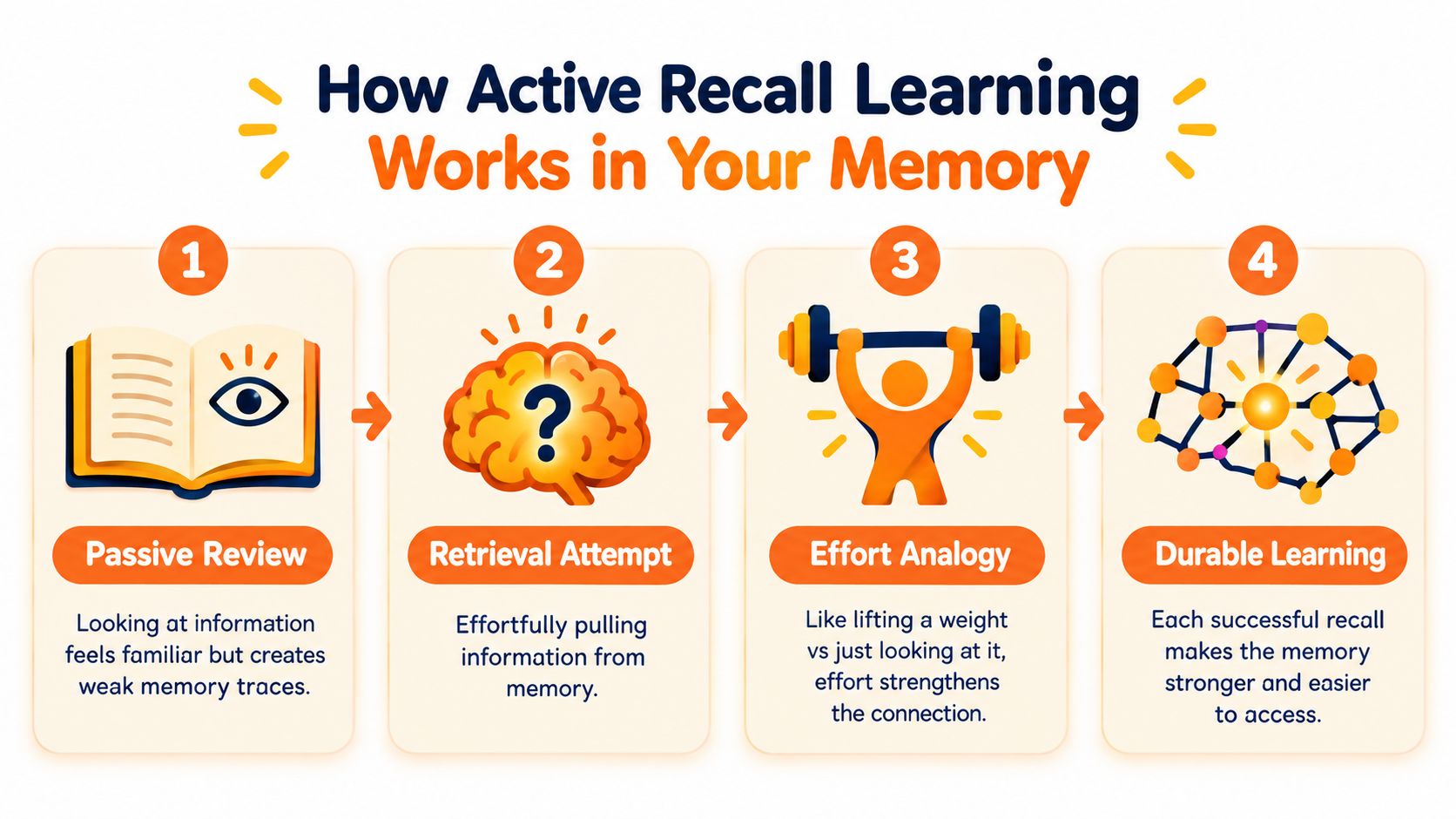
The easiest way to understand active recall is to compare it with passive review. When you reread a chapter, the information feels familiar because your eyes are on the page. That's recognition, not retrieval. Recognition means “I've seen this,” while retrieval means “I can pull this out myself.”
Lifting a weight builds strength; just looking at it does not. The effort of lifting is what makes the muscle stronger. Memory works in a similar way. The act of trying to remember creates a stronger path back to the information.
In learning science, retrieval practice means testing yourself from memory. Active recall is the student-friendly version of that idea. Feedback means checking the answer afterward, so you can correct mistakes instead of carrying them forward. Without feedback, retrieval can stop at “I got it wrong” instead of becoming “Now I understand why.”
That's why getting an answer wrong can still help. If you guess, check, and fix the mistake right away, the effort still counts as learning. The memory trace gets a second pass, and the correction matters just as much as the first attempt.
Practical rule: If you can answer only after peeking, you're mostly rereading. If you answer first and check after, you're actually studying.
Retrieval plus feedback builds durable learning.
What the research shows and what it does not
The strongest broad takeaway is simple. A large meta-analysis that included 118 articles and 159 independent comparisons found an overall weighted effect size of Hedges' g = 0.61 for practice testing versus control conditions, and g = 0.51 for the most conservative comparison against restudy only, which means practice testing outperformed passive rereading in the studies it pooled together (meta-analysis summary). Those numbers don't tell you that every student will see the same result, but they do show that retrieval practice has a real advantage over passive review.
Spacing makes the benefit stronger. A review of spaced retrieval practice found a larger advantage over massed retrieval practice, with g = 0.74, while a separate analysis found no clear difference between expanding and uniform spacing schedules, with g = 0.034 (spaced retrieval review). In plain English, this means the timing of review matters, but the exact shape of the schedule may matter less than avoiding cramming.
A separate experimental study on repeated testing reported a 200% improvement in long-term retention when repeated retrieval used long intervals compared with repeated retrieval with no spacing (Karpicke and Bauernschmidt). That's a striking result, but it came from a specific research setup, so it shouldn't be treated as a promise for every classroom or subject.
The limit most students miss is this. Retrieval alone is not automatically enough when the material contains misconceptions or deeper reasoning. A 2024 systematic review found flashcards, self-testing, and retrieval practice were associated with higher academic achievement in young adults, but concept mapping also helped and is often underused (systematic review). That points to a more careful lesson. Active recall is powerful, but it isn't the whole story for every kind of learning.
Recent work also notes that students often use retrieval mainly to check what they know, not to strengthen memory, and they often prefer rereading because retrieval feels harder and takes more time. Feedback matters because it helps correct misconceptions and improve retention, especially in classroom and AI-assisted settings (2025 review). That's one reason a quick answer check is not optional. It's part of the learning event.
For a broader discussion of how AI tools should support learning without replacing it, see this meta-analysis on LLMs in education. The main point there is consistent with the evidence above. Tools can support learning, but they don't remove the need for retrieval, correction, and thoughtful practice.
When to use active recall and when to pair it with other strategies
Active recall works best when the goal is to remember discrete information clearly. Vocabulary, formulas, dates, definitions, and short-answer facts are a good fit because the target is specific and the answer can be pulled from memory without too much extra reasoning. A flashcard that asks “What is the definition of diffusion?” fits that job well.
Some subjects need more than recall by itself. In physics, chemistry, algebra, and complex biology topics, students often carry misconceptions or partial understanding into class. If you only quiz facts, you may miss the deeper error that caused the wrong answer in the first place.
Choosing the right strategy by material type
| Material Type | Best Approach | Why It Works |
|---|---|---|
| Vocabulary, dates, formulas | Active recall alone | The answer is specific, so repeated retrieval builds fast access. |
| Biology processes, chemistry concepts | Recall plus explanation | Students often need to connect terms to how a process works. |
| Algebra steps, worked problems | Worked examples plus retrieval | Seeing the method first helps, then recall checks whether you can reproduce it. |
| U.S. history themes | Recall plus concept mapping | Facts stick better when they're grouped by cause, effect, and timeline. |
| English literature and writing | Recall plus examples from text | You need both memory and interpretation, not just a single right answer. |
A few subject examples make the split clearer. In biology, you can use active recall for cell parts, but you may also need a concept map for photosynthesis or genetics. In chemistry, naming ions is one thing, but balancing equations often works better with a worked example first.
In algebra, a student might recall the steps for solving a linear equation, then practice one or two worked problems to make sure the process holds. In U.S. history, flashcards can help with terms and events, while a timeline or concept map helps connect causes and consequences. In English, recall works well for literary terms, but it should be paired with evidence from the text so the answer isn't just memorized vocabulary.
Use recall for the parts you need to bring back quickly. Use explanation or mapping for the parts where a wrong idea can hide underneath a correct-looking answer.
A Simple System for Flashcards Spaced Practice and Retrieval Schedules
A good system doesn't need to be fancy. It needs to be easy enough that you'll use it after school, after practice, or before dinner. The goal is to make retrieval short, honest, and repeatable.
Start with cards that force recall, not recognition. A weak card says, “I saw this in my notes, right?” A strong card asks, “What does this term mean?” or “Why does this step come next?” That difference matters because you want your brain to produce the answer, not just spot it.
Then add spacing. The evidence above shows that retrieval gets stronger when it's spread out. You don't need a complicated expanding schedule to get started. What matters more is not doing all the work in one sitting.
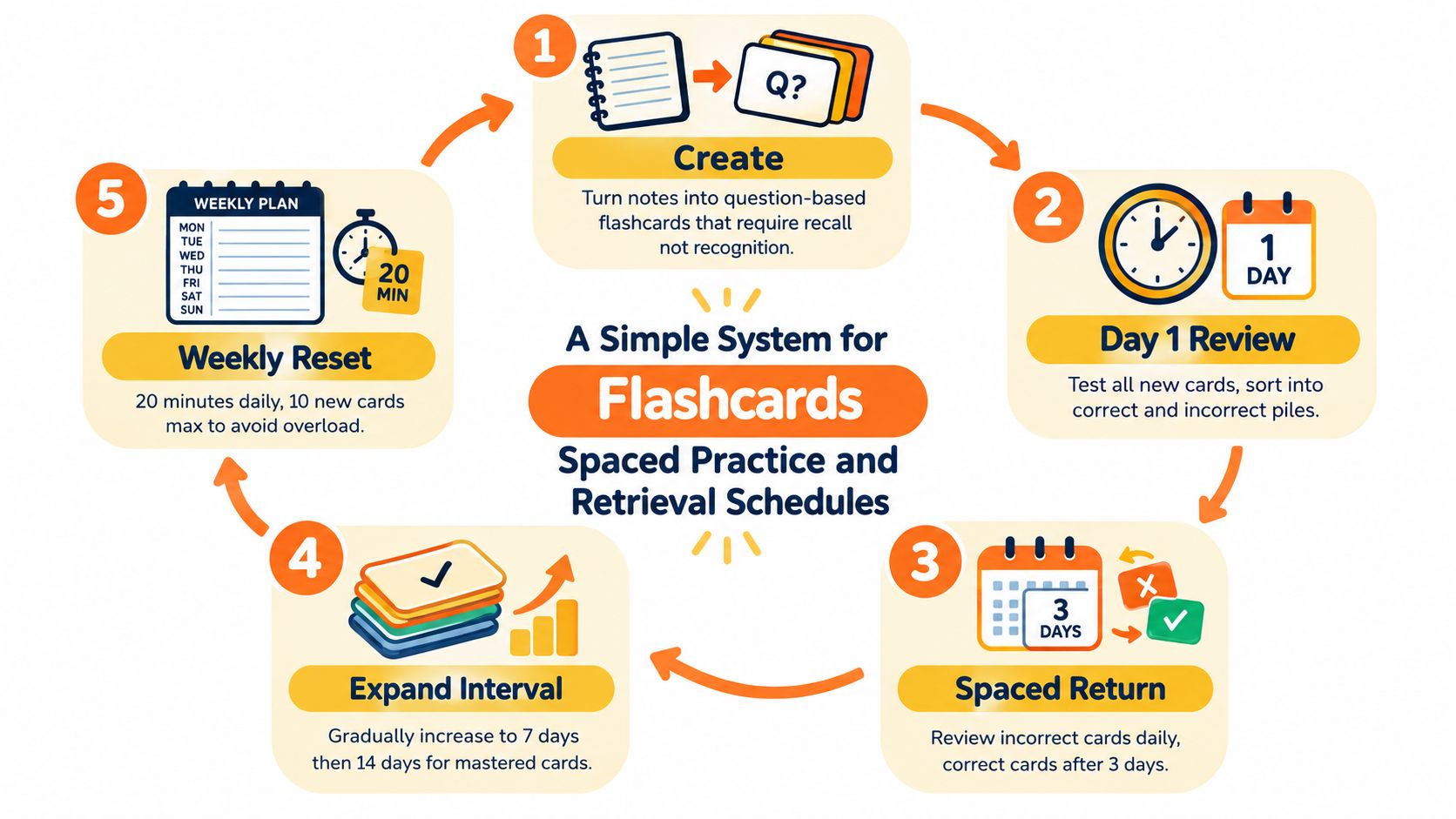
A simple weekly rhythm
- Create cards from notes. Turn one page of class notes into a few question-based flashcards.
- Test new cards the same day. Try to answer before flipping.
- Review the misses soon. Bring back the cards you missed the next day or two.
- Wait longer for the ones you know. Give mastered cards more space before reviewing them again.
- Reset each week. Keep the set small enough that you can finish a session without rushing.
That rhythm works because it keeps the effort focused. A short daily review is easier to maintain than a huge weekend cram session. If you want a simple digital workflow, Knobee can turn notes into Study Sets, and its Daily Boost sessions fit the same idea of short, repeated retrieval. You can also use Knobee's flashcard generator to turn class material into practice prompts faster, then review only the cards that still need work.
Voice mode can help too, especially when you want to say the answer out loud instead of typing it. That matters because spoken answers can make it harder to hide behind vague familiarity. If you're using a set of study cards, keep the source material close so the questions stay tied to what your teacher covered.
Common mistakes that make active recall feel harder than it should
A lot of students try active recall once, decide it's frustrating, and go back to rereading. That reaction makes sense. Retrieval feels slower, less smooth, and more mentally demanding than scanning a page. But that effort is the point, not a sign that you're doing it wrong.
The mistakes to watch for
- Mistaking effort for failure. If retrieval feels hard, that often means you're exercising memory instead of just recognizing familiar text.
- Using recognition cards. A card that repeats a definition word for word usually turns into rereading with extra steps.
- Skipping feedback. If you don't check the answer right away, you can't correct the mistake while it's still fresh.
- Packing in too many cards. Long, overloaded sessions make it harder to stay honest and consistent.
- Studying without a schedule. Random review is easy to forget, which is why spacing has to be planned.
The feedback piece matters a lot. Recent work emphasizes that students often treat retrieval as a self-check and underestimate the role of correction, especially when they're working through mistakes with classroom or AI support (2025 review). If the answer is wrong, the follow-up explanation is what turns the miss into progress.
A useful audit question is simple. Does each card force you to produce an answer, or can you recognize it as soon as you see the prompt? If it's the second one, rewrite the card.
Quick self-check: if you can guess, reveal, and move on without thinking, your card is too easy.
Putting active recall learning to work this week
The shortest version is this. Try to remember, check the answer, then come back later. That loop is what makes active recall learning more than a memorization trick. It turns each study pass into a stronger memory event.
A practical way to start is to take one set of notes and turn it into a small Study Set. Keep the cards focused on one class, one chapter, or one unit. Then schedule three short review sessions over the next several days instead of waiting until the night before the test.
If you want support that still leaves the thinking to you, Knobee can help with flashcards, quizzes, and Daily Boost review sessions. Kno can also ask guided questions and offer hints, which fits the same idea as active recall with feedback rather than answer-dumping. For a quick refresher on building speed without losing understanding, this guide on memorizing faster pairs well with the approach here.
Start with one subject this week, not all of them. Pick the class that's due soonest, make a few honest recall questions, and see what your mistakes tell you.
If you want a simple way to turn class notes into real practice, visit Knobee AI. It can help you build Study Sets, review with short daily sessions, and use hints and feedback so your studying stays active instead of passive.