AP World History Unit 1 Test: How to Prepare for Success
Learn how to prepare for an AP World History Unit 1 test with a topic checklist, practice question strategies, and effective study schedule.
Topics: ap world history unit 1 test, ap world history, test prep, study guide, unit 1 test
Table of Contents
- Focus on these high-yield themes
- A simple way to handle each format
- What to include in your Study Set
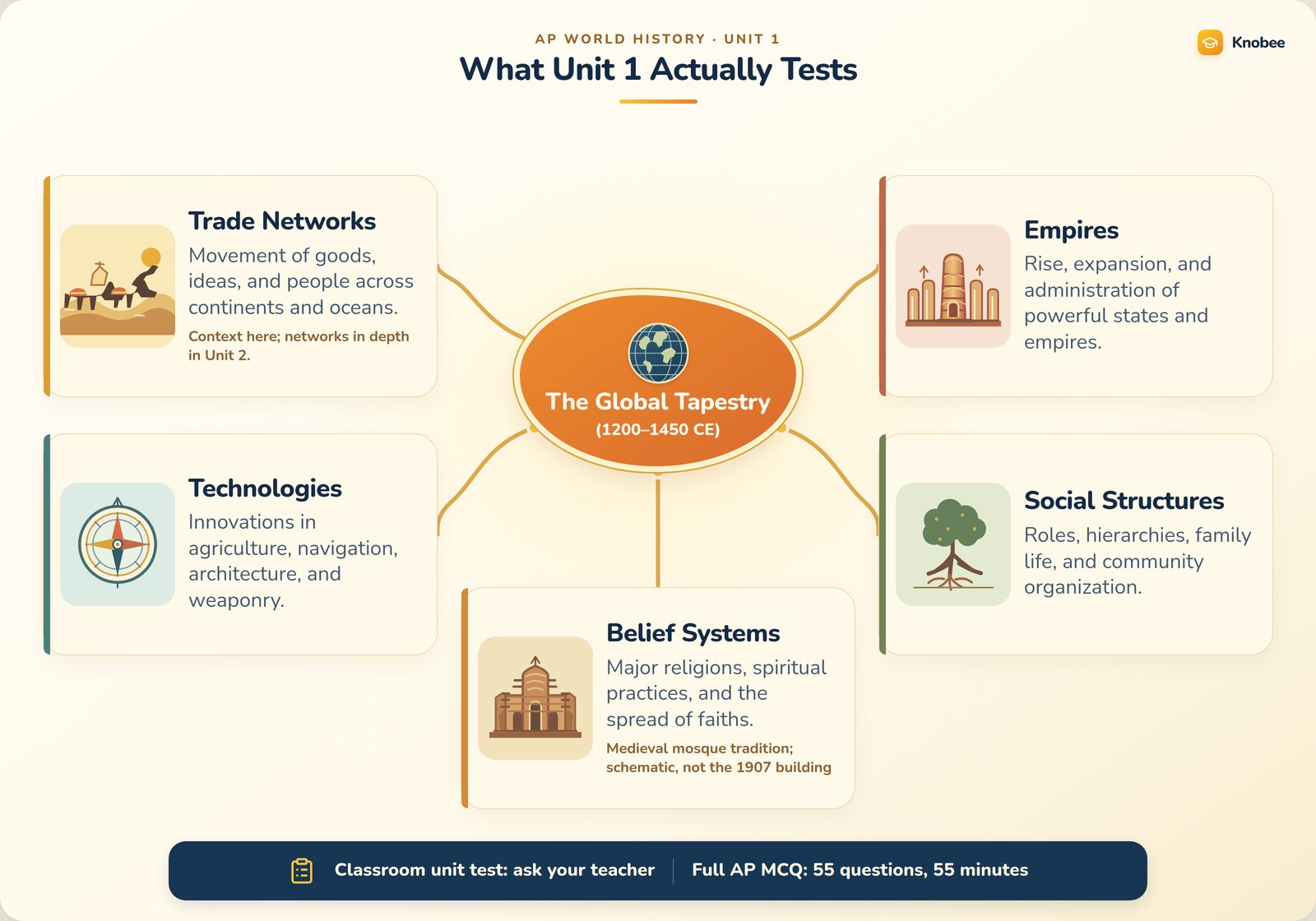
Unit 1 is The Global Tapestry, it covers 1200 to 1450 CE, and it counts for 8% to 10% of the AP World History: Modern course and exam weighting (College Board course at a glance). The students who do well on the ap world history unit 1 test usually aren't the ones who memorized the most names, they're the ones who can compare regions, place evidence in context, and explain what changed.
That's why this unit feels confusing at first. You can spend hours on empires, trade routes, and belief systems, then still lose points because the prompt wanted a comparison, not a recap. The good news is that Unit 1 rewards a repeatable way of thinking, and that's easier to train than raw memorization.
What Unit 1 actually tests and why most students prepare wrong
The AP World History: Modern exam lasts 3 hours and 15 minutes and includes 55 multiple-choice questions, 3 short-answer questions, 1 document-based question, and 1 long essay question (College Board exam description). On the multiple-choice section, you have 55 minutes and it counts for 40% of the score, while the short-answer section takes 40 minutes and counts for 20% (College Board exam page). That matters because Unit 1 isn't really a “read and remember” unit. It's a “read, compare, and explain” unit.
A lot of students study Unit 1 like a vocabulary list. They try to collect every dynasty, kingdom, and trade good, then feel confident because the notes are thick. But AP-style prompts usually ask what two regions have in common, how they differ, or how a belief system helped rulers claim legitimacy, which means isolated facts only get you partway there (Fiveable AP World Unit 1 guide).
Practical rule: if your answer could fit one region only, it's probably too narrow for Unit 1.
The historical backdrop helps explain why comparison keeps coming up. The Silk Roads linked Afro-Eurasia for more than 1,500 years, and one study guide places their origins around 130 BCE under the Han dynasty, with a major revival after 1200 CE (TutorChase Silk Roads notes). That long exchange history makes AP writers ask students to compare how different states managed power, trade, and cultural influence across the same era.
A better way to think about the AP World History Unit 1 test is this: you are not proving that you know everything. You're proving that you can build a defensible comparison under time pressure. That's a different skill, and it changes how you should study from the first day.
The Unit 1 topic checklist you actually need
Start with regions, not random facts. Unit 1 responses often become strong when you can compare at least two non-overlapping regions, especially East Asia, Dar al-Islam, South and Southeast Asia, Africa, Europe, and the Americas (High School Test Prep AP World guidance). If you can explain one similarity and one difference in state formation, you already have the bones of a useful answer.
Focus on these high-yield themes
- State formation: Look at how rulers in at least two regions built authority, expanded territory, and organized power. A comparison between Han China and another major state is more useful than a long list of isolated rulers.
- Legitimacy through belief systems: Think about how rulers used religion or philosophy to justify rule. Political power and cultural ideas intersect in this context.
- Trade networks: The Silk Roads matter because they show long-distance exchange of luxury goods, ideas, and technologies across Eurasia (TutorChase Silk Roads notes).
- Large empires and states: Han China, the Roman Empire, and the Gupta state are classic reference points for the broader classical and early premodern pattern of state complexity and exchange (Varsity Tutors Silk Roads lesson).
- The Americas: Don't leave the Aztec and Inca out. Unit 1 comparison questions often reward students who remember the Americas, not just Eurasia (Fiveable AP World Unit 1 guide).
The tricky part is knowing what to skip. Mongols are important for AP World overall, but they're mainly a Unit 2 topic, so don't let them crowd out earlier state-building patterns (Fiveable AP World Unit 1 guide). Likewise, treat medieval trade as a bridge to later change, not as a standalone memorization pile.
Keep your checklist short enough to rehearse from memory. If you can't explain it out loud in two minutes, it's not ready.
A useful study move is to build one comparison row for each region pair. Write the state, the source of legitimacy, one labor or social pattern, and one trade connection. That keeps your notes aligned to the way AP asks the question, instead of the way textbooks organize chapters.
Practice question types and how to approach each one
Multiple-choice on this unit usually rewards historical thinking, not just recognition. A question may look like it's asking for a fact, but the underlying task is to identify causation, comparison, or continuity and change. If you only search for familiar names, you can miss the actual skill being tested.
For short-answer questions, the trap is writing a summary paragraph when the prompt wants an argument. You need to answer the command verb directly, then support it with evidence that fits the prompt's region and time frame. Review materials repeatedly warn that students lose points when they restate content instead of explaining it, or when they lean too hard on Europe-centric evidence in prompts that call for broader comparison (High School Test Prep AP World guidance).
A simple way to handle each format
- For multiple-choice, name the thinking skill first. Ask yourself whether the item is about comparison, causation, or continuity and change before you look at the answer choices.
- For short answer, answer in one sentence before adding evidence. That keeps you from drifting into summary.
- For document-based work, separate what the source says from what it means. The source is not the answer. Your interpretation is the answer.
Timed practice matters because AP writing is as much about pace as knowledge. One review source recommends daily stimulus-style multiple choice, timed review sessions, and error analysis, while another frames preparation as content review, source reading, and full timed papers that expose weak rubric points (High School Test Prep AP World guidance). That's the right mindset for Unit 1, too.
If you miss a question, don't just mark it wrong and move on. Write down why you missed it, then group the mistake into a pattern. Was it a content gap, a confusing source, or an answer that sounded right but didn't match the prompt? That's how incorrect answers become useful study data.
Building Study Sets from your notes for active recall
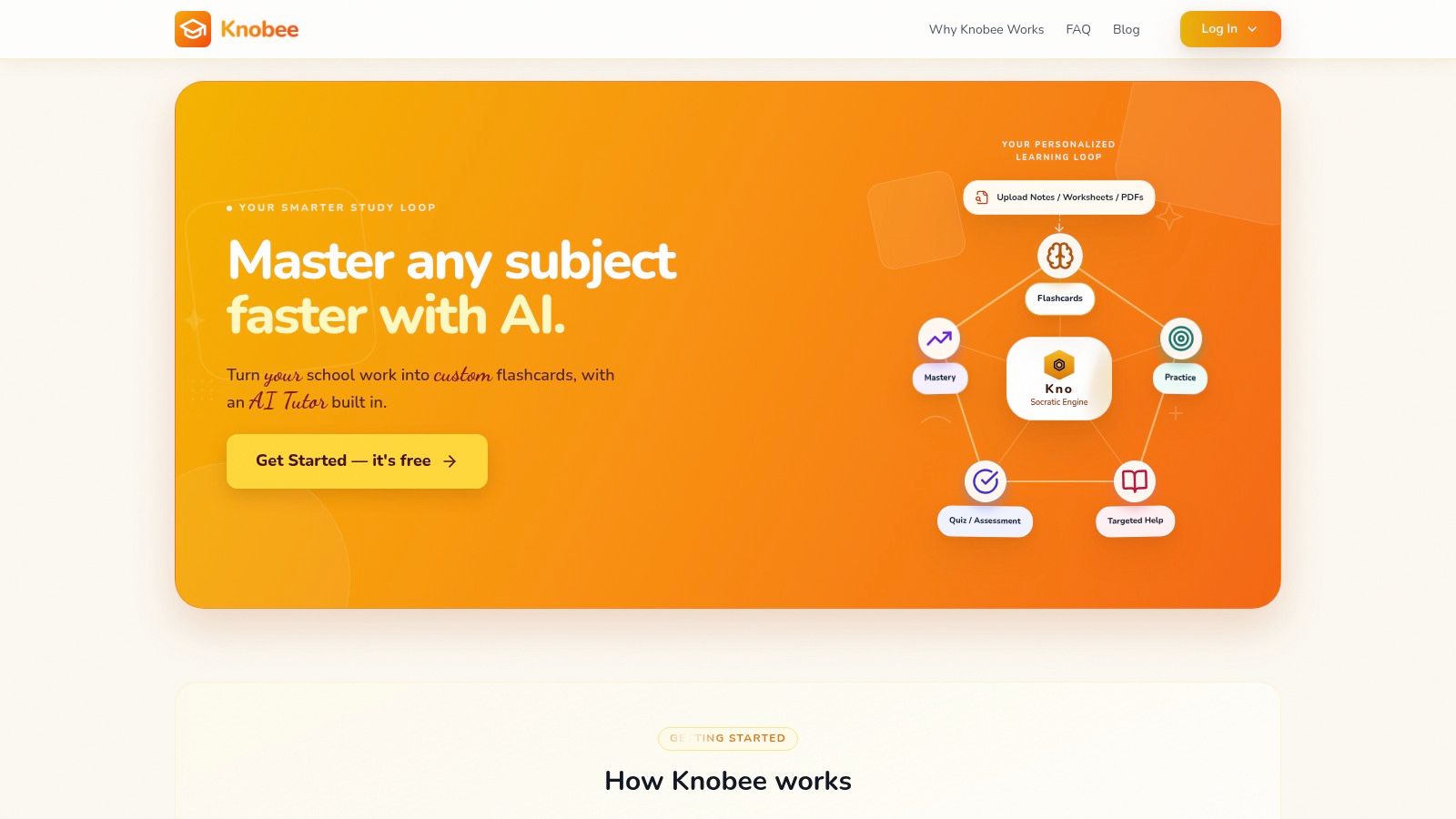
The easiest notes to study from are the ones you've already turned into questions. If your class notebook is full of paragraphs, that's not a problem. It just means you need to convert it into retrieval practice instead of rereading it line by line. Knobee AI can turn pasted notes or uploaded documents into Study Sets with flashcards and quizzes, which is one way to structure that conversion, but the main idea works with any tool.
The best Study Set cards don't stop at definitions. They ask you to compare two regions, explain a cause, or apply a concept to a historical example. That kind of card forces you to think the way the exam expects you to think, which is much more useful than recognition alone. It also gives you a clean way to notice which parts of Unit 1 still feel shaky.
What to include in your Study Set
- Worked examples: Use a card that asks how legitimacy worked in one state, then answer with a short explanation instead of a single term.
- Intuition tips: Add a note that reminds you why a concept matters, not just what it means.
- Visual aids: A quick map, diagram, or comparison chart can help you organize regions in space as well as time.
- Voice practice: Speaking an answer out loud can expose gaps that silent reading hides.
A second useful step is to review your missed cards after a quiz or practice set. That makes the errors do more work for you. The point isn't to create more material, it's to create better retrieval chances.
Later in the week, you can use a short guided session from active recall learning to test the same facts in a different format. That matters because the exam won't ask you for information in the same shape every time.
A good rule is simple, if you can only recognize the answer when you see it, you're not done yet. You want to be able to produce it from memory, explain it clearly, and connect it to a second region without looking at your notes.
A realistic 7-day study schedule for Unit 1
A week is enough time to get much better at this unit if you keep the work narrow and repeated. The schedule below assumes you're also juggling other classes, so it focuses on what gives you the most return for the AP World History Unit 1 test without overloading you.
On Day 1, sort your notes into a clean set of topics, then turn the biggest ideas into flashcards. If you want a faster start, generate flashcards from notes and then edit them so they ask for comparison, not just definitions. By the end of the day, you should have a short list of regions and themes you'll reuse all week.
On Days 2 and 3, do focused question practice. Use one set of multiple-choice questions, then one short-answer prompt, and mark every miss by skill, not just by topic. If you missed a comparison question, rewrite the answer so it names two regions and one similarity-difference structure. If you missed a source question, identify the clue you overlooked.
Days 4 and 5 should shift toward timed work. Use one passage or stimulus set, then one short response under time pressure. After that, spend more time reviewing the mistakes than taking the questions themselves. That's where the learning usually happens.
A short timed attempt followed by honest correction is more useful than an hour of passive rereading.
On Day 6, do a mixed review of your weak areas. That's when you revisit the cards or notes that kept getting missed, then test them again in a different order. On Day 7, keep it light and confident, with a quick comparison grid, a few flashcards, and one final short response to check pacing.
The point of the schedule is not perfection. It's to keep the same ideas returning in slightly different forms so the material sticks when you're under exam pressure. That is much closer to the actual test than a last-minute cram session.
Common mistakes that cost points on Unit 1 exams
The biggest mistake is treating Unit 1 like a Mongols unit. The Mongols matter in AP World, but the core of Unit 1 is earlier state formation, legitimacy, and comparison across regions (Fiveable AP World Unit 1 guide). If you spend all your time on the wrong era, you'll be prepared for the wrong prompt.
Another common error is writing a summary instead of an argument. Students quote or paraphrase documents, then stop before explaining what the evidence shows about governance, legitimacy, or regional difference. Review guidance on AP World writing consistently warns against this kind of descriptive answer (High School Test Prep AP World guidance).
You also can't leave out the Americas and still expect a strong comparison answer. Unit 1 rewards breadth, but only when that breadth is organized around a clear similarity or difference. If your response uses at least two non-overlapping regions and a real comparison structure, it usually looks much stronger than a long list of examples.
The deeper fix is simple. Don't ask, “What else can I memorize?” Ask, “What pattern keeps showing up in the questions?” For Unit 1, that pattern is comparison under time pressure.
If you want a cleaner way to turn class notes into flashcards, quizzes, and short review sessions, Knobee AI can organize your Unit 1 material into Study Sets and help you practice the exact kinds of recall this unit demands. Use Knobee AI to convert your notes into focused practice, then test yourself on comparison and evidence before you sit down for the actual exam.