How to Memorize Something Fast for a Test—and Make It Stick
Learn how to memorize something fast with proven techniques for students — chunking, mnemonics, active recall and micro-reviews that make facts stick.
Topics: how to memorize something fast, memorization techniques, active recall, study tips for students, spaced repetition
How to Memorize Something Fast for a Test—and Make It Stick
The night before a test, your notes can look like a pile of facts that refuse to stay put. You read a page, understand it, close the book, and realize that half of it has already disappeared.
Fast memorization is not mainly about having a naturally “good memory.” It is about using three steps in the right order:
Chunk it: Turn the material into small, meaningful units.
Retrieve it: Answer questions without looking at your notes.
Space it: Return to the material after a delay, focusing on what you missed.
If your test is tomorrow, do not spend the entire evening rereading. Spend a few minutes organizing the material, test yourself without looking, take a short break, and then retest the parts you could not recall. Before bed and again the next morning, complete one final retrieval round.
A Quick 30-Minute Memorization Plan
If you are short on time, start with this plan:
Minutes 1–5: Divide the material into five or fewer topics.
Minutes 6–10: Turn each topic into short questions or prompts.
Minutes 11–20: Hide your notes and answer every question from memory.
Minutes 21–25: Check your answers and correct the gaps.
Minutes 26–30: Retest only the questions you missed or answered hesitantly.
If you have more time, take a break and repeat the final step later. The goal is not to look at the material as many times as possible. The goal is to practice producing the information you will need on the test.
Practical rule: If you cannot explain it without looking, you do not know it well enough yet.
Why Rereading Feels Productive but Often Fails
Rereading can create a strong feeling of familiarity. When a sentence looks recognizable, your brain interprets that recognition as knowledge. But recognizing an answer on a page is different from producing it independently.
A test usually requires you to recall a term, choose between similar answers, explain a process, apply a formula, or connect several ideas. Those tasks require retrieval.
Memory becomes stronger when you:
Encode the information clearly.
Retrieve it without seeing the answer.
Check and correct your response.
Retrieve it again after some time has passed.
Research across multiple learning settings generally finds that spaced retrieval is more effective than repeatedly reviewing the same material. The size of the benefit varies by subject, learner, assessment, and review schedule, but the practical direction is consistent: students learn more when they must attempt to recall information rather than only look at it again.
A 2024 randomized trial published in Academic Medicine found that spaced repetition improved learning scores and knowledge transfer in its study population. A separate meta-analysis reported a meaningful benefit for spaced retrieval over massed retrieval. Research in introductory STEM courses has also found that retrieval practice can outperform rereading.
These studies do not mean that every student will improve by the same amount or that one study schedule works for every subject. They do support a useful principle: practice the act of remembering, not just the act of reviewing.
Step 1: Turn the Material Into Small, Recall-Ready Chunks
Your working memory can hold only a limited amount of information at once. If you try to memorize an entire chapter as one unit, details compete for attention and quickly become difficult to retrieve.
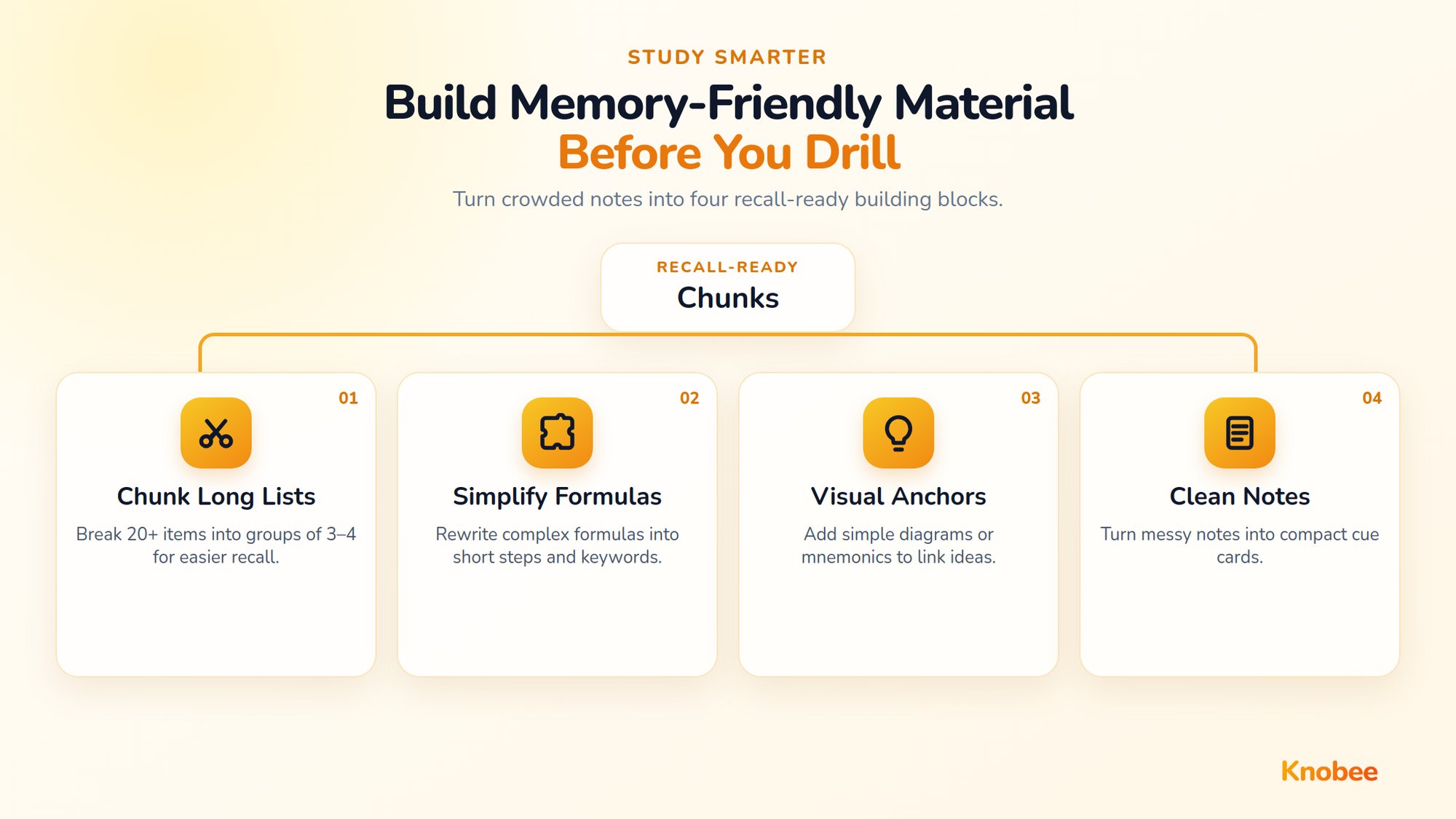
Before testing yourself, divide the material into smaller groups.
For example:
Divide biology terms by body system or function.
Organize a historical unit into causes, events, and consequences.
Separate a math formula into its name, variables, and conditions for use.
Group literary vocabulary into devices, character traits, and transitions.
Divide a scientific process into stages.
Chunking does not reduce the total amount of information. It gives the information a structure. Research on working memory suggests that a meaningful chunk can function as one organized representation rather than several unrelated details, freeing mental capacity for additional material.
Four or five meaningful groups will usually feel easier to manage than one long, random list.
Keep preparation short
Organizing material can become another form of procrastination. Give yourself a time limit—perhaps five or ten minutes—to clean up the notes.
Your goal is not to produce beautiful study materials. It is to create prompts that you can answer from memory.
A long note such as this:
Boyle’s law states that the pressure of a gas is inversely proportional to its volume when temperature and the amount of gas remain constant.
Could become three prompts:
What does Boyle’s law relate?
What remains constant?
What happens to pressure when volume decreases?
These prompts are easier to test than the original paragraph.
Step 2: Use Mnemonics and Images Where They Actually Help
A mnemonic is a compact cue that helps you retrieve information. It might be an acronym, phrase, rhythm, image, or location.
Mnemonics work best when they are:
Easy to picture or repeat.
Connected to the information’s order or meaning.
Simple enough to remember under pressure.
Used as a retrieval cue rather than a substitute for understanding.
For an ordered list, you could create a sentence using the first letter of each item. For a scientific process, you could imagine each stage as part of one exaggerated visual scene.
For information that must be remembered in order, you can also use a memory route, sometimes called the method of loci. Imagine placing each fact at a familiar location: your front door, hallway, desk, kitchen, and backyard. To recall the sequence, mentally walk through those locations.
The image should help you find the fact. It should not be so complicated that remembering the mnemonic becomes harder than remembering the material.
Put the image where the fact belongs, not where it merely sounds clever.
Mnemonics are especially useful for sequences, categories, vocabulary, and lists. They are less useful when the test requires you to explain reasoning or apply a concept. For those tasks, you still need practice questions and worked problems.
Step 3: Run a Short Active-Recall Loop
Once the material is organized, stop looking at it and try to retrieve it.
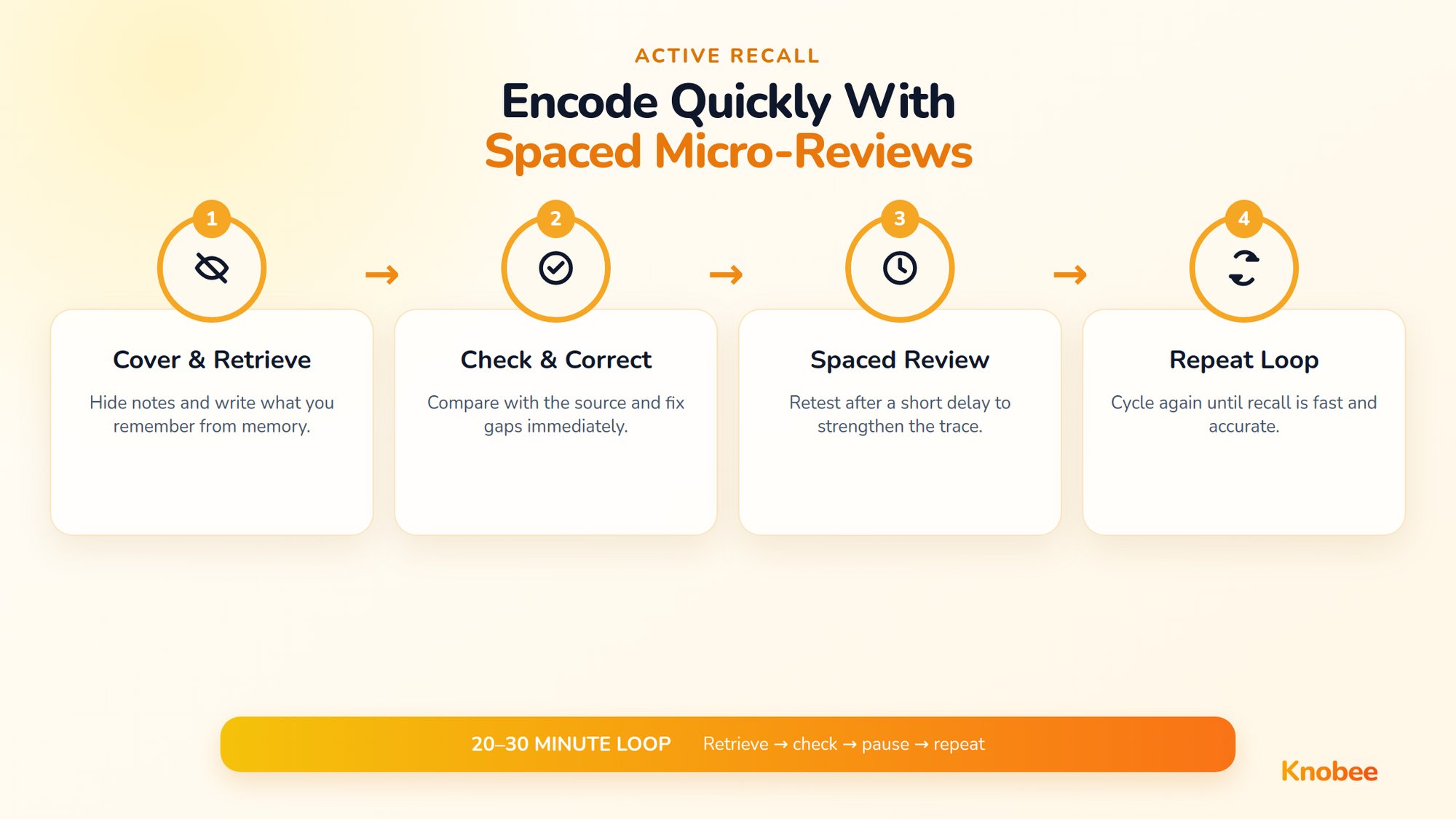
Use this six-step loop:
Choose one small topic.
Hide the source.
Write or say everything you remember.
Check the source immediately.
Correct anything missing or inaccurate.
Test the same topic again later.
The first attempt may feel uncomfortable. That difficulty is useful because it shows you what your memory can actually produce.
If you are studying a formula, do more than recite it. Explain what every symbol means and when the formula applies.
If you are studying vocabulary, look at the word, hide the definition, explain it in your own words, and use it in a sentence.
If you are studying history, retrieve the event and explain at least one cause and one consequence.
If you are memorizing a speech or poem, retrieve the first line, then the first two lines, and continue adding one section at a time.
Test, don’t just look.
Check your response soon after each attempt. Immediate correction helps prevent an inaccurate version from becoming familiar.
Step 4: Use Short Spacing Instead of One Continuous Cram
Spacing means separating retrieval attempts instead of completing them all back-to-back.
When a test is close, even a short break between two retrieval rounds is preferable to repeating the same answer immediately. During an uninterrupted drill, the answer may still be sitting in short-term memory. A delay makes the next attempt a more realistic test of whether you can retrieve it.
For stronger long-term retention, continue reviewing over the following days. Much of the research on spacing examines intervals longer than one study session, often ranging from one day to a week or more.
A simple schedule could look like this:
First retrieval round after organizing the material.
Second round after a short break.
Third round before bed.
Fourth round the next morning.
Another short review two or three days later.
Do not give every item equal attention. If you answer a card correctly and confidently several times, let it rest. If you repeatedly miss it, simplify the prompt, correct your understanding, and return to it sooner.
Step 5: Decide What Deserves Your Time
When only one study block remains, the hardest decision is often not how to study. It is what to study first.
Sort the material into three categories:
Solid
You can answer correctly, clearly, and without hints.
Shaky
You know part of the answer but hesitate, confuse details, or need a clue.
Missing
You are guessing, giving an inaccurate answer, or drawing a blank.
Spend most of your remaining time on the shaky and missing categories. Check solid material only when it is especially important or serves as a prerequisite for another topic.
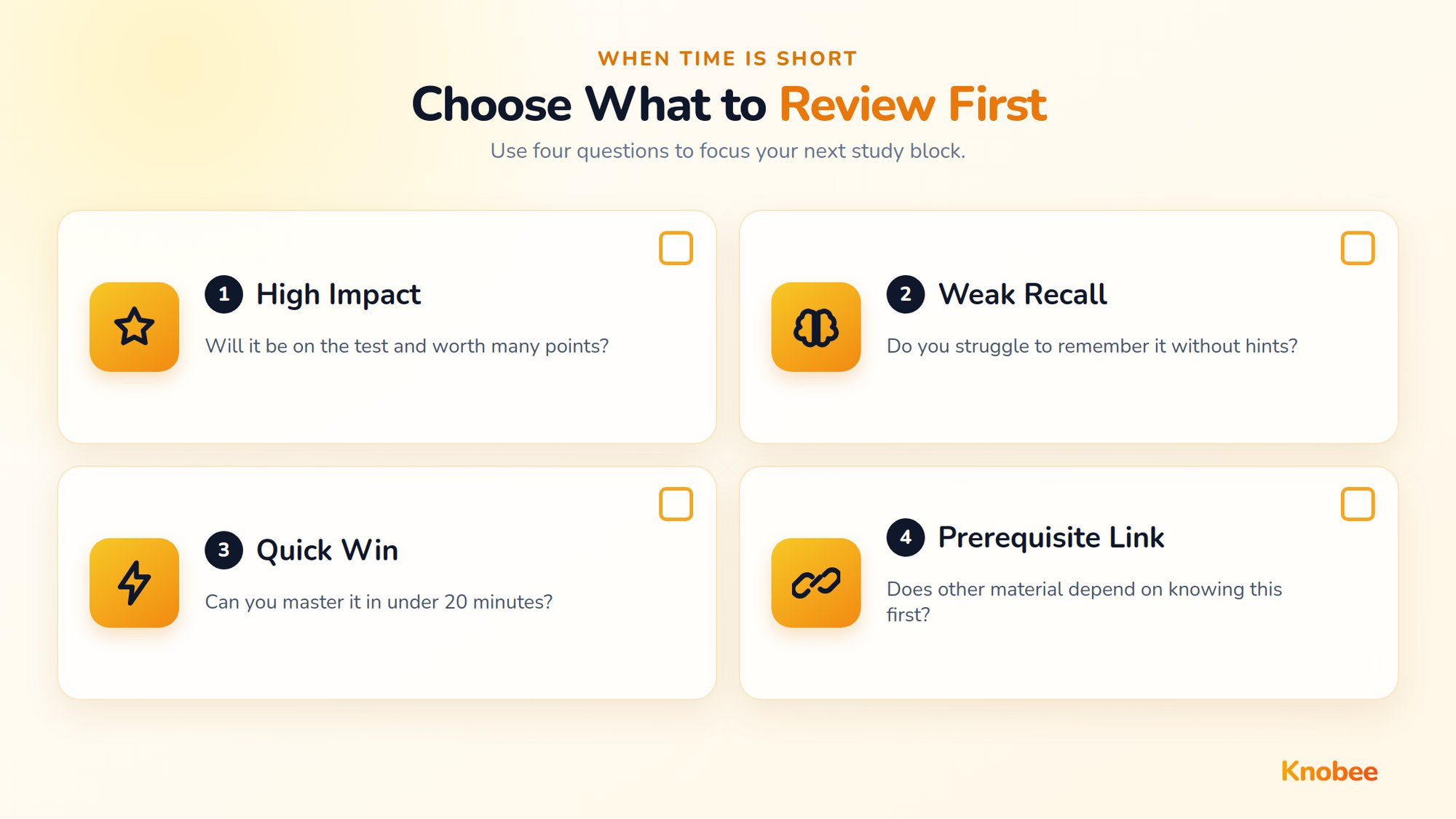
Use these questions to prioritize:
High impact: Is the concept likely to appear on the test or carry significant weight?
Weak recall: Can you answer it without a hint?
Quick win: Could one short review resolve the confusion?
Prerequisite: Do other questions depend on understanding it?
As a rough study-session heuristic, you might spend about 70% of your time on missing material, 25% on shaky material, and 5% confirming important items from the solid group. This is not a universal research formula. Adjust it based on the subject and your teacher’s expectations.
Match the Retrieval Task to the Subject
Different subjects require different kinds of memory.
Math
Do not memorize only the formula. Retrieve:
The formula.
The meaning of each variable.
The conditions in which it applies.
The first step of a representative problem.
Then solve problems without viewing an example.
Science
Connect definitions to processes and causes. Ask:
What is it?
What causes it?
What happens next?
How would changing one variable affect the result?
History
Organize information into:
Causes.
Events.
People.
Consequences.
Comparisons with related events.
Timelines help, but practice explaining why one event led to another.
English language arts
For vocabulary, retrieve the definition and use the word in a new sentence. For literature, connect characters, decisions, themes, and evidence. For essays, practice recalling your claim and supporting evidence rather than memorizing complete paragraphs.
Speeches and performances
Practice in small sections, then connect the sections. Start from different points so one forgotten line does not prevent you from completing everything that follows.
How Smart Tools Can Support the Process
A useful study tool should create opportunities to practice. It should not replace the practice.
Knobee can turn notes, slides, PDFs, Word documents, textbook excerpts, and topic descriptions into flashcards, quizzes, and visual aids. That can reduce the time students spend converting messy material into recall-ready questions.
The student still needs to answer before revealing the response.
Knobee’s Daily Boost can bring lower-mastery material back into short review sessions. Mastery tracking helps distinguish concepts that feel familiar from concepts that can be retrieved consistently. Voice Mode allows students to practice explaining answers aloud, while the Test Analyzer can turn mistakes from a graded assessment into targeted practice.
Kno, Knobee’s AI tutor, uses hints and questions to guide students through reasoning instead of immediately supplying a finished answer.
The healthiest workflow remains simple:
Bring your learning materials.
Turn them into clear retrieval prompts.
Attempt each answer independently.
Check and correct your response.
Return to weak material later.
Technology can organize the practice, but the learner must perform the retrieval.
Make the Material Stick Beyond Tomorrow
Emergency studying can help before one test, but the process becomes easier when retrieval is part of a regular routine.
A short daily review prevents weak material from accumulating into one large cram session. If you miss a question, move it back into active practice. If you answer it accurately and confidently, increase the time before reviewing it again.
This produces a useful cycle:
New material begins as missing.
Practice moves it into shaky.
Repeated successful retrieval moves it into solid.
Spaced review checks whether it remains solid over time.
A student does not need perfect concentration or hours of uninterrupted study. Ten focused minutes of retrieval can be more useful than a longer session spent passively rereading.

Your Quick Plan to Memorize Faster
If you need to memorize something quickly, remember three words:
Chunk. Retrieve. Space.
First, divide the material into small and meaningful pieces. Next, close the notes and produce the answer from memory. Finally, revisit what you missed after a delay.
Tonight:
Shorten and organize the material.
Create questions instead of summaries.
Test every question without looking.
Correct errors immediately.
Retest the weakest material after a break.
Tomorrow:
Begin with the questions you missed.
Explain important concepts aloud.
Complete one final retrieval round before the test.
Avoid spending the last few minutes repeatedly reviewing material you already know.
Later in the week:
Return to the material before it becomes completely unfamiliar.
Increase the spacing for questions you consistently answer correctly.
Keep weak concepts in active practice.
Pick one page of notes now. Break it into five questions, close the page, and answer the first question without looking. That first retrieval attempt will tell you more about what you know—and what to study next—than another complete reread.
If you want help turning your notes, slides, PDFs, or textbook pages into flashcards and quizzes, Knobee can organize them into retrieval practice and help you focus on the material you have not mastered yet.