AP World Practice Questions: 7 Places to Practice Smarter
Find AP World practice questions with explanations, from free review to paid question banks. Compare 7 options and get tips for MCQs and short answers.
Topics: AP World practice, AP World History, AP World MCQs, AP World review, AP history study
A student rereads the same unit three times, closes the book, and still freezes on a multiple-choice question about trade networks. The reading wasn't wasted. The retrieval was missing. Pulling an answer out of memory is what makes it stick, and the questions you pull with decide how well that works.
AP World History: Modern asks for specific moves. Read a short source, place it in time and place, then explain how it supports a claim. A practice set that only asks you to name empires trains a different skill than the one the exam scores.
The seven options below cover free content review, high-volume multiple-choice drilling, official free-response practice, and a short daily self-check. Each entry names the job it does best, shows a sample question pattern, and gives you a way to review the explanation afterward. Most students can build a workable routine for free, then pay only where a gap shows up.
You don't need all seven. You need one from each part of the exam, plus a habit that keeps them running.
Table of Contents
- 1. World History Flashcards & Study Tools
- 2. College Board AP Central and AP Classroom
- 3. Fiveable AP World History Modern
- 4. UWorld AP World History Modern Question Bank
- 5. Kaplan AP World History Practice Question Bank
- 6. Khan Academy AP World History
- 7. CrackAP AP World History Modern Practice Tests
- How the seven AP World practice options compare
- Build a Weekly Practice Routine That Sticks
1. World History Flashcards & Study Tools
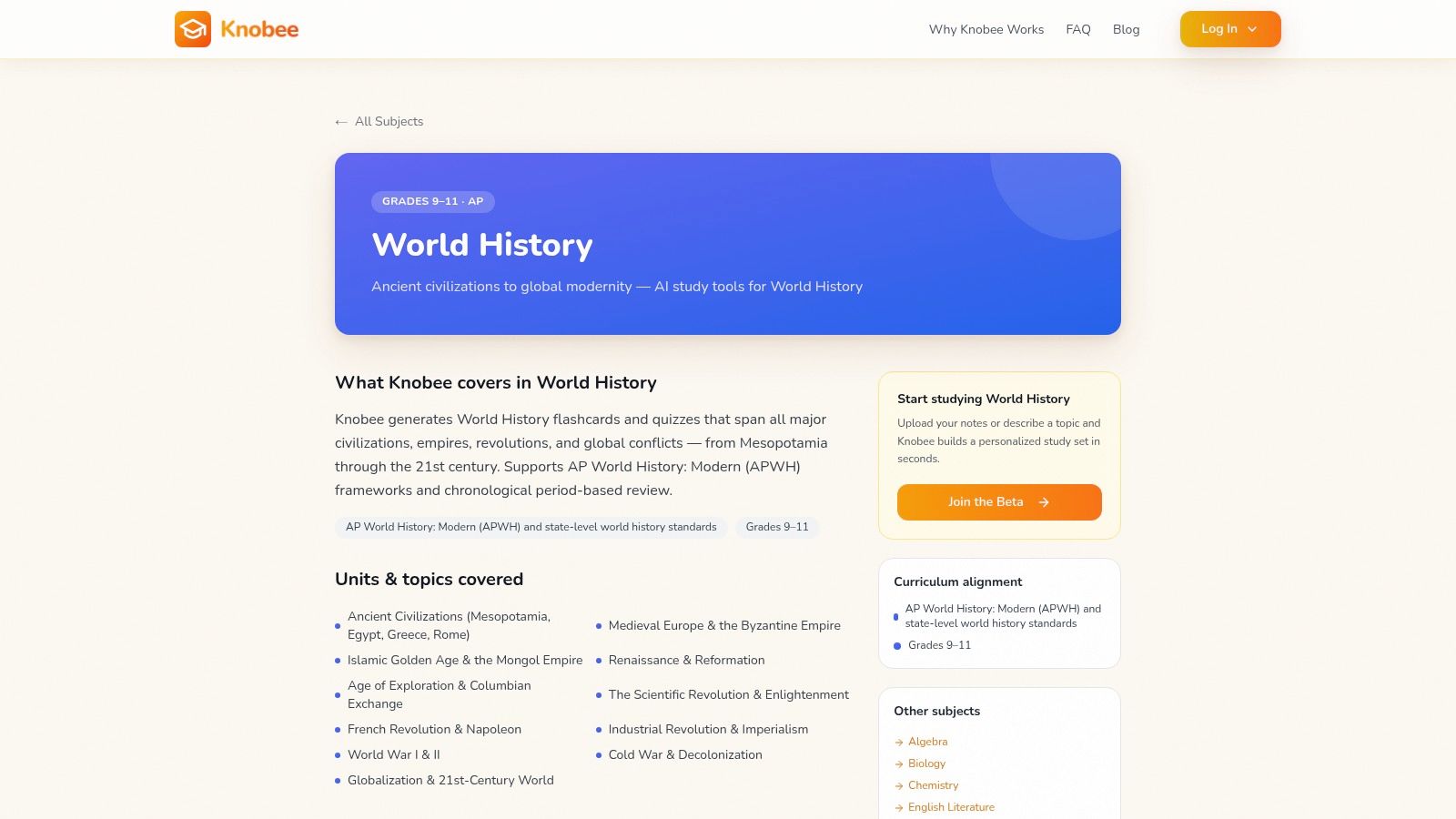
Start with your own material. Paste a page of notes, upload a unit packet, or type a topic like "trans-Saharan trade routes," and the World History study tools build flashcards and a multiple-choice quiz from what you gave it. Coverage runs from ancient civilizations through globalization, and the World History content supports AP World History: Modern frameworks and period-based review.
That fit matters in a course where your teacher's emphasis rarely matches a generic test bank. A quiz built from your Unit 4 notes follows the way your class taught Unit 4, including the examples your teacher used. A session can run five minutes before dinner or forty minutes on a Sunday.
A sample question pattern
Try this shape "Which of the following best explains the expansion of Indian Ocean trade after 1200?" The distractors are where the learning happens. One option states something true about the Silk Roads (wrong region), one describes a cause from the 1500s (wrong period), and one flips an effect into a cause.
How to review the feedback
Every card asks you to commit to an answer before the answer appears, which is what makes the retrieval count as practice rather than rereading. The reasoning behind that habit is laid out in this guide to active recall.
When you miss a question, don't just read the correct option and move on. Name the reason for the miss in three words or fewer, then check the fact against your textbook or class notes.
- Built from your own materials: Notes, uploaded documents, and topic prompts all produce usable sets, so review follows your syllabus instead of a generic sequence.
- Wide chronological range: Content spans ancient civilizations through globalization, which covers the broad arc of the modern course.
- Feedback on every answer: Quizzes include explanations, and a Mastery Check has you answer flashcard questions while Kno evaluates your meaning rather than your exact wording.
- Check the content: AI-generated questions and explanations can contain errors, so cross-check important facts with your teacher or textbook.
- A supplement, not a course: These tools support assigned reading and instruction. They don't replace either.
Website: World History Flashcards & Study Tools
2. College Board AP Central and AP Classroom
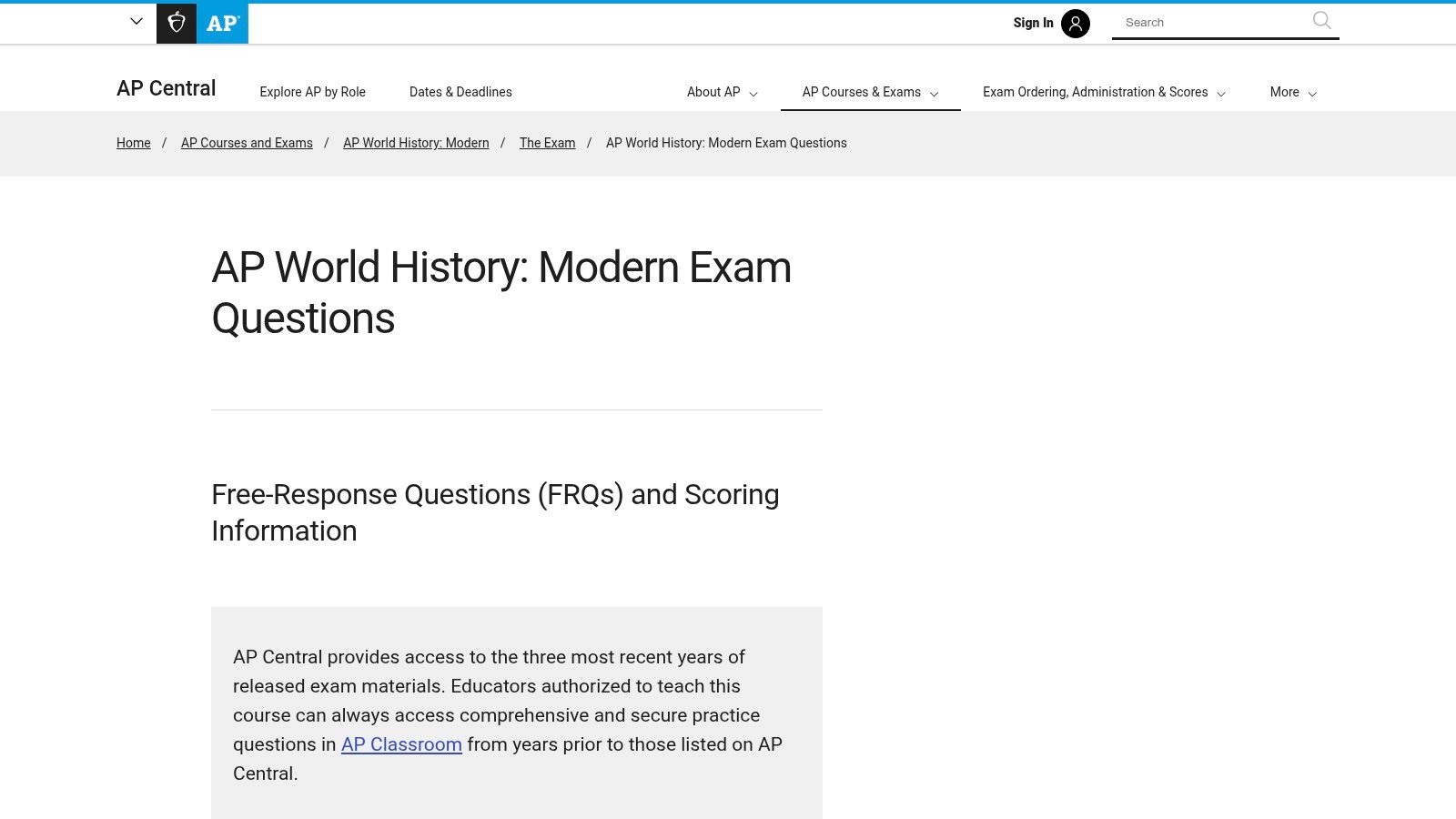
Start with the source of the exam itself. AP Central publishes released free-response questions, the scoring guidelines that go with them, and sample student responses at each score point. AP Classroom holds a much larger bank of multiple-choice and free-response questions, but access usually comes through your teacher and your course enrollment.
The official AP World History exam page lays out the shape you're training for. The multiple-choice section is 55 questions in 55 minutes and contributes 40% of the final score. Three short-answer questions take 40 minutes and are worth 20%. Two free-response essays take 1 hour and 40 minutes and account for the other 40%, with a 15-minute reading period attached to the document-based essay.
That split is a study plan. Roughly two-fifths of your preparation belongs to multiple-choice reasoning and two-fifths to extended writing. The middle fifth is short answers, which most students practice least.
A sample question pattern
Take one released DBQ and answer it in full, timed, with the reading period included. The prompt style is familiar: "Evaluate the extent to which..." followed by documents and a demand for outside evidence. Then do the same with one released LEQ.
How to review with the scoring guidelines
Read the guideline before you read your own essay, so you know what the reader is looking for.
- Score yourself: Award a point only when the sentence on the page earns it. "I meant to say that" does not count.
- Read two sample responses: Compare a high-scoring essay with a mid-range one on the same prompt. The difference is usually explanation, not knowledge.
- Use AP Classroom if you have access: The secure bank is the closest thing to real exam questions, but your teacher controls what becomes available.
- Know the limit: Released public material leans toward essays, so you'll still need somewhere else for self-grading multiple choice.
Website: AP World History past exam questions
3. Fiveable AP World History Modern
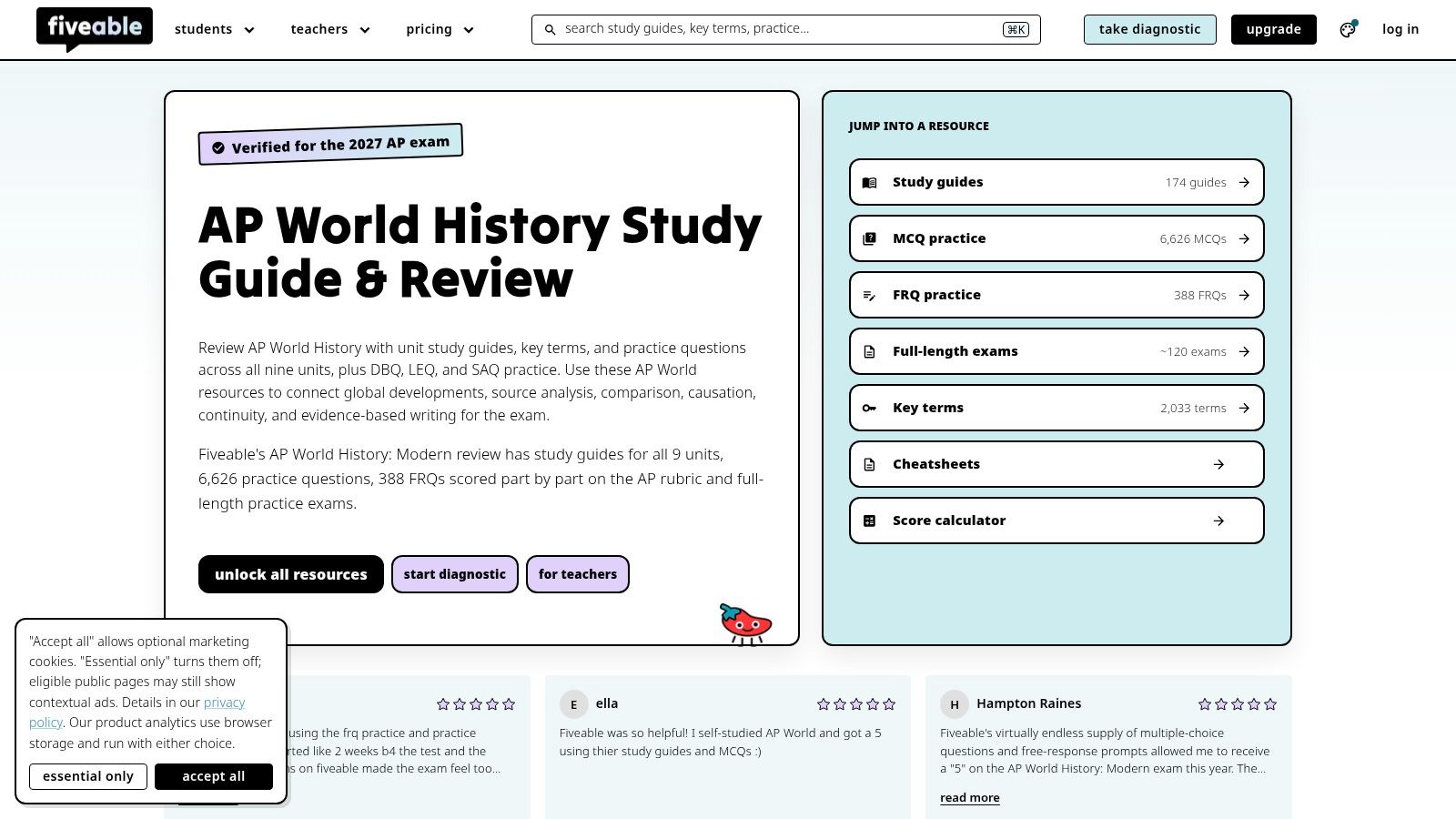
A document can state what happened without showing why the author presented it that way. Fiveable offers practice across AP World History's nine units, with multiple-choice sets and work on SAQs, DBQs, and LEQs. Some resources are one-time purchases; other features require an account or subscription.
The 2025 AP World History Chief Reader Report reports low average points for evidence beyond the documents, sourcing, and complex understanding. That makes document analysis a useful focus when practicing written responses.
A sample question pattern
Read a short document, then ask: “How does the author's purpose limit this source as evidence of economic change?” Follow with: “What outside evidence could help explain the change?” The first question tests sourcing; the second helps you practice connecting a document to broader historical context.
How to review the feedback
Treat point-by-point feedback as a first read, not an official College Board score. Check each comment against the rubric, then revise the specific sentence or claim it identifies.
- Match feedback to the rubric: If a comment calls your evidence vague, find the sentence and make the evidence more specific.
- Use unit filters while learning: Start with questions from a current unit, then try mixed sets after you have studied several units.
- Check access before buying: Confirm whether the feature you want requires a subscription.
Website: Fiveable AP World History
4. UWorld AP World History Modern Question Bank
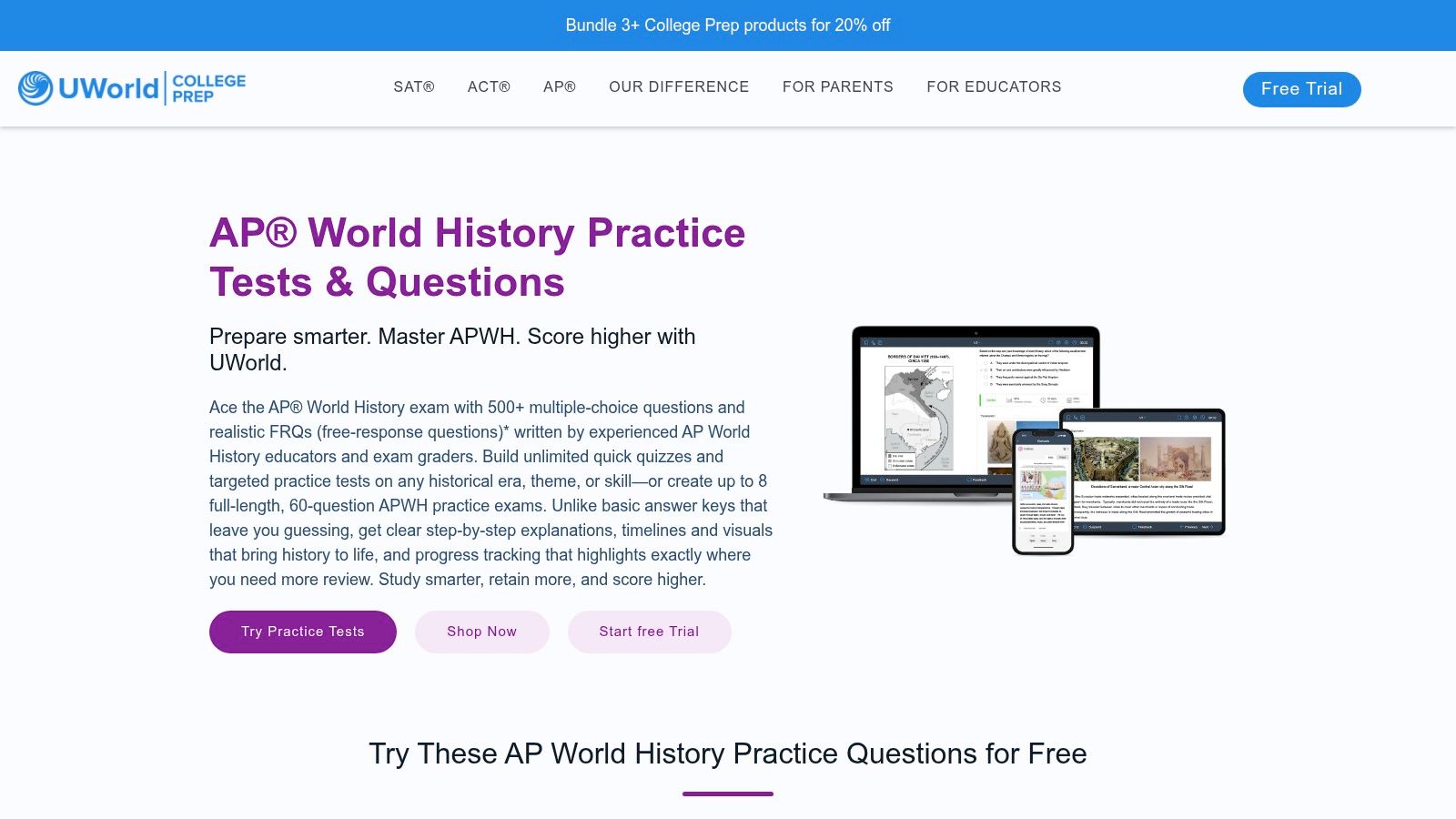
If you can recall the content but still miss questions, practice the reasoning behind each choice. UWorld offers more than 500 multiple-choice questions, customizable mini-quizzes, timed practice, a full-length mock exam, and explanations for the answers. These are provider-created exam-style questions, not released College Board items.
The 2025 AP World History score distribution reports 411,547 test takers, a mean score of 3.16, and 64.3% earning a 3 or higher. Students who fall short may lose points through weak reasoning, rushed pacing, or misreading a task, so question volume alone may not close the gap.
A sample question pattern
Build a ten-question mini-quiz from one unit. Answer without a timer, then mark each response as confident, unsure, or guessed before checking the result. That small distinction helps separate a content gap from a lucky guess.
How to review a miss
Read the explanation for the correct answer, then examine why each distractor fails. A wrong option might use the wrong chronology, region, or cause. Name the error before returning to the topic.
A missed question is a diagnosis, not a verdict. Record the error type before recording the topic.
- Log the error type: Classify each miss as content, chronology, geography, source reading, or misread task. Look for patterns across several questions.
- Return to the unit: If errors cluster in one area, review the matching material, such as this guide to AP World History Unit 1 practice, before trying mixed questions again.
- Pair it with essay practice: Multiple-choice drills do not teach you to write a DBQ. Use released College Board prompts for that skill.
- Check the cost: Paid access is required, so decide which practice features you need before subscribing.
Website: UWorld AP World History Modern practice
5. Kaplan AP World History Practice Question Bank
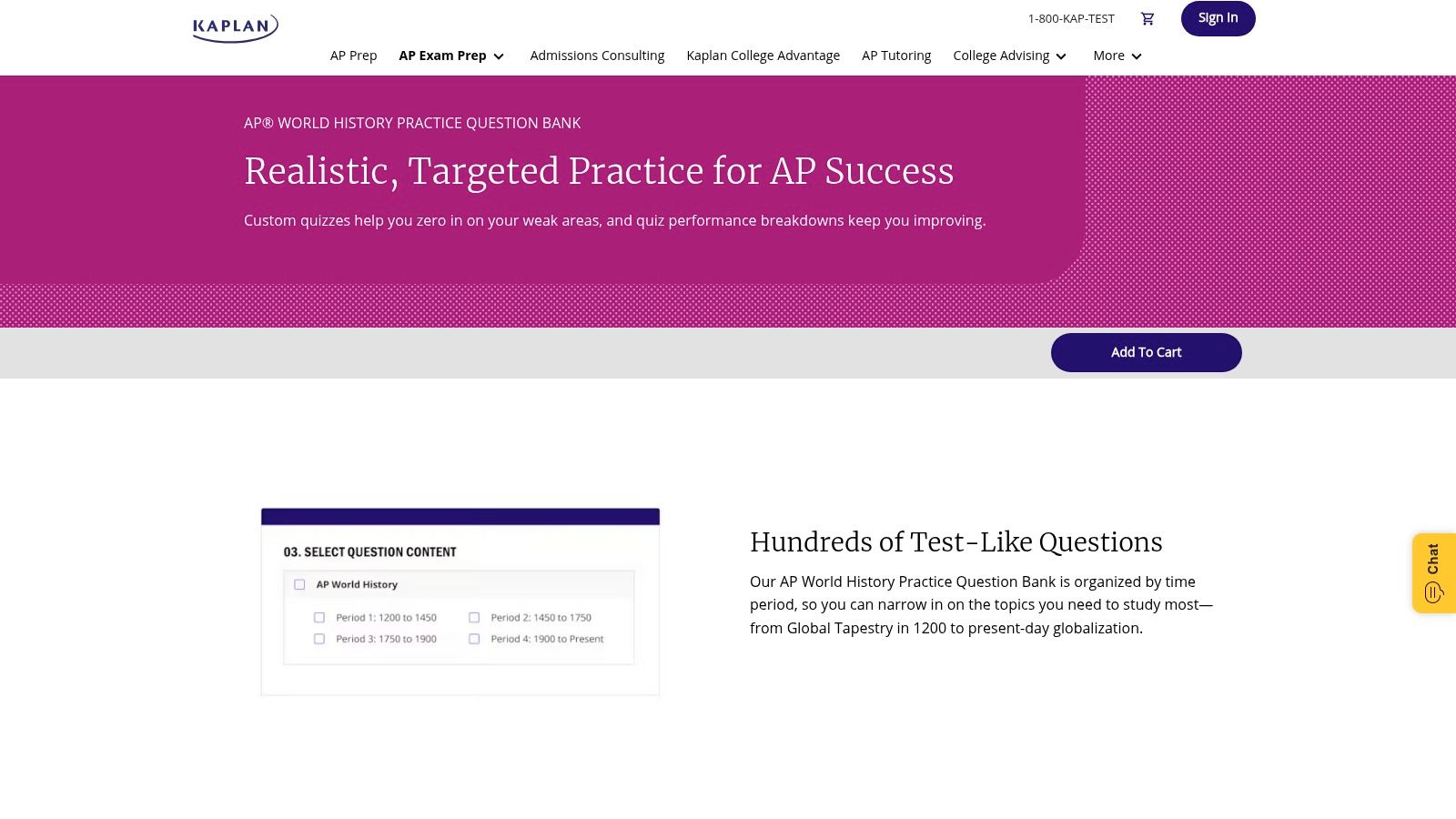
Chronology can turn a familiar topic into a missed question. The 2024 Chief Reader Report describes students struggling to place events in the correct chronological framework, along with errors that assigned African political ideologies and systems to the wrong region or economy.
Kaplan's question bank groups practice by four historical periods. That makes it useful for checking whether you can place events in sequence, especially near the boundary between periods. The bank offers 500 questions, quiz building, timed and tutor modes, answer-choice explanations, and performance assessments.
A sample question pattern
Choose one period and try a question such as: “Which of the following developed in the same century as the caravel?” Before selecting an answer, place the caravel on a timeline. Then test each option against that date. This links technology, trade, and empire to one chronological frame.
How to review a distractor
Start in tutor mode while learning. Read the explanation before moving on, then switch to timed mode once your accuracy is steady.
- Diagnose each wrong option: Was it from the wrong period or region, did it reverse cause and effect, or was it true but irrelevant?
- Draw the timeline: If two questions depend on dates, sketch the century and place the key events before continuing.
- Pair MCQs with writing practice: The bank focuses on multiple-choice questions. Use official prompts and rubrics to practise DBQ and LEQ writing.
- Check the access terms: The question bank is a paid product, so confirm its access terms before you subscribe.
Website: Kaplan AP World History question bank
6. Khan Academy AP World History
Free content review earns its place in the routine, especially early. Khan Academy's AP World History course organizes instruction into nine units, pairing videos and short articles with quizzes, unit tests, and a course challenge at the end.
The best use isn't the quiz score. It's the ten minutes before you open a question bank. Watch one video on a unit you haven't reviewed since October, take the unit test, and then move straight into exam-style items while the material is warm.
A sample question pattern
Khan's knowledge checks tend to ask you to identify and explain rather than to reason through a source. That's useful for filling a gap, but it won't rehearse the document work the exam demands.
Use free review to load the material. Use exam-style questions to find out whether it's actually there.
How to review without fooling yourself
A 5 out of 5 on a unit test after watching the video mostly measures recency. Come back in three days with no video and try again.
- Sequence it correctly: Video, then knowledge check, then exam-style practice, then a spaced return.
- Note what's missing: Not much document analysis, and no timed writing, so plan those separately.
- Check the scope: Confirm the lessons match the modern course rather than older world history material.
- Keep it free: No subscription is needed, which makes it a sensible first stop.
- Build the habit around it: A weekly plan for studying AP World History keeps review from turning into scrolling.
Website: Khan Academy AP World History
7. CrackAP AP World History Modern Practice Tests
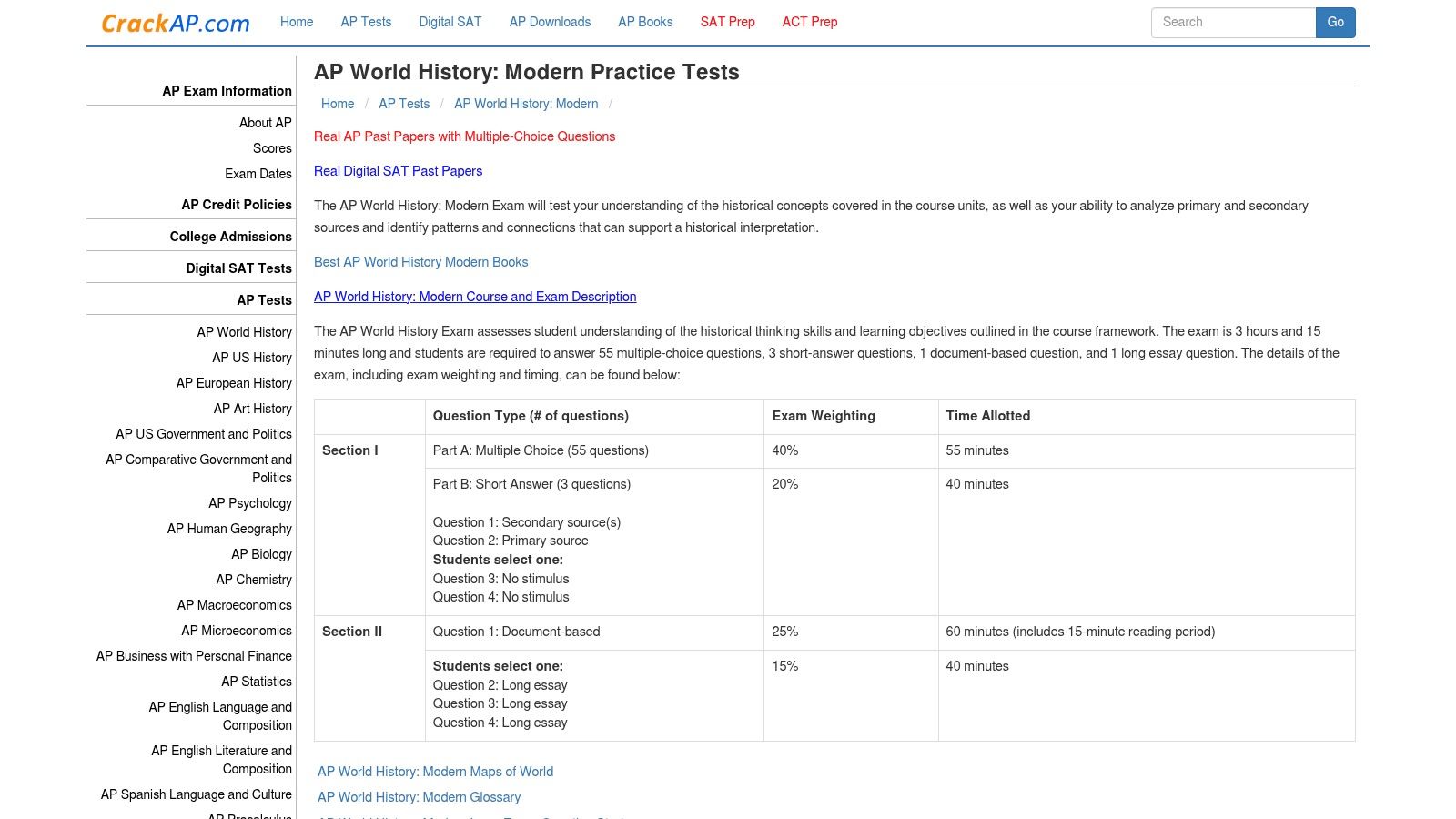
Extra free volume has a place, with a caveat. CrackAP lists numerous online multiple-choice practice sets, some labeled by modern-era time periods, plus downloadable materials. It's convenient for a quick quiz on a phone or a fast recall session before class.
The caveat is accuracy of format. The site carries older AP World material alongside modern content, so an item that looks like a current exam question may reflect a retired course or a retired exam design.
A sample question pattern
Use these sets for rapid recall, not for predicting your score. A question asking you to identify a trade network is a warm-up. A question asking you to evaluate a source's reliability is closer to the authentic experience.
How to review with a filter
- Check the label first: If the set isn't marked for the modern course, treat it as background reading.
- Verify against official items: When an answer feels off, compare it with a released College Board question on the same topic.
- Watch for old essay formats: Free-response prompts from older years may not match the current structure.
- Don't make it your only source: Use it as filler volume between better-aligned practice.
Website: CrackAP AP World History Modern practice tests
How the seven AP World practice options compare
Each option supports a different kind of practice. Use the table to choose a starting point, then match your practice to its purpose: review content, drill multiple choice, work with official prompts, or check what you remember.
| Item | Best for | Cost or access | Main question types |
|---|---|---|---|
| World History Flashcards & Study Tools | Personalized world history review and active recall | Generate quizzes from your own materials or a topic | AI-generated quizzes and flashcards |
| College Board, AP Central and AP Classroom | Official exam practice and scoring guidance | Released materials are free; AP Classroom generally requires course and teacher access | FRQs, MCQs, SAQs, DBQs, and LEQs |
| Fiveable, AP World History: Modern | Unit-based review across multiple exam formats | Some resources are paid; some features require an account or subscription | MCQs, SAQs, DBQs, LEQs, and full-length exams |
| UWorld, AP World History: Modern Question Bank | Timed and customizable MCQ practice | Paid access required | MCQs, mini-quizzes, and a full-length mock exam |
| Kaplan, AP World History Practice Question Bank | Targeted practice by historical period | Paid question bank | MCQs in timed or tutor mode |
| Khan Academy, AP World History | Free instruction and unit-by-unit review | Free access | Quizzes, unit tests, and course challenge questions |
| CrackAP, AP World History: Modern Practice Tests | Extra online practice and quick quizzes | Free online materials | MCQs and practice tests |
A question bank can build speed, while a lesson or flashcard set can help clarify a topic. For any missed or uncertain answer, explain why the correct choice fits and why another choice does not. For example, if a question asks how a trade network spread cultural practices, identify the exchange or contact that supports your answer, not just the name of the network.
Use World History Flashcards & Study Tools for personalized recall practice based on your materials or a topic. College Board resources are the reference point for official prompts and scoring guidance. The other options offer different ways to review units or practice questions, so check that the format matches the skill you want to work on.
Build a Weekly Practice Routine That Sticks
Three sources, one routine. Choose one free resource for content review, one question bank for volume, and official released free-response questions for writing. That covers reasoning, pacing, and writing without paying for everything at once.
A week that holds up usually looks like this.
- Monday and Tuesday: Fifteen minutes of mixed multiple choice, timed at about a minute per question.
- Wednesday: One short-answer question or one DBQ body paragraph, written by hand or typed if your exam is digital.
- Thursday: Review only. No new questions, just your error log.
- Saturday: One timed section, either a full multiple-choice set or a single essay.
Keep the log short. Five columns are enough: unit or period, topic, skill tested, reason for the miss, and the specific correction. After two weeks, count the patterns instead of the individual misses. Three chronology errors mean you build a timeline. Three sourcing errors mean you practice author, audience, purpose, and situation until the question stops surprising you.
Read the explanation for every question you missed, including the ones you guessed right. A lucky answer hides the same gap as a wrong one.
If you can't explain the answer out loud without the question in front of you, you don't own it yet. Come back in three days.
For a daily habit, Knobee's World History study sets work as the short check. You attempt each answer before it's revealed, and a Daily Boost gives five fresh questions in about five minutes, weighted toward the sets where your mastery is lowest. That's enough to keep older units from going cold while you focus on the current one.
Cross-check anything that feels uncertain with your teacher or textbook. Practice questions are a diagnostic tool, and your teacher is the person who knows what your course emphasizes.
Knobee AI turns your notes, unit packets, and textbook pages into flashcards and multiple-choice quizzes, with explanations attached to every answer, so your AP World practice questions come from the material your class covers. When a graded test comes back marked up, the Test Analyzer reads it question by question, names the reasoning error behind each miss, and builds targeted practice around it. Start with a World History study set at Knobee AI and see what your first five questions tell you.