How to Study for AP World History and Actually Score Well
Learn how to study for AP World History with a step-by-step plan, smart practice routines, and exam-day strategies that build real historical thinking skills.

Topics: AP World History, AP exam prep, study plan, history flashcards, AP study tips
You've filled a notebook with Mongol expansion, Renaissance trade, industrialization, and decolonization. Then you open a practice essay and find a prompt asking you to connect developments across regions and centuries. The problem isn't that you haven't worked hard. It's that rereading a timeline doesn't automatically prepare you to analyze documents, build an argument, or write under pressure.
To study for AP World History effectively, treat the course as a source-analysis and writing exam with content attached. You'll still need a broad command of world history, but every fact should serve a purpose: helping you contextualize a prompt, compare societies, explain causation, or support a defensible thesis.
Table of Contents
- Why AP World History Feels Overwhelming
- Map the Course Before You Start Studying
- Build Study Sets From Your Class Materials
- Practice the Exam Format Until Timing Feels Easy
- Drill the Free-Response Skills That Move Scores
- Set a Weekly Review Routine That Lasts
- Avoid Common Pitfalls and Finish Strong
Why AP World History Feels Overwhelming
A student can know plenty of history and still struggle on AP World History. Knowing that the Mongols connected parts of Eurasia, for example, is useful. Knowing how to use that fact to explain changes in trade, state power, or cultural exchange is what turns knowledge into an exam answer.
College Board describes AP World History: Modern as a global course covering world history from about 8000 BCE to the present in its official exam materials. That span makes the class feel enormous because it is not centered on one country, region, or civilization. You're expected to recognize patterns across technology, trade, empires, industrialization, and globalization.
The course is broad, but the task is structured
The course is organized into nine units across four major periods, which gives you a usable framework instead of one endless list of names and dates. The recurring themes are often remembered through SPICE-T, covering social structures, political systems, interactions with the environment, cultural developments, economic systems, science and technology.
Use those themes as questions:
- Social: Who gained status, and who lost it?
- Political: How did rulers build or defend authority?
- Interactions with the environment: How did people use land, water, animals, or energy?
- Cultural: Which beliefs or practices changed?
- Economic: How did production, trade, and labor operate?
- Technology: Which tools or systems altered daily life or state power?
Practical rule: Don't memorize a fact until you can explain which historical theme it illustrates and which argument it could support.
The exam rewards more than recognition. Its free-response tasks require argument, evidence selection, contextualization, and document analysis. That's why a student with a perfect timeline can underperform, while a student with fewer isolated details can earn points by using evidence precisely.
Your first change in approach is simple. Stop asking, “How can I memorize every detail?” Ask, “Which details will help me make and defend a historical claim?”
Map the Course Before You Start Studying
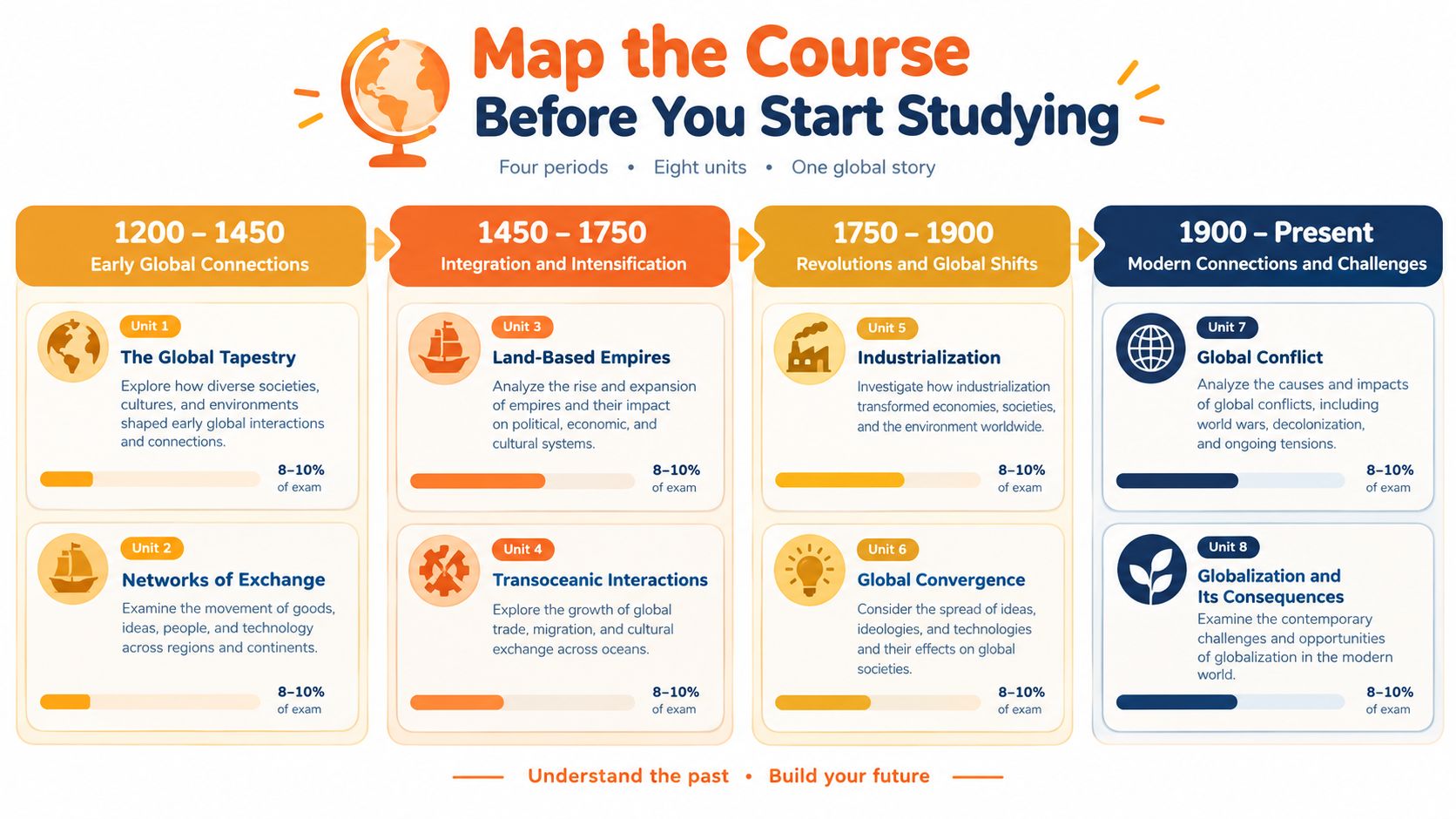
Start with the official AP World History course and exam description, then draw the course as four chronological blocks:
- 1200–1450: Global developments before sustained European maritime expansion
- 1450–1750: Maritime empires, exchange, and early modern state-building
- 1750–1900: Industrialization, imperialism, and large-scale political change
- 1900–present: Global conflict, decolonization, state systems, technology, and globalization
College Board organizes AP World History into nine units across those periods. Don't treat the units as isolated chapters. Treat them as connected evidence banks. A unit on trade can help you answer a later question about cultural exchange. A unit on industrialization can supply evidence for arguments about labor, empire, migration, or environmental change.
Build a weighted calendar
The exam's unit distribution should influence your study calendar. Current preparation guidance identifies Units 3–6 as carrying roughly 48–60% of the exam, so those units deserve deeper recall practice and more writing applications than a lower-weight unit, as explained in this AP World History 2026 guide.
That doesn't mean ignoring the other units. Lower-weight material can still provide powerful contextual evidence, comparison points, and examples for essays. The point is to avoid spending equal time on unequal priorities.
For a 12-week plan, assign each week a dominant focus:
- Weeks 1–2: Establish the full chronology and review the earliest units.
- Weeks 3–7: Give concentrated attention to the higher-weight middle units.
- Weeks 8–9: Connect units through themes such as trade, state-building, religion, technology, and environment.
- Weeks 10–12: Emphasize timed multiple-choice sets, DBQs, LEQs, and targeted repair of weak skills.
For each unit, write down three things: the essential developments, the themes it represents, and the historical thinking skills it supports. Then label the unit for either deep drilling, short retrieval review, or essay evidence practice.
Students looking for organized material can also use World History study resources as one place to keep course content connected to the broader subject.
Build Study Sets From Your Class Materials
Your class notes become useful when they force you to retrieve and apply information. Within a day of each lesson, close the notebook and turn the material into questions before you reread it. If you can't answer a question, reopen the notes, repair the gap, and test yourself again.
For each lecture, reading, or slide deck, create a compact set with three kinds of prompts:
- Identification prompts: What was the term, where did it occur, and what date band does it belong to?
- Causation prompts: What caused the development, and what changed as a result?
- Argument prompts: What defensible claim could this evidence support?
A weak card asks, “What was the Columbian Exchange?” A stronger card asks, “How did the Columbian Exchange transform societies in the Americas and Afro-Eurasia?” The second question prepares you to explain a process rather than recite a definition.
Turn evidence into essay material
For an argument card, write a prompt such as: “Develop an arguable claim about trade networks in an early modern unit.” Under it, add a thesis starter and two possible pieces of evidence. Your answer doesn't need to be a polished essay. It needs to show that you can move from a broad topic to a claim supported by specific history.
Primary sources need the same treatment. Add a few excerpts from each unit and make cards asking:
- Who created this source?
- What was the author trying to accomplish?
- Who was the intended audience?
- What perspective or limitation affects the source?
- How could this source support an argument?
The goal isn't to memorize every sentence. It's to practice seeing a document as evidence produced by a person in a particular setting.
Use a simple spacing pattern
Review a new Study Set twice during its first week, then revisit it at increasing intervals such as 2, 4, 7, and 14 days. The exact schedule matters less than returning to material after some forgetting has occurred. Rereading feels fluent because the page is familiar. Retrieval shows whether you can produce the idea without the page.
You can generate flashcards from notes as a starting point, but review every card for accuracy and usefulness. A generated card should reflect your class materials and curriculum, not replace your judgment about what your teacher emphasizes.
Practice the Exam Format Until Timing Feels Easy
AP World History requires two different kinds of stamina. The multiple-choice section tests fast reading, historical knowledge, and reasoning from sources. The free-response section asks you to sustain an argument while selecting evidence and managing limited time.
The exam includes 55 multiple-choice questions in 55 minutes. It also includes two free-response questions in 100 minutes, with each section weighted 40% of the total exam score, according to the AP World History exam overview. That makes pacing part of preparation, not a detail to consider at the end.
| Exam section | Questions/tasks | Time | Per-item time | Weekly practice habit |
|---|---|---|---|---|
| Multiple choice | 55 questions | 55 minutes | About 1 minute per question | Complete a short set, then review every miss |
| Free response | 1 DBQ and 1 LEQ | 100 minutes | Practice planning and writing within the official format | Alternate timed DBQ and LEQ drills |
Train accuracy before speed
Begin a new topic with untimed questions. Read the stimulus carefully, identify what the question is testing, and explain why each answer choice is right or wrong. Once your reasoning is accurate, add time pressure.
For a missed multiple-choice question, classify the error:
- Content gap: You didn't know the relevant development.
- Reading error: You missed a qualification or misread the stimulus.
- Reasoning error: You knew the content but chose evidence that didn't answer the question.
- Timing error: You rushed and failed to complete the reasoning.
This classification determines your next drill. A content gap calls for a focused Study Set. A reasoning error calls for more stimulus analysis. Rereading the entire unit won't fix every type of mistake.
Separate essay pacing from essay quality
Practice planning before writing. Spend enough time identifying the task, forming a position, and selecting evidence that your paragraphs have a clear purpose. Then write within the remaining time instead of allowing one paragraph to consume the entire response.
The official free-response course overview identifies one DBQ and one LEQ in the free-response section, and the DBQ uses seven documents presenting different perspectives on a historical development or process. Your practice should therefore include document selection, not just general essay writing.
Drill the Free-Response Skills That Move Scores
I've read many AP history essays that contain accurate facts but never turn those facts into an argument. The student knows the subject. The response still loses ground because it summarizes documents, lists examples, or explains background without answering the prompt directly.
Use a repeatable four-pass process for DBQs.
Pass one establishes context
Write two or three sentences that place the document set inside a broader historical situation. Context isn't a decorative opening. It should explain what developments were already taking place and why the prompt's issue mattered.
For a prompt about industrialization and environmental change, relevant context might include the expansion of fossil-fuel-powered production, urban growth, or the increased ability of states and companies to extract resources. Choose context that prepares the reader for your argument.
Pass two turns documents into evidence
For each document, identify its author, audience, purpose, and point of view. Then connect that feature to your claim.
“An official defended the policy” is description. “Because the official needed to justify the policy to a skeptical audience, the document presents the policy as necessary, which supports the argument that rulers used public explanations to strengthen authority” is analysis.
Practice sourcing with at least three documents, but don't force a sourcing comment into every paragraph. One well-explained connection is more useful than several labels with no relationship to the argument.
Pass three organizes the argument
Write a thesis that answers the prompt and previews your reasoning. A defensible thesis usually includes a position and categories of explanation, comparison, or change.
Then group documents by an actual idea. You might group them by whether they describe economic effects, political responses, or social consequences. The groups should help the reader follow your argument, not merely divide the documents into convenient piles.
Pass four selects precise evidence
Use specific content from the documents and add relevant outside evidence. Don't name a document without explaining what it proves. Don't add a memorized fact unless you can connect it to the paragraph's claim.
For LEQs, keep the same basic sequence without documents. Identify the task, establish context, write a thesis, select specific evidence, and explain the relationship between your examples and your argument. Rotate among comparison, causation, continuity and change, and turning-point prompts so you don't become comfortable with only one reasoning pattern.
Use a self-scoring checklist based on the rubric categories:
- Thesis: Does the response make a defensible claim?
- Contextualization: Does it explain a broader historical setting?
- Evidence: Does it use specific evidence to support the argument?
- Sourcing: Does it explain how source features affect the argument?
- Complex understanding: Does it show nuance, qualification, or a nuanced relationship?
- Grammar and clarity: Can a reader follow the reasoning?
The exact scoring language should come from the current rubric, so check the official College Board materials before relying on an older checklist. Then keep an error log. If your thesis works but your evidence is vague, your next practice should target evidence, not another complete reread of the course.
Set a Weekly Review Routine That Lasts
A workable routine fits around school, homework, activities, and ordinary tiredness. It should not depend on a heroic weekend marathon. Short sessions create repeated retrieval opportunities and show whether your weakness is missing content, weak evidence, or unclear reasoning. Since AP World rewards source analysis and historical argument, give regular practice time to those skills, not only to timeline review.
Use this weekly rhythm:
- Two 45-minute blocks: Rebuild current content with active-recall questions, then connect each topic to causes, effects, comparisons, or changes over time.
- One 20-minute block: Retrieve older material before opening your notes. Explain one connection between an earlier and current unit.
- End-of-day check: Test yourself on the five hardest ideas from the current unit.
- Weekend writing drill: Complete one timed DBQ or LEQ, then score the response with the current rubric.
If you miss a day, resume with the next planned block. Do not double the workload as punishment. A routine that survives interruptions gives you more useful practice than an impressive schedule you abandon.
Make review diagnostic
Mark a concept after you miss it twice, then identify the repair it needs. The gap may be a definition, a chronological connection, a cause-and-effect chain, or a specific example that can support an argument. Your next session should target that gap rather than repeat a broad reread.
Mix older material into weekly review. Pair a current unit with an earlier one and ask a comparison question, such as how states used belief systems to support authority in different periods. This keeps the course connected instead of placing each unit in a separate mental folder.
A short daily session can function as a Daily Boost. The label does not matter. The useful cycle is question, answer, feedback, and another attempt. For memory methods, consult this guide on how to memorize something fast, then adapt its ideas to AP history. Memorization should supply evidence for analysis, not replace analysis.
Review your routine regularly
At the end of each month, inspect your error log. Remove activities that consume time without showing what you know. Keep practices that expose weaknesses, especially timed sourcing, evidence selection, and thesis writing. If your thesis is defensible but your evidence stays vague, assign more evidence drills rather than rereading the entire course.
The College Board score distributions report that in 2025, 64.3% of test takers earned a 3 or higher, with a mean score of 3.16. In 2024, the 3-or-higher rate was 63.7%, and the mean was 3.11. Those results cannot predict your score, but they support a practical plan: spend consistent study time on the rubric-driven tasks that turn content knowledge into an argument.
Avoid Common Pitfalls and Finish Strong
The most common mistake is treating AP World History as a memorization sprint. Timelines and flashcards help, but they won't teach you to explain why a document's purpose matters or how evidence supports a thesis.
Watch for these traps:
- Memorization without application: Replace one rereading session with a short sourcing drill.
- A DBQ body without a clear thesis: Write the thesis before grouping documents.
- Ignoring evidence beyond the documents: Keep an outside-evidence bank organized by theme.
- Skipping timed practice: Complete a full timed practice before exam day so pacing problems appear early.
In the final week, use retrieval rather than broad rereading. Complete a cold review of weak units, write one timed DBQ, write one timed LEQ, and revisit the argument stems you repeatedly misuse. Keep the focus narrow enough that you can evaluate the result.
College Board lists Thursday, May 6, 2027, Session 1 as the next AP World History: Modern exam date in its public schedule, so students preparing for that administration should build backward from that date using the current exam framework.
Choose one class unit this week. Convert it into identification, causation, argument, and sourcing prompts, then pair the set with one past-style question. That small cycle will tell you more about your readiness than another evening spent highlighting notes.
Knobee AI can turn your notes, slides, and textbook excerpts into Study Sets with flashcards and quizzes, while Kno guides review through questions and explanations rather than supplying finished answers. Visit Knobee AI to turn one AP World History unit into focused retrieval practice and begin building a study routine you can evaluate.