AP World History Unit 2 Review: A Study Guide
Get a clear AP World History Unit 2 review with timelines, key themes, practice prompts, and study strategies to help you prepare for the exam.
Topics: ap world history, unit 2, study guide, networks of exchange, ap exam prep
You're two weeks from the AP World History exam, and your Unit 2 notes feel like a jumble of trade routes, technologies, and rulers. Start with one idea: these weren't three isolated roads. They were connected networks that moved goods, people, beliefs, and disease, and understanding how those connections worked is more useful than memorizing a list.
This AP World History Unit 2 review will help you build that picture step by step. You'll compare the Silk Roads, Indian Ocean routes, and trans-Saharan trade, then examine how Mongol rule changed travel and communication. You'll also practice tracing connections across networks and writing answers that explain causes and consequences. If you're reviewing earlier course content too, this guide to the AP World History Unit 1 test can help you revisit the context that came before.
Table of Contents
- What to Expect in This AP World History Unit 2 Review
- The Big Picture of Networks of Exchange
- Comparing the Three Major Trade Networks
- The Mongol Empire Beyond Conquest
- Tracing Connections Across the Networks
- Common Misconceptions That Cost Points
- Practice Prompts in the Real AP Style
- Your 10-Day Study Plan and Next Steps
What to Expect in This AP World History Unit 2 Review
Unit 2 is about networks of exchange: the routes, technologies, commercial practices, and political conditions that helped distant societies interact. To make the topic manageable, keep asking three questions: What moved? What made the movement possible? What changed because of it?
You'll begin with the big picture and then compare the networks by their environments, transportation, goods, and political support. That comparison matters because an AP answer needs to explain why networks differed, not just name them. A ship using seasonal winds faced different conditions from a camel caravan crossing a desert.
Then you'll look at the Mongol Empire as both a force of conquest and a system that supported movement across parts of Eurasia. You'll also trace a good, a religion, and a disease through connected routes. The point isn't to claim that every item traveled along every route in the same way. It's to see how distinct networks could connect through merchants, ports, cities, and empires.
Finally, you'll use practice prompts and a short study schedule to turn knowledge into explanations. Read once to understand the system, then return to the comparisons and prompts to test what you can recall without looking at your notes.
The Big Picture of Networks of Exchange
A merchant leaving Central Asia around 1300 might sell silk at one caravanserai, buy porcelain at the next, and never learn that his goods kept traveling long after he turned back. The routes did the connecting for him. AP World History Unit 2, officially titled “Networks of Exchange,” covers approximately 1200–1450 and accounts for 8–10% of the AP World History: Modern exam, according to the College Board course framework.
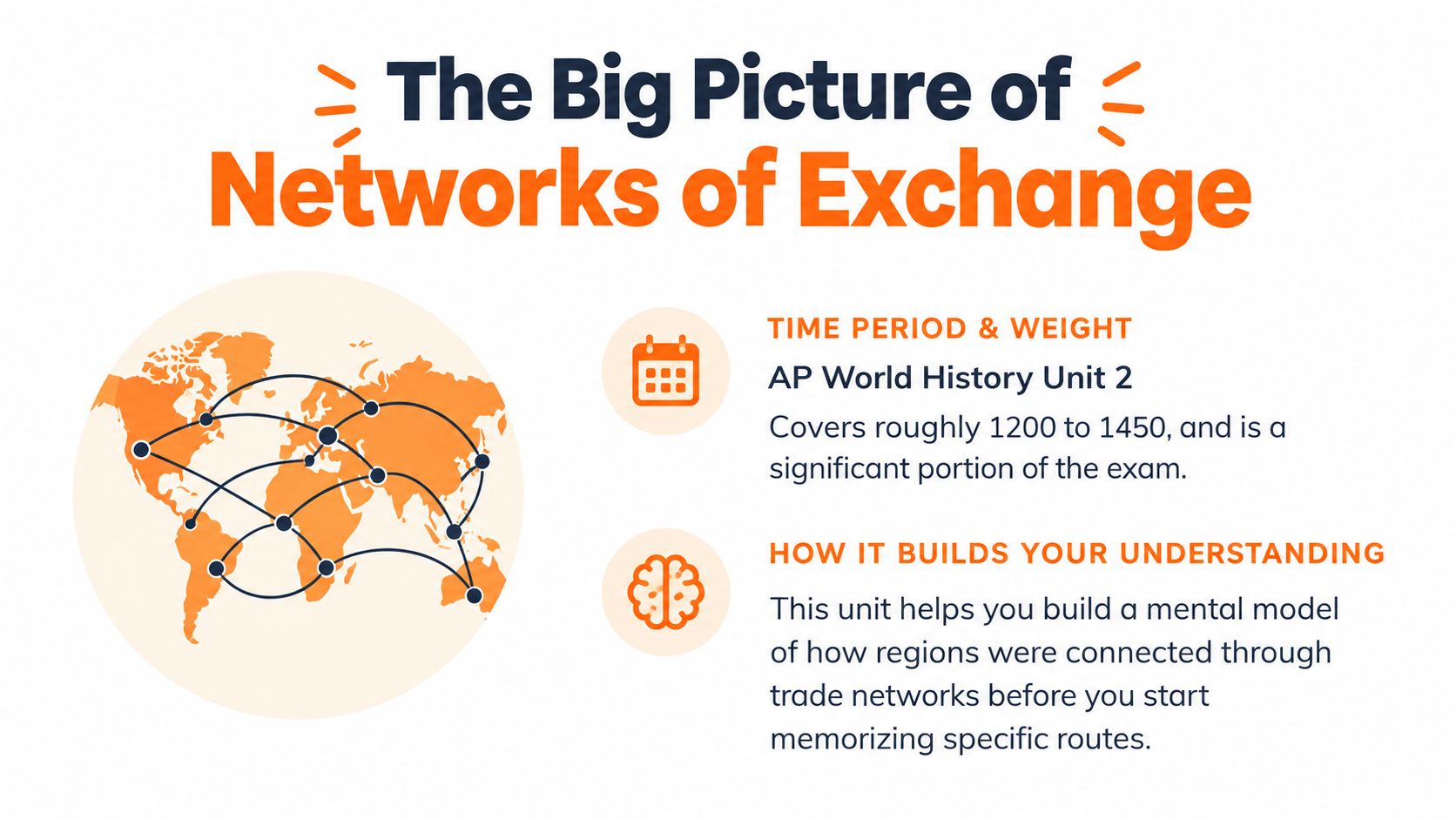
The required topics stretch further than students often expect: the Silk Roads, the Mongol Empire, Indian Ocean exchange, trans-Saharan trade, the cultural and environmental consequences of connectivity, and a comparison of economic exchange. Read that list closely. Trade is the engine, and the exam grades you on what the engine set in motion.
A useful mental model
Each network works like a different kind of road system. Geography sets the challenge. Technology, commercial practice, and political power decide who can travel, how often, and how safely. A desert crossing rewards the camel caravan, while a sea ruled by seasonal winds rewards a different vessel entirely.
Students often miss the next step. A road that carries silk also carries everything else travelers bring: faiths, languages, technologies, and diseases. A modern highway moves commuters to work, and it also moves a flu virus from one school district to the next. The exchange networks of 1200–1450 behaved the same way, which is why historians treat the period as one connected system rather than three separate routes.
| Item | Detail |
|---|---|
| Unit name | Networks of Exchange |
| Timeframe | Approximately 1200–1450 |
| Exam weight | A small share of the AP World History: Modern exam |
| Core networks | Silk Roads, Indian Ocean, trans-Saharan trade |
| Main analytical focus | How exchange created both integration and disruption |
The College Board course-at-a-glance outline lists every required topic, so keep it as a checklist. Study the topics as one system. When you trace a single commodity, a single religion, and a single disease across all three networks, you build the comparison and causation reasoning the exam rewards.
Comparing the Three Major Trade Networks
To compare trade networks, use the same four lenses each time: environment, technology, goods, and political support. This keeps your answer focused on explanation instead of a loose list of facts.
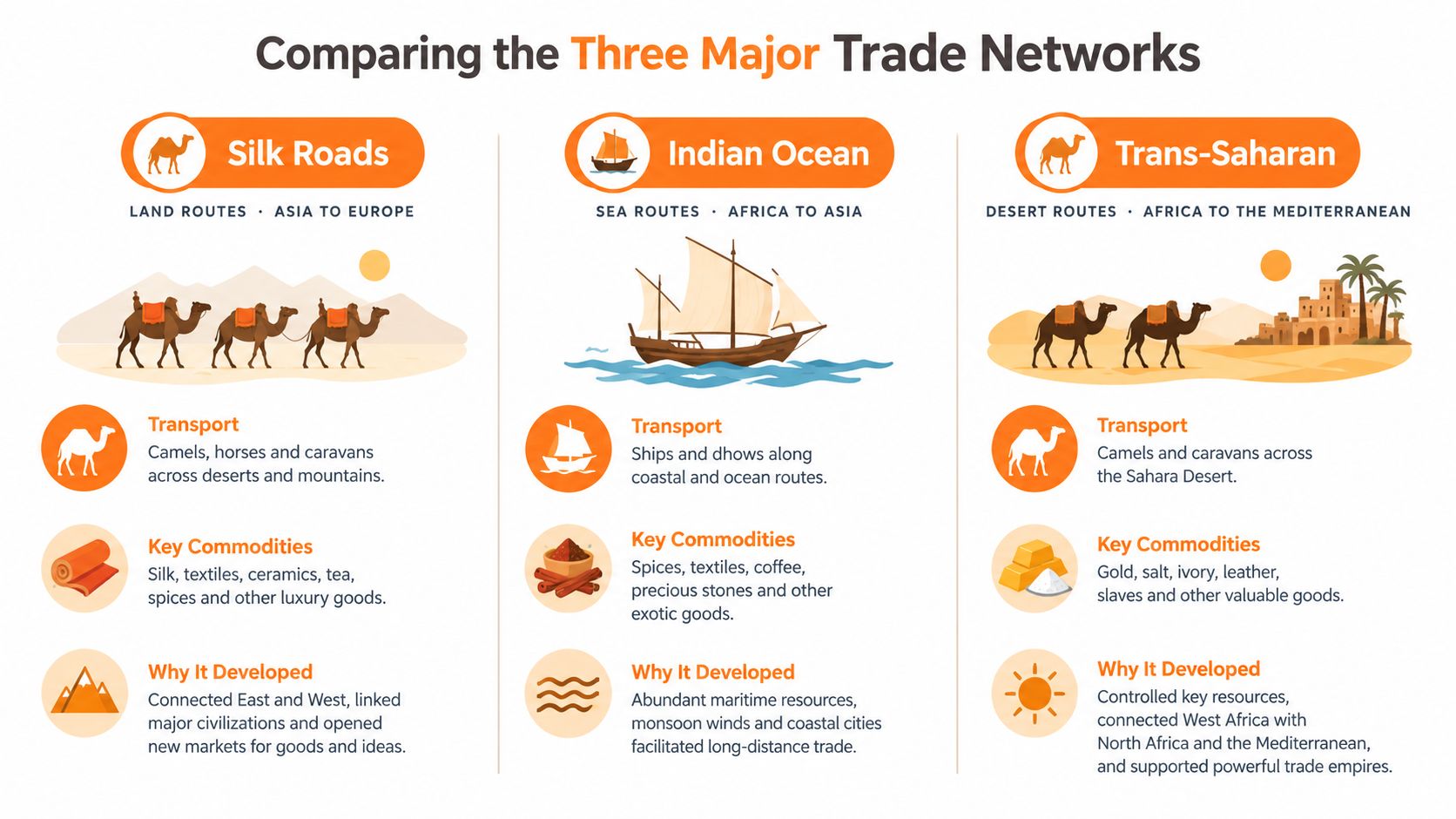
| Network | Environment | Key technology | Typical goods | Political support |
|---|---|---|---|---|
| Silk Roads | Long overland journeys across Central Asia | Camel caravans and caravanserai | Portable goods such as silk, porcelain, paper, and spices | State protection and facilities that supported merchants |
| Indian Ocean | Seas shaped by seasonal monsoon winds | Lateen-rigged vessels and navigational knowledge | Spices and other goods, including bulky cargo moved by ship | Port communities and states that supported maritime commerce |
| Trans-Saharan | Desert travel across the Sahara | Camel caravans | Gold moving north and salt moving south | Rulers and commercial centers along the routes |
The Silk Roads connected China, Central Asia, the Middle East, and Europe. Their overland conditions made caravanserai useful: these roadside facilities gave merchants places to rest and resupply. Long-distance trade depended on more than the goods themselves. Merchants needed routes they could travel and political conditions that reduced the risks of the journey.
The Indian Ocean network linked East Africa, Arabia, India, Southeast Asia, and China. Sailors used predictable monsoon winds to plan travel between ports. Because ships could carry large loads, maritime exchange could move bulky goods that would be less practical for a long caravan journey. But the seasonal wind pattern also shaped when and where ships could sail.
Across the Sahara, camel caravans carried gold northward from West Africa and salt south toward the Sahel and forest regions. The camel made desert crossings possible, while the traded goods helped connect West African communities to North African markets.
Comparison rule: Don't stop at “one used ships, one used camels.” Explain how the environment shaped the technology, and how that technology influenced what merchants could move.
A strong comparison uses a shared question for each network: What problem did geography create, and what practice helped people manage it? That answer gives you a cause-and-effect explanation, not just a route description.
The Mongol Empire Beyond Conquest
The Mongols expanded exchange through specific systems, but those systems grew out of conquest. Genghis Khan, first known as Temüjin, united Mongol and Turkic tribes and was recognized as khan in 1206. During the thirteenth century, Mongol conquests created the largest contiguous land empire in recorded history. At its greatest extent, in the late thirteenth century, the empire covered approximately 9 million square miles, stretching from the Pacific Ocean to the Danube River. Encyclopaedia Britannica's account of the Mongol Empire describes its reach and the devastating warfare that accompanied expansion.
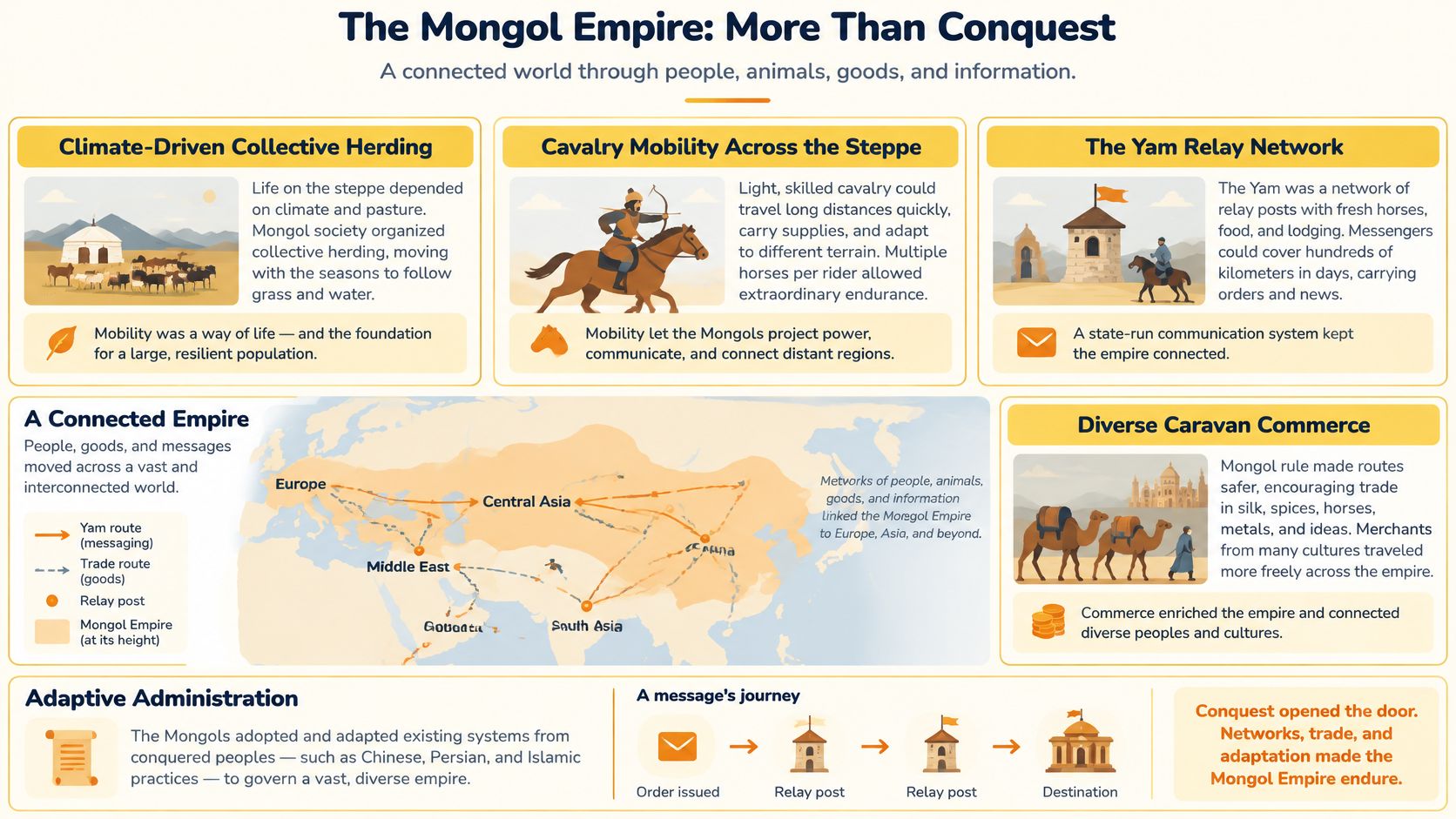
Military strength helped create political connections, but administration helped maintain them. Mongol cavalry tactics and Genghis Khan's reorganization of Mongol society supported conquest. Afterward, the yam, a postal or relay system, improved communication. Caravanserai offered merchants places to rest and resupply along routes.
Mongol rulers also used trade practices such as paper money in some areas and generally allowed different religious traditions to continue. These policies could make travel and exchange easier across parts of the empire. Yet “easier” didn't mean peaceful for everyone. Conquest brought destruction, coercion, and tribute, even as imperial connections supported commerce and communication.
A useful cause-and-effect chain is:
- Conquest brought large territories under Mongol rule.
- Political connections and communication systems supported movement across those territories.
- More movement helped merchants, technologies, and ideas travel between regions.
- Greater connectivity also exposed societies to harm, including the spread of disease.
For an explanation of Mongol policies, don't call the empire only a destroyer or only a promoter of trade. Name the mechanism, then acknowledge the uneven costs.
The following video offers another way to visualize Mongol rule and exchange.
Tracing Connections Across the Networks
A student who memorizes three route maps in three separate colors often writes three separate essays. The stronger move is to treat 1200–1450 as one connected system and trace a single thread through every network. Cities, ports, and overland crossings tied the routes together, so a good, a belief, or a pathogen could pass from one network into the next.
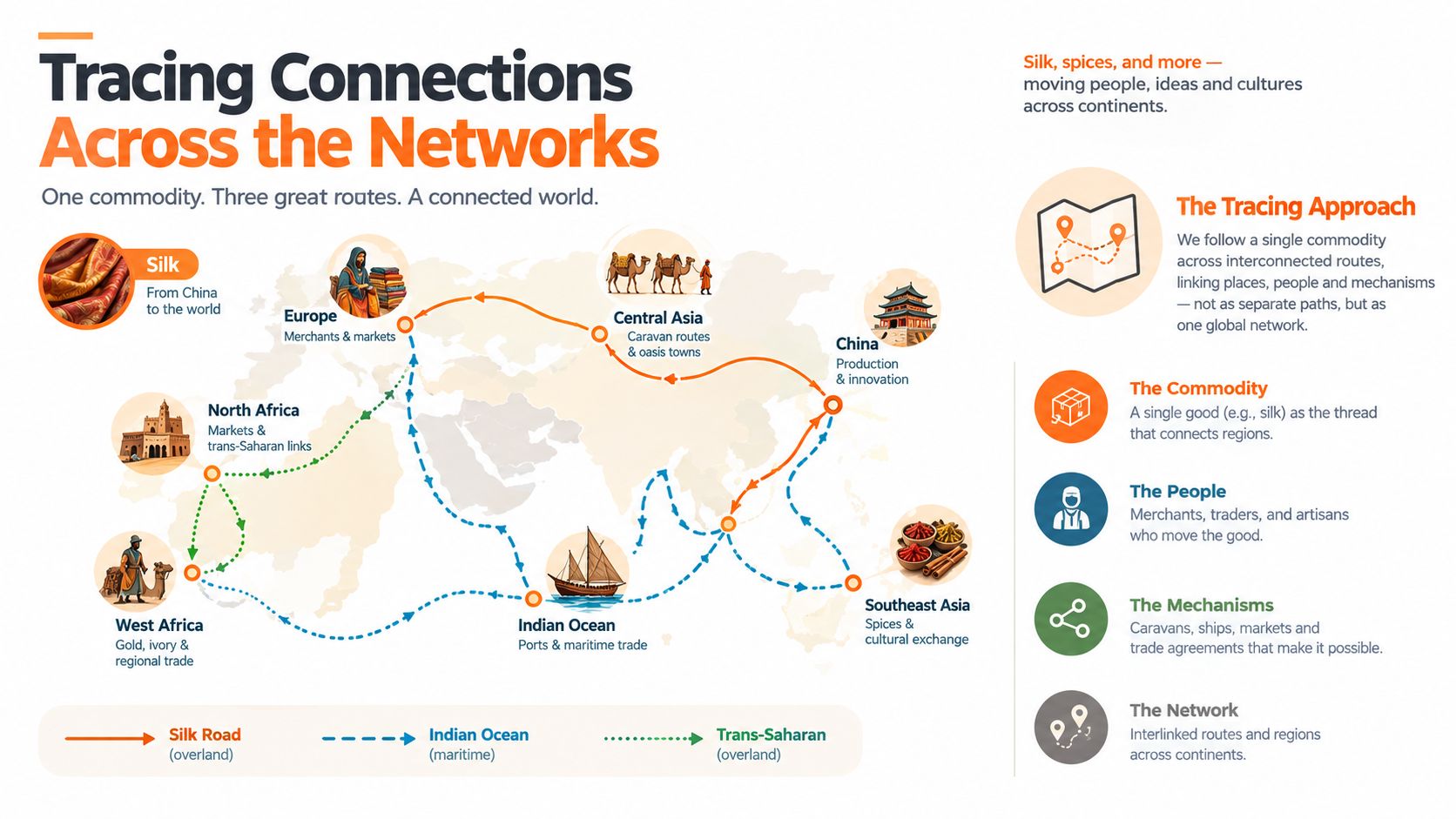
Follow a good
Silk and porcelain moved along overland routes across Central Asia. Indian Ocean ports linked coastal merchants across East Africa, Arabia, India, Southeast Asia, and China, while trans-Saharan caravans carried gold and salt between West Africa and regions to the north. These weren't identical journeys, and no single commodity had to ride every route. What matters for the exam is that routes linked regional markets into wider patterns of exchange, so a product made in one region could shape demand somewhere it had never been produced.
Follow a religion
Islam offers a clean example. It spread through merchants and political rulers along commercial routes in North and West Africa, South Asia, and Southeast Asia, reaching each society through local interactions rather than one identical process everywhere. When you write about religious diffusion, name a route or region and explain who carried it: a merchant community settling in a port city, a ruler adopting the faith.
Follow a disease
The same movement that carried goods and beliefs could transmit pathogens. Mongol rule made travel and communication more secure across parts of Eurasia, and that mobility gave disease a pathway, which is why the Black Death traveled along the same routes that made commerce thrive. As noted earlier, the course framework treats both cultural and environmental consequences as part of connectivity, so your essays should weigh benefits against costs instead of calling exchange purely positive.
Essay move: Connect the chain. A network enabled movement; movement carried more than goods; effects differed from one society to the next.
That tracing habit is also how you earn comparison and causation points. For each example, ask what moved, how it traveled, and what changed afterward. Then ask the question most students skip: did the same force produce the same result everywhere? Three networks, one system, different outcomes depending on where a society stood. That is an argument, not a list.
Common Misconceptions That Cost Points
Misconception: The Mongols only destroyed. Conquest and warfare caused devastation, but Mongol systems also supported communication and trade across parts of Eurasia. A more complete answer explains both effects and identifies who experienced each one.
Misconception: The Mongols peacefully connected everyone. That version leaves out violence, coercion, tribute, and the unequal effects of imperial rule. Political integration could help merchants travel while imposing serious costs on conquered populations.
Misconception: Indian Ocean trade was one unified, year-round system. The network linked many regions, but sailors relied on predictable monsoon winds. Those seasonal patterns shaped travel timing and the routes people could use.
Misconception: Unit 2 is just about trade. The College Board's topics include cultural and environmental consequences, as well as comparison of economic exchange. Religious diffusion and disease transmission show why “more exchange” could bring opportunity and vulnerability at the same time.
Misconception: Naming a technology proves causation. Saying that ships used monsoon winds isn't yet an explanation. Show how knowledge of those winds helped sailors plan journeys between ports, then connect that movement to wider exchange.
If a sentence in your notes says “trade increased,” add the missing reasoning. What enabled it? Which regions did it connect? What consequences followed, and were they the same for everyone?
Practice Prompts in the Real AP Style
Use these prompts to practice explaining evidence, not just recognizing vocabulary. For each response, make a clear claim, add a specific example, and explain how the example supports your reasoning. If you're new to retrieval practice, this guide to active recall learning explains how to test what you can bring to mind without rereading first.
- Short answer: Explain one way Mongol policies or institutions affected exchange across Eurasia. Then explain one way Mongol rule could disrupt societies.
- Comparison: Compare the Silk Roads and Indian Ocean network by explaining one difference in their environmental conditions and one effect of that difference on trade.
- Causation: Explain how expanding commercial networks could lead to both cultural diffusion and environmental or demographic consequences.
Check your response
- Claim: Did you answer the question directly?
- Evidence: Did you name a relevant system, practice, region, or example?
- Reasoning: Did you explain how the evidence supports your claim?
- Nuance: For prompts about consequences, did you recognize that exchange could help some people while harming others?
For the comparison prompt, don't write three facts about each network and stop. State the difference, then explain why it mattered. For the causation prompt, show the link between movement and outcome rather than treating them as unrelated events.
Your 10-Day Study Plan and Next Steps
Use short retrieval sessions instead of rereading the same notes. Cover your page, recall what you can, then check what you missed.
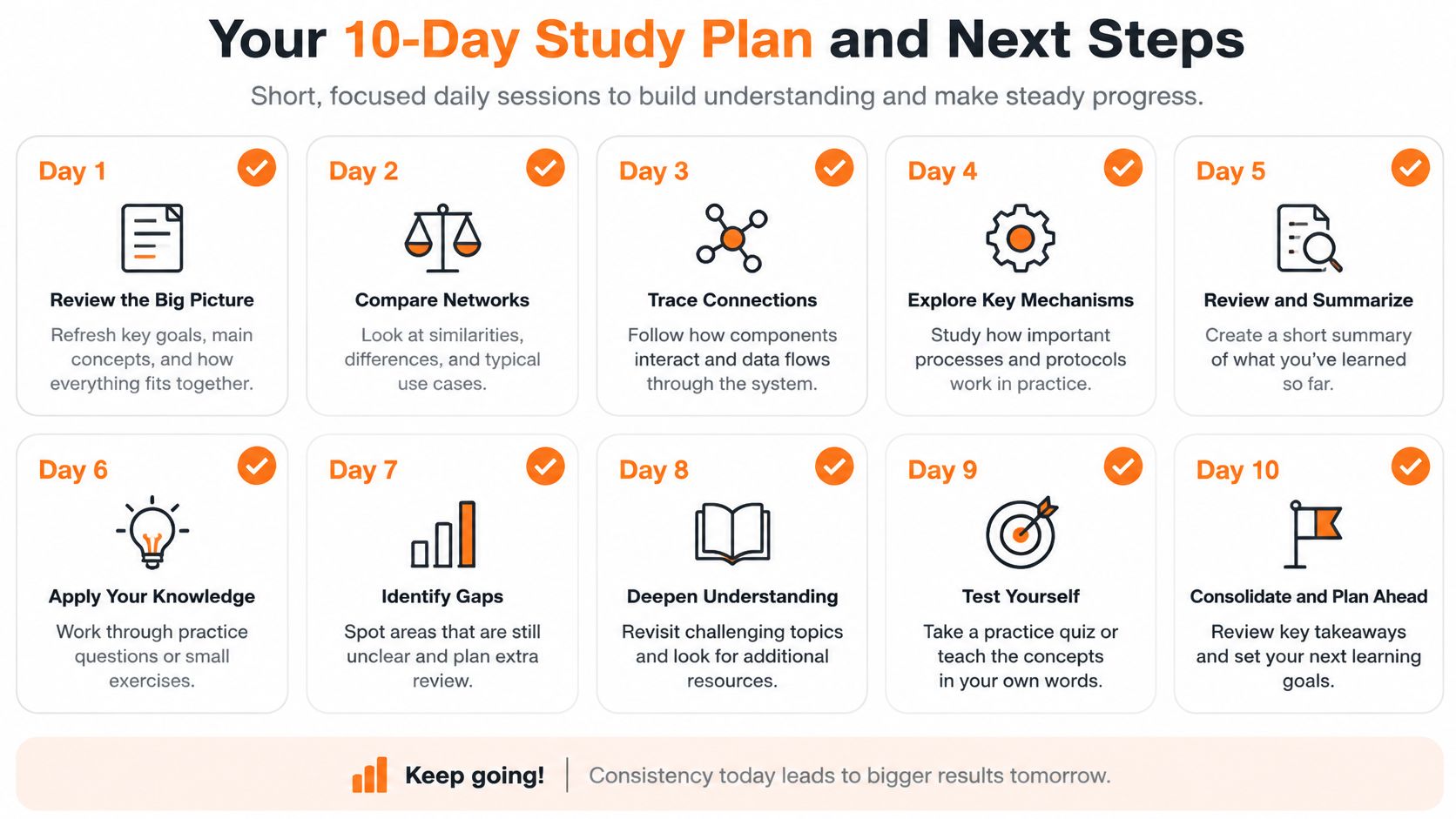
- Day 1: Sketch the unit's big picture and timeline.
- Day 2: Compare the three trade networks.
- Day 3: Recall Mongol mechanisms and policies.
- Day 4: Explain conquest, integration, and disruption.
- Day 5: Review cultural consequences.
- Day 6: Review environmental and demographic consequences.
- Day 7: Trace a good, religion, and disease across the networks.
- Day 8: Answer a short-answer prompt without notes.
- Day 9: Write a comparison response and check your reasoning.
- Day 10: Complete a self-check, then revisit weak points.
Today, choose one prompt and answer it from memory before checking your class notes. If you want a broader routine for the course, use this AP World History study guide to plan your next review session.
Knobee offers Study Sets that turn your notes or a unit topic into flashcards and multiple-choice quizzes, while Kno guides you with questions and hints grounded in your study material. Try a Unit 2 set on the three networks, then use the questions to find what you still need to review with your teacher or class notes. Visit Knobee AI to explore the study tools.