Unit 1 Physics: Core Concepts and Sample Problems
Learn Unit 1 physics step by step: units, scalars and vectors, motion equations, worked sample problems and study cards that help you remember.
Topics: unit 1 physics, physics study guide, scalars and vectors, kinematics basics, physics flashcards
You're looking at a new physics unit, and the topic list already feels like a pile of unfamiliar symbols. Unit 1 physics becomes easier when you treat it as a few dependable habits: write the units, keep track of direction, and check what your answer means before you move on.
Table of Contents
- What Unit 1 physics covers and where to start
- Units, prefixes and scientific notation made simple
- Scalars and vectors where direction matters
- Distance, displacement, speed and acceleration
- How to solve sample problems step by step
- Common mistakes in Unit 1 and how to fix them
- Build your Unit 1 study plan this week
What Unit 1 physics covers and where to start
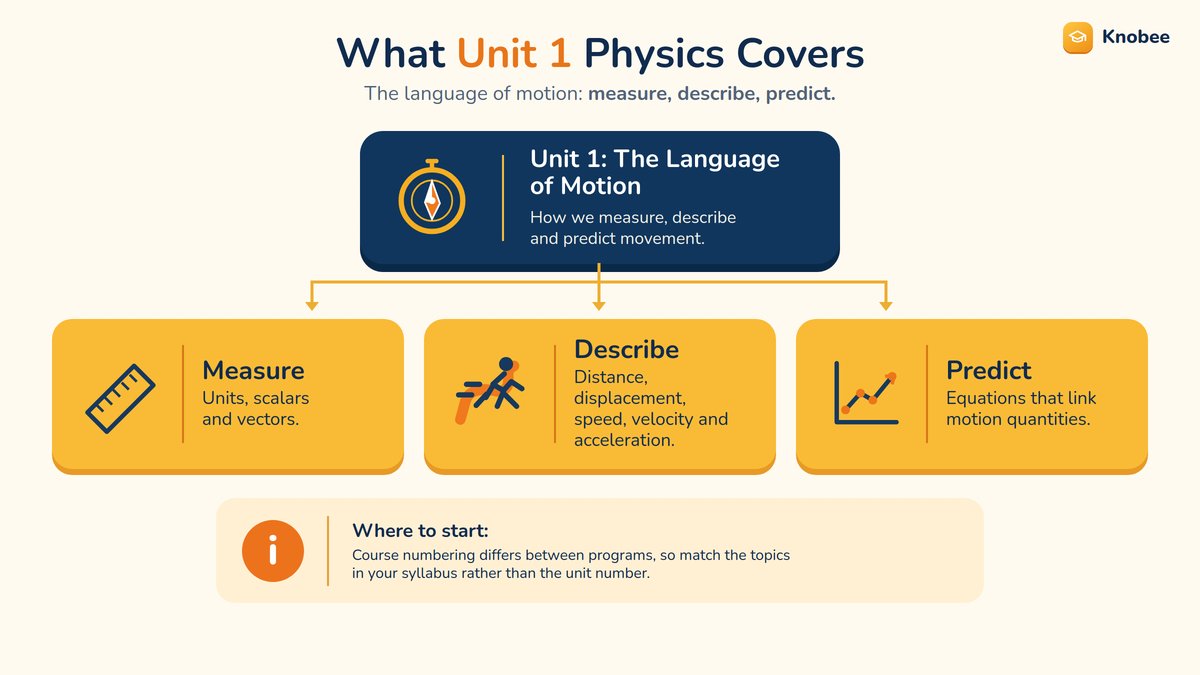
In most introductory courses, Unit 1 covers the language of motion: how you measure, describe, and predict movement. You don't need to memorize every equation before you begin. You need to understand what each quantity tells you.
Course numbering differs between programs. AP Physics 1 starts with kinematics, the description of motion, while many general high school courses begin with measurement and units. Check your syllabus and your teacher's topic list rather than relying on the unit number alone.
- Measurement and units: Every measurement needs a unit and a sensible size. How would you convert 4.5 km to meters?
- Scalars and vectors: Some quantities describe size alone; others also need direction. Is 20 m/s north a scalar or a vector?
- Distance and displacement: The route you travel isn't always the same as your change in position. If you walk 3 m east, then 5 m west, what are both quantities?
- Speed and velocity: Covering ground and changing position are related but different. What's the average speed of a runner who covers 400 m in 80 s?
- Acceleration: Velocity can change in size, direction, or both. What's a car's acceleration if it goes from rest to 20 m/s in 5 s?
- Kinematic equations: Equations connect displacement, velocity, acceleration, and time. Can you find a car's stopping distance from a braking acceleration of 2 m/s² alone? No. You also need its initial speed.
Use this topic map to match your class materials to the main ideas.
Start with your course materials
Put your syllabus beside a recent worksheet. Identify which topics your teacher expects you to use now, then choose matching practice from your textbook or physics study resources.
These ideas build on one another. Units make measurements meaningful, direction makes motion descriptions complete, and equations help you predict what happens next. Your starting goals are practical: convert units, label vectors, choose a suitable motion equation, and check whether an answer is reasonable.
Units, prefixes and scientific notation made simple
Adding 5 dollars to 5 euros doesn't give you a useful total until you convert to a common currency. Measurements work similarly: you can't add meters and kilometers as though their numerical values use the same scale.
The SI system provides standard units. For introductory motion problems, start with the meter for length, kilogram for mass, and second for time. Derived units combine these base units: meters per second describes velocity, while meters per second squared describes acceleration.
Read the prefix before calculating
A prefix changes the size of a unit, not the kind of quantity you're measuring. In the table, each example shows how a prefixed unit relates to the unprefixed unit.
Common prefixes in Unit 1
| Prefix | Symbol | Power of ten |
|---|---|---|
| mega | M | (10^{6}), so (1\ \text{Mm}=1{,}000{,}000\ \text{m}) |
| kilo | k | (10^{3}), so (1\ \text{km}=1{,}000\ \text{m}) |
| centi | c | (10^{-2}), so (1\ \text{cm}=0.01\ \text{m}) |
| milli | m | (10^{-3}), so (1\ \text{mm}=0.001\ \text{m}) |
| micro | µ | (10^{-6}), so (1\ \text{µm}=0.000001\ \text{m}) |
Symbols are case-sensitive. The prefix M means mega, while the prefix m means milli; an m written by itself as a unit means meter.
To convert a measurement, multiply by a ratio equal to one. Arrange that ratio so the unwanted unit cancels:
Kilometers to meters:
[
4.5\ \text{km}\times\frac{1000\ \text{m}}{1\ \text{km}}
=4500\ \text{m}
]
You need more small units to describe the same length, so the number increases.Millimeters to meters:
[
250\ \text{mm}\times\frac{1\ \text{m}}{1000\ \text{mm}}
=0.25\ \text{m}
]
You need fewer large units, so the number decreases.
Make large and small numbers readable
Scientific notation writes a number as a value multiplied by a power of ten. For example, (3200\ \text{m}=3.2\times10^{3}\ \text{m}), while (0.0005\ \text{s}=5\times10^{-4}\ \text{s}).
A negative exponent doesn't mean a negative measurement. It means the power of ten is a fraction.
Size check: Before accepting a conversion, ask whether the numerical value should grow or shrink.
Try converting (72\ \text{km/h}) to meters per second:
[
72\ \frac{\text{km}}{\text{h}}
\times\frac{1000\ \text{m}}{1\ \text{km}}
\times\frac{1\ \text{h}}{3600\ \text{s}}
=20\ \text{m/s}
]
That's more plausible for a car on a highway than an ordinary bicycle ride on a flat road. It means covering 20 meters every second, which gives you a concrete way to judge the result without treating it as a legal speed limit.
Scalars and vectors where direction matters
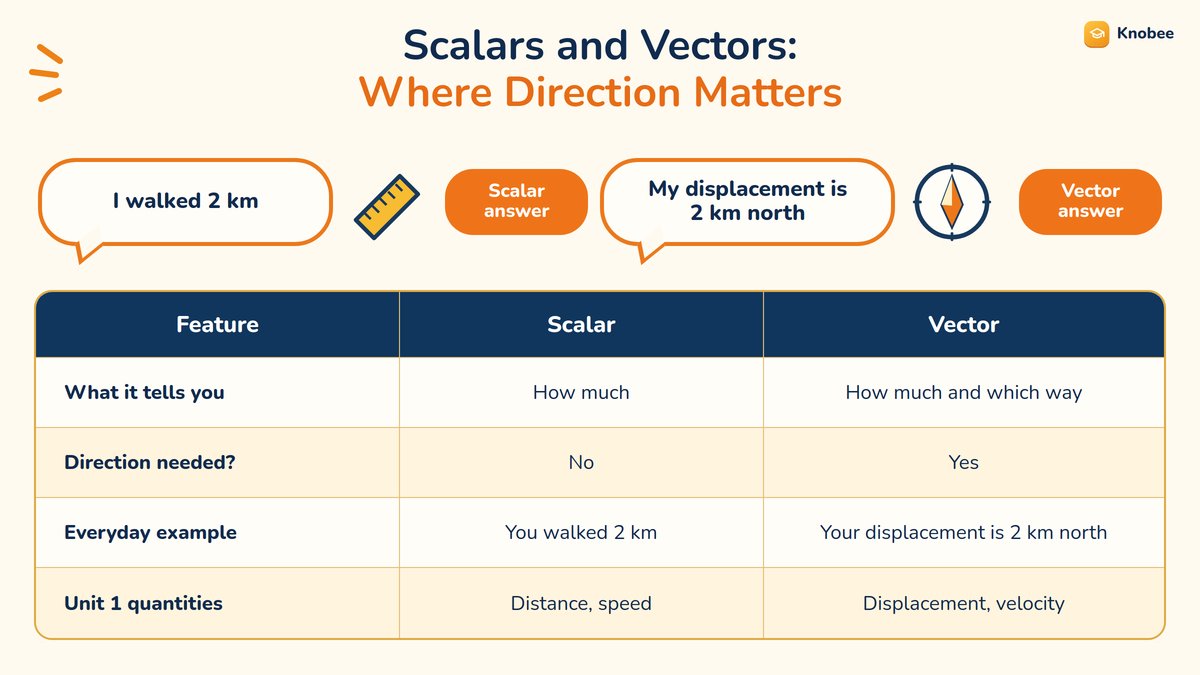
Saying you walked 2 km gives a scalar description of your journey's distance. Saying your position changed by 2 km north gives a vector description. The extra information isn't decoration: it changes how you calculate.
A scalar has magnitude, meaning size. A vector has magnitude and direction.
Scalars versus vectors
| Feature | Scalar | Vector |
|---|---|---|
| What it tells you | Size only | Size and direction |
| Examples | Distance, speed, mass, time | Displacement, velocity, acceleration, force |
| Typical notation | Plain letter, such as (d) or (v) for speed | Arrow or bold, such as (\vec{v}) |
| How it adds | Ordinary arithmetic for scalar amounts | Direction matters, so opposite directions subtract |
| Worked example | 2 km walked describes distance | 5 m east + 3 m west = 2 m east displacement |
The comparison below highlights the information each description includes.
Choose a direction before adding
Suppose you walk 5 m east, then 3 m west. Choose east as positive before writing the calculation, so the first displacement is positive and the second is negative.
[
\Delta x=(+5\ \text{m})+(-3\ \text{m})=+2\ \text{m}
]
The answer is 2 m east. You haven't subtracted because west is negative by nature; you've subtracted because west is opposite to your chosen positive direction.
You could choose west as positive instead. Your numerical result would then be negative, but the physical answer would still point east. Changing the coordinate convention must not change the actual motion.
Match the description to the question
Speed is the magnitude of velocity at a particular instant. A vehicle moving at 20 m/s north has a speed of 20 m/s and a velocity of 20 m/s north.
Be careful with averages, though. Average speed uses the total path length, so it isn't generally the magnitude of average velocity.
- For straight-line problems: Use a signed number along a clearly labeled axis.
- For changing directions: Draw arrows before writing arithmetic.
- For right-angle vectors: Follow your course sequence. Many introductory courses introduce component methods later.
A useful quick test is to ask whether a complete answer needs a direction. If it does, you're dealing with a vector quantity. A negative sign alone doesn't prove something is a vector, since some scalar quantities can also be negative.
Distance, displacement, speed and acceleration
Suppose a runner completes one 400 m lap in 80 s and finishes at the starting line. The runner has traveled a substantial distance, but their final position is exactly where it began.
The track diagram helps you separate the route traveled from the change in position.
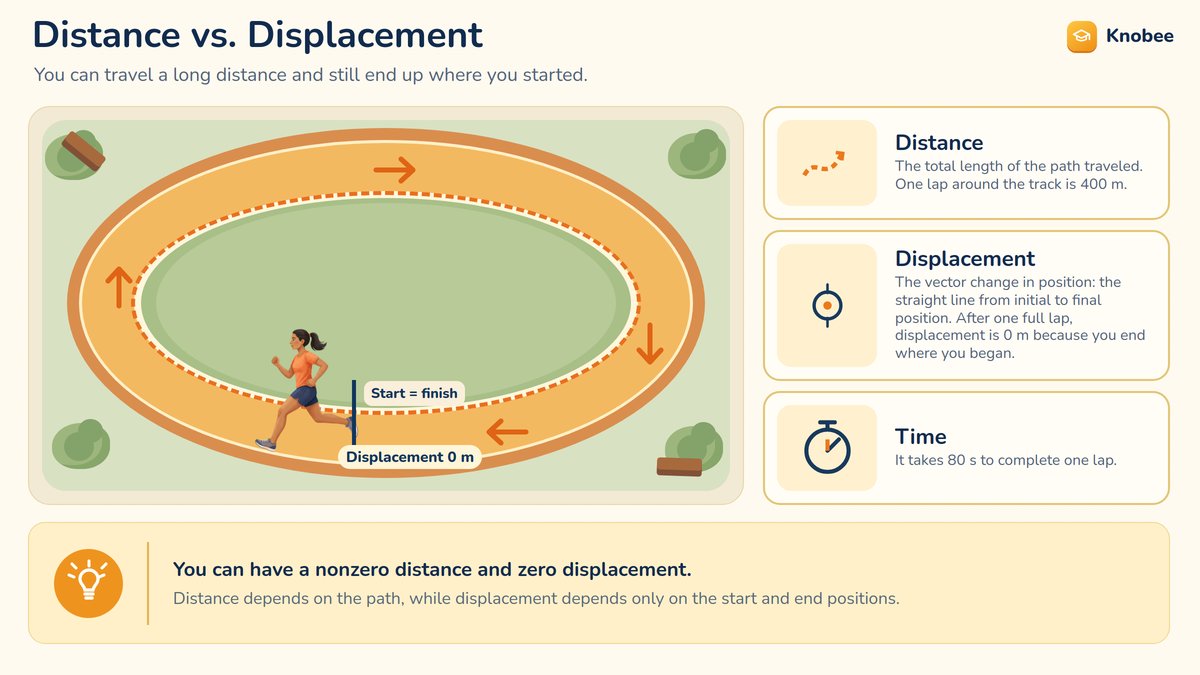
For an accessible sketch, label the starting point A and the endpoint B. Trace the curved running path, then draw the straight-line displacement arrow from A to B; for a complete lap, A and B coincide, so that arrow has zero length.
Suggested descriptive alt text for that sketch is: “Runner follows a curved track from start A to end B; the straight-line displacement connects A to B, and is zero when both points coincide.”
Separate the quantities before dividing
The runner's distance is 400 m, and their displacement is 0 m. Dividing each by the same elapsed time gives different answers because the numerators describe different things.
[
\text{Average speed}=\frac{400\ \text{m}}{80\ \text{s}}
=5\ \text{m/s}
]
[
\text{Average velocity}=\frac{0\ \text{m}}{80\ \text{s}}
=0\ \text{m/s}
]
| Quantity | Common symbol | SI unit | What it describes |
|---|---|---|---|
| Distance | (d) | (\text{m}) | Total path length, a scalar |
| Displacement | (\Delta x) | (\text{m}) | Change in position, a vector |
| Speed | (v) | (\text{m/s}) | Rate of covering distance, a scalar |
| Velocity | (\vec{v}), or signed (v) in one dimension | (\text{m/s}) | Rate of position change, a vector |
| Acceleration | (\vec{a}), or signed (a) in one dimension | (\text{m/s}^{2}) | Rate of velocity change, a vector |
| Time interval | (\Delta t) | (\text{s}) | Elapsed time, a scalar |
The symbol (\Delta), pronounced “delta,” means change. For position, (\Delta x=x_{\text{final}}-x_{\text{initial}}); it doesn't mean the total route traveled.
Understand what acceleration changes
Average acceleration is the change in velocity divided by the elapsed time:
[
a=\frac{\Delta v}{\Delta t}
]
Suppose a car moving in the positive direction goes from 0 to 20 m/s in 5 s. Its average acceleration is:
[
a=\frac{20\ \text{m/s}-0\ \text{m/s}}{5\ \text{s}}
=4\ \text{m/s}^{2}
]
The unit means that velocity changes by 4 m/s each second if this acceleration stays constant. Acceleration can also describe a change in direction, which is why a runner rounding a bend can accelerate without changing speed.
Negative acceleration points along the negative axis; it doesn't automatically mean slowing down. An object slows when its velocity and acceleration point in opposite directions, and speeds up when they point in the same direction.
For another visual explanation, use this motion explanation video alongside your track sketch.
Returning to your starting point can make average velocity zero without making average speed zero.
How to solve sample problems step by step
A physics problem is easier to organize when you decide what the symbols mean before using a calculator. Your setup should make the equation choice understandable, not look like a guess.
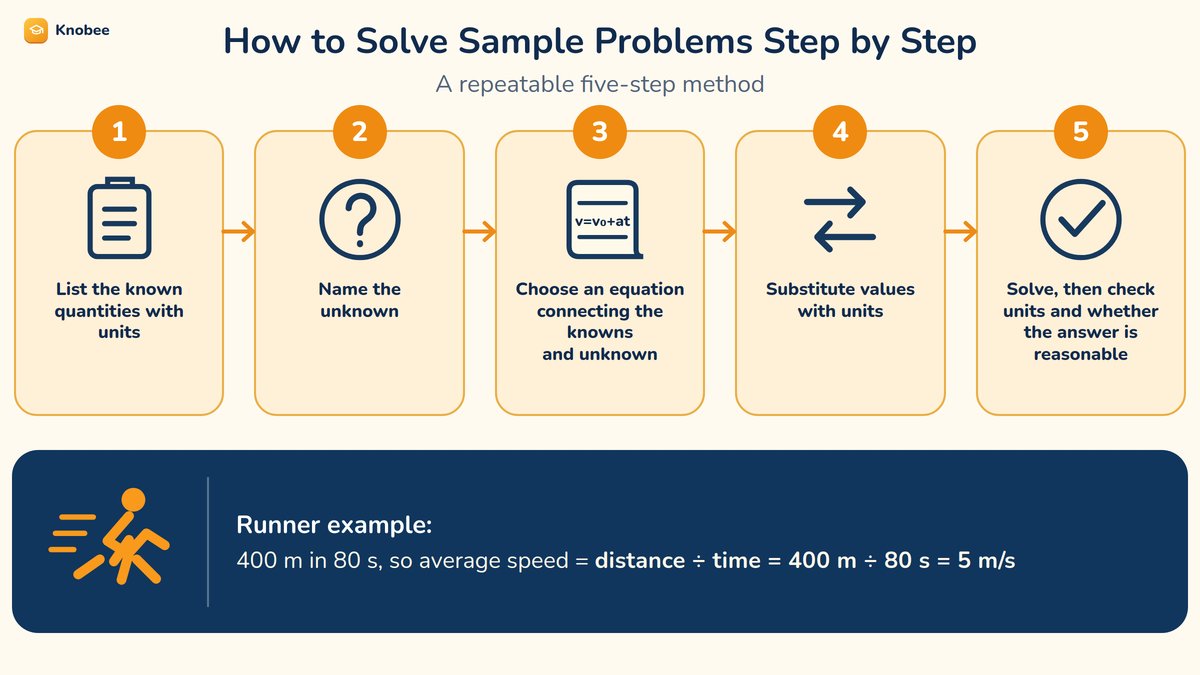
Use this five-step routine:
- List the known quantities with units. Include a positive direction so signed values have meaning.
- Name the unknown. Write the quantity you're finding, not just a question mark.
- Choose an equation that connects the knowns and unknown. Avoid introducing an additional unknown you can't determine.
- Substitute values with units and solve. Keep the algebra visible so you can trace your reasoning.
- Check the sign, size, and units. Translate the result back into the physical situation.
Keep this visual beside your practice sheet until the sequence feels familiar.
Choose equations by their variables
These equations apply to motion with constant acceleration. Here, (v_0) is initial velocity, (v) is final velocity, and (t) is elapsed time.
Kinematic equations and when to use them
| Equation | Variables linked | Use it when |
|---|---|---|
| (v=v_0+at) | Final velocity, initial velocity, acceleration, time | You need velocity after a time and have no position data |
| (\Delta x=v_0t+\tfrac12at^2) | Displacement, initial velocity, acceleration, time | You need position change after a time, with no final velocity |
| (v^2=v_0^2+2a\Delta x) | Velocities, acceleration, displacement, no time | Time is missing and you need speed or displacement |
| (\Delta x=\tfrac12(v_0+v)t) | Displacement, both velocities, time | You know both velocities and the time interval |
The equations describe displacement, not automatically total distance. They give a stopping distance directly when the object moves in one direction until it stops.
Example one finds a cart's final velocity
Suppose a cart starts at 2 m/s and accelerates at 3 m/s² for 4 s. Take its initial direction as positive and assume constant acceleration.
- Knowns: (v_0=+2\ \text{m/s}), (a=+3\ \text{m/s}^{2}), and (t=4\ \text{s}). These values describe the motion before calculation.
- Unknown: Find final velocity (v). No position information is needed.
- Equation: Choose (v=v_0+at), since it connects exactly these quantities.
- Substitution:
[
v=2\ \text{m/s}+(3\ \text{m/s}^{2})(4\ \text{s})
=14\ \text{m/s}
] - Check: The positive result points along the chosen positive axis. The speed increased, which fits acceleration in the same direction as motion.
Example two finds a stopping distance
Suppose a car traveling at 10 m/s brakes with constant acceleration of (-2\ \text{m/s}^{2}) until it stops. Choose the original direction of travel as positive.
- Knowns: (v_0=+10\ \text{m/s}), (v=0\ \text{m/s}), and (a=-2\ \text{m/s}^{2}). Stopping tells you the final velocity, not the stopping time.
- Unknown: Find (\Delta x), the displacement during braking.
- Equation: Use (v^2=v_0^2+2a\Delta x), because time is absent.
- Substitution:
[
0=100\ \text{m}^{2}/\text{s}^{2}
+2(-2\ \text{m/s}^{2})\Delta x
]
[
\Delta x=25\ \text{m}
] - Check: The displacement is positive because the car keeps moving forward until it stops. The negative acceleration reduces its forward velocity.
After studying either solution, cover it and reconstruct the setup yourself. This guide to active recall offers ways to turn reading into a self-check.
Common mistakes in Unit 1 and how to fix them
Unit 1 symptoms, causes and fixes
| Symptom | Likely cause | Fix |
|---|---|---|
| Right number, wrong or missing unit | Units skipped during setup | Write units on every line and cancel them |
| Distance and displacement always match | Treating the path as the change in position | Draw the path, mark start and end, then connect the endpoints |
| Negative acceleration assumed to mean slowing | Confusing sign with speed | Choose a positive direction, then compare velocity and acceleration |
| Vector answer has no direction | Writing only the magnitude | Add east, west, up, down, or a sign relative to your chosen axis |
| Unit prefixes converted incorrectly | Reversing the conversion factor | Write the unit ratio and check which unit cancels |
| Equation chosen by guessing | Known and unknown quantities not listed | List the quantities, then select an equation that connects them |
A correct calculation can still answer the wrong question. If you divide path length by time when the question asks for average velocity, more careful arithmetic won't fix the setup.
Treat setup as your first place to look when reviewing lost points. You don't need to assume every mistake is a calculator error or a failure to memorize formulas.
Read the requested quantity carefully
Before calculating, circle words such as distance, displacement, speed, and velocity. Beside the question, write a short description of what the answer must represent.
For a distance question, you might write “total route length.” For a velocity question, write “position change per time, with direction.” That small translation helps you choose the numerator before reaching for an equation.
Before erasing: Ask whether an unexpected sign disagrees with the motion or only with your expectation.
Say a student calculates (-4\ \text{m/s}) and immediately assumes the answer is wrong. Their sketch shows that right was chosen as positive, while the object is moving left.
The negative result is consistent with that sketch. The useful final statement is “4 m/s left,” or the signed answer accompanied by the labeled axis, not a silently changed positive number.
Correct the first wrong line
For each missed problem, find the earliest line where the reasoning stopped matching the question. Rewrite that line correctly, then label the error as interpretation, units, direction, equation choice, algebra, or arithmetic.
- If the diagram was wrong: Redraw it before redoing the calculation.
- If the equation was wrong: Explain which variable was missing or unnecessary.
- If the arithmetic was wrong: Keep the correct setup and repair the calculation.
Use this as a practice routine, not a judgment about your ability. It gives your next study session a specific task.
Build your Unit 1 study plan this week
A useful study plan builds four habits: recall, explanation, calculation, and correction. You do not need every session to look the same. Start attempting problems before everything feels familiar, since choosing units, direction, and an equation often takes more care than the arithmetic.
Use this five-day sequence, adjusting the difficulty to your grade and syllabus.
- Day 1 focuses on measurement and vector cards. Make cards from your class notes and answer them without looking. Include unit conversions and questions that ask whether direction matters.
- Day 2 uses motion quantities. Draw a route and explain which measurements describe the path, endpoints, and elapsed time. Then solve a problem where distance and displacement differ.
- Day 3 is equation practice. List the knowns and unknown before choosing an equation. Explain why it applies, including whether acceleration is constant.
- Day 4 mixes problems without notes. Include conversions, definitions, and calculations so the worksheet title does not suggest a method. Mark any question where you needed a hint.
- Day 5 is for corrections. Use the first-wrong-line routine on missed questions, then try a fresh problem with the same error type.
The process graphic offers a visual reminder to plan, attempt, inspect, and revise your work.

Make cards that require an answer
Put one idea on the front of each card. Phrase it as a question, not a heading, and specify whether the answer needs a unit, direction, explanation, or calculation.
For example, “What is the SI unit of acceleration?” asks you to recall (\text{m/s}^{2}). “Is displacement a vector, and why?” asks for both the category and the reason.
On the back, give a short answer and, when useful, a compact worked example. A whole textbook paragraph makes it harder to tell which idea you remembered.
- Retrieve before rereading: Try to answer first, then check.
- Spread out review: Revisit earlier cards on later days instead of finishing a topic once and abandoning it.
- Explain aloud: Say why an equation fits, not only which numbers you entered.
- Check against class materials: Follow your teacher's definitions, notation, and expected level of detail.
If you are studying introductory chemistry too, the chemistry Unit 1 guide can help you organize a parallel review of measurement topics.
Using Knobee alongside your notes
Knobee is one option alongside paper cards and teacher-provided practice. It can create Study Sets from notes or slides, offer guiding questions and explanations through Kno, and provide Daily Boost review weighted toward material where performance is lower. These are product features, not evidence of improved scores.
Study tools can support your work, but they do not replace your teacher's guidance. Check generated cards against your class notes, especially for definitions, notation, and the level of detail your course expects.
Start with a manageable first session
Tonight, gather your syllabus, notes, and one worksheet. Begin Day 1 with the topics your teacher assigned. Keep the first session focused: prepare a few clear questions, attempt a problem independently, and note any reasoning you want to ask your teacher about.
- Materials ready: You know which notes to use.
- Questions prepared: Each card asks for one clear response.
- Practice selected: You have a problem to attempt independently.
- Help identified: You know what to ask your teacher if your reasoning remains unclear.
Knobee AI offers flashcards, quizzes, and guided study based on course materials. Use Knobee AI to turn Unit 1 physics notes into practice questions, then compare the results with your teacher's examples.