Chemistry Unit 1: A Complete Study Guide for 2026
Prepare for Chemistry Unit 1 with our complete guide. Learn key topics, study strategies, and what to expect in 2026 to ace your course.
Topics: chemistry unit 1, chemistry foundations, intro to chemistry, study guide, high school chemistry
You open your chemistry unit 1 packet and find a page of unfamiliar phrases: scientific method, isotopes, atomic structure, conservation of mass, periodic trends. It can look like four unrelated subjects squeezed together. It isn't. Most introductory chemistry courses return to the same connected ideas, even when schools arrange them in different orders.
This guide will help you recognize those building blocks, decode your own syllabus, understand the concepts behind early equations, and prepare for the kinds of questions and labs that commonly appear. Your course may use different headings, but the underlying pattern is usually familiar.
Table of Contents
- What chemistry unit 1 actually covers
- How to read your unit 1 syllabus
- Core concepts every unit 1 builds on
- Conservation of mass and balanced equations
- Using the periodic table to predict behavior
- Common misconceptions students bring in
- Typical assessments and lab expectations
- A practical one-week study plan for unit 1
What chemistry unit 1 actually covers
A student might open a Grade 9 honors syllabus and see “measurement, atoms, isotopes, periodic trends.” At first glance, that list feels like a collection of facts. Read more carefully, and each phrase fits into a larger structure.
The recurring four-block pattern
The first block is how chemistry is done. You learn how scientists make observations, measure substances, record data, use units, and work safely in a laboratory. Some courses place this material at the beginning. A Florida Chemistry 1 scope and sequence, for example, identifies Unit 1 as “Scientific Methods Used in Chemistry and Laboratory” and connects it to standards about scientific inquiry and laboratory practice. You can see that structure in the Florida Chemistry 1 curriculum document.
The second block is the structure of matter. This includes atoms, subatomic particles, elements, isotopes, ions, molecules, and compounds. “Atoms” and “isotopes” from the sample syllabus belong here.
The third block is conservation and representation. Chemical reactions rearrange atoms, so equations must represent the same atoms before and after a reaction. This block leads directly to balancing equations, stoichiometry, and later reaction calculations.
The fourth block is the periodic table as a map. “Periodic trends” belongs here. You use an element's position and outer-electron pattern to make predictions about its properties, possible ion charge, and chemical behavior. Some curricula explicitly connect periodic-table use with predicting relative element properties from patterns in the outermost energy level, as described in the Diocese of Greensburg Chemistry 1 curriculum.
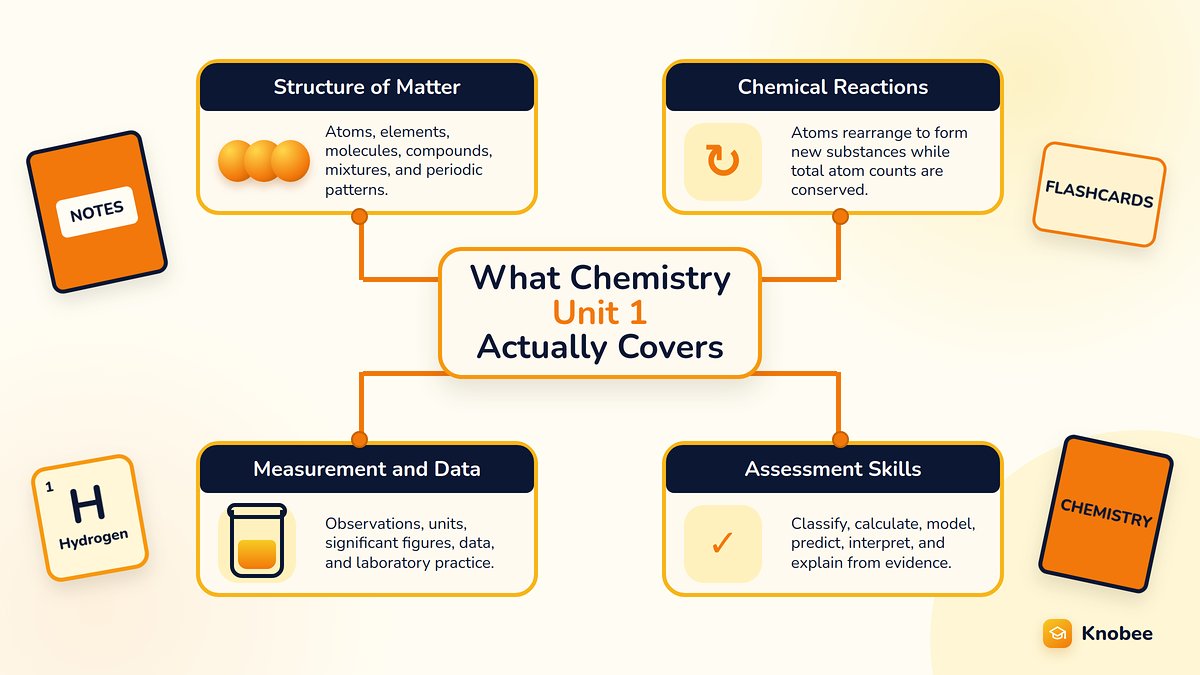
These blocks support later topics such as bonding, reactions, and stoichiometry. Unit 1 is foundational, not a test of whether you can memorize an entire textbook. If you can recognize which block a question belongs to, you've already built an important study skill. For course-specific chemistry materials, you can also compare your class topics with Knobee's chemistry subject resources, while keeping your teacher's syllabus as the final authority.
How to read your unit 1 syllabus
Your syllabus is more useful than a list of dates. It tells you what kind of thinking your teacher expects. A line such as “1.2 distinguish between elements, compounds, and mixtures” contains clues about both the content and the likely assessment.
Start with the verb. In this example, the verb is distinguish. That means you'll need to tell categories apart and explain the difference, not repeat a definition. The concept family is classification of matter. A likely question could ask you to sort examples, compare two substances, or justify why a sample belongs in one category rather than another.
Match the verb to the task
Use the wording of each standard to predict how you should practice:
- Define: State the meaning accurately, then explain it in ordinary language.
- Identify: Recognize a symbol, particle, diagram, substance, or pattern.
- Calculate: Show an organized process, substitute values correctly, and include units when required.
- Predict: Use a rule or pattern to make a conclusion about an unfamiliar example.
- Distinguish: Compare categories and name the feature that separates them.
- Describe: Give the relevant characteristics in a complete explanation.
- Model: Draw or construct a representation that shows relationships between parts.
A student who sees “calculate mass” and only rereads notes is preparing for the wrong task. A student who sees “predict an ion charge” and drills only vocabulary is also missing the point. The verb tells you whether retrieval, calculation, comparison, or explanation should lead your study session.
Next, highlight repeated terms. Mark words such as atom, element, periodic, and mass wherever they appear. Then sort them under four headings: methods, atoms, conservation, and periodic table. “Measurement” may fit methods, while “mass” can signal both measurement and conservation. Use the surrounding verb to decide what your teacher wants you to do with it.
Practical rule: Study the action word as carefully as the chemistry noun.
Try this ten-minute exercise. Take your own Unit 1 syllabus and place every standard under one of the four blocks. If a line seems to fit two blocks, write a short note explaining why. That small act turns a crowded page into a study map and shows you which ideas connect.
Core concepts every unit 1 builds on
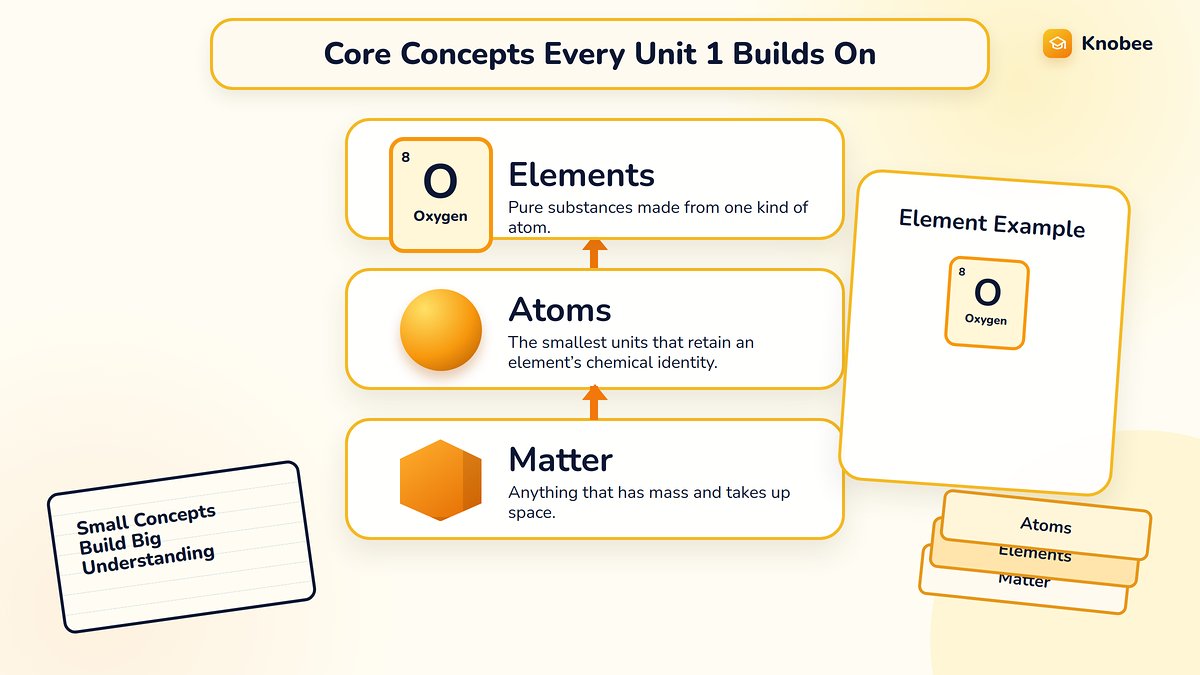
Chemistry becomes easier when you treat matter like a construction system. Matter is anything that has mass and takes up space. A desk, a drop of water, the air in a balloon, and the metal in a paper clip all qualify.
An atom is a tiny unit that keeps the identity of an element. An element is a pure substance made from one kind of atom. Every oxygen atom is oxygen because of its atomic identity, just as every particular type of building block has features that distinguish it from other blocks.
Build larger ideas from smaller pieces
Atoms can join together to form molecules. In a simple building-block analogy, the atoms are separate pieces connected in a specific arrangement. A compound contains atoms from different elements bonded together, while a mixture is a physical combination in which substances are collected together without becoming one new substance.
The distinction matters because early assessments often test classification:
- Element symbol questions: You may need to connect O with oxygen or identify the element represented by a symbol.
- Matter classification questions: You may sort a sample as an element, compound, or mixture.
- Written justification: You may need to explain that a compound contains different elements joined chemically, while a mixture contains substances together without changing their identities.
Consider water. A diagram showing repeated units made from hydrogen and oxygen represents a compound, because the particles contain atoms of more than one element joined in a definite substance. The label should not be “hydrogen element” just because hydrogen appears in the diagram. The whole sample is water, a compound of hydrogen and oxygen.
Early science standards describe this same structural idea through models of atomic composition. NGSS MS-PS1-1 explains that atoms can form molecules and extended structures, including repeating crystal structures, as shown in this NGSS-aligned explanation of molecules and extended structures.
One useful self-check is a retrieval prompt. Cover your notes and say, in your own words, what matter, an atom, an element, a molecule, a compound, and a mixture are. If your explanation depends on copying the textbook sentence, keep practicing until you can explain the idea with a new example.
Conservation of mass and balanced equations
Balancing equations isn't a decoration added after the chemistry. It follows from a basic rule: in a closed system, the total mass of the reactants equals the total mass of the products. Antoine Lavoisier helped establish this principle through careful quantitative experiments. Historical summaries place a key statement in 1773 and later formalization in 1789, although Jean Rey had described mass increase during metal calcination in 1630, and Mikhail Lomonosov proposed a version of mass preservation in the mid-1700s. The University of Wisconsin chemistry history tutorial explains this development and its importance in making chemistry measurement-based.
Think about a candle burning inside a sealed container. The wax and oxygen seem to disappear, but they haven't vanished. Carbon dioxide, water vapor, soot, and ash account for the reactants after the atoms have been rearranged. The container's total mass stays the same because atoms move into new combinations rather than appearing or disappearing.
Take the unbalanced equation:
H₂ + O₂ → H₂O
The left side has two hydrogen atoms and two oxygen atoms. The right side has two hydrogen atoms and one oxygen atom. You change the coefficients, not the small numbers inside formulas, to make the counts agree. The balanced form is:
2H₂ + O₂ → 2H₂O
The same reasoning applies to other equations. In C + O₂ → CO₂, the carbon count is one on each side before and after balancing, and the oxygen count is two on each side. In Na + Cl₂ → NaCl, chlorine has two atoms on the left but one on the right, so the balanced equation becomes:
2Na + Cl₂ → 2NaCl
The Next Generation Science Standards express the core idea directly: students should model how the total number of atoms stays the same in a chemical reaction, so mass is conserved in MS-PS1-5. The NGSS standard for conservation in chemical reactions gives the broader learning target.
| Equation | Atom (side) | Unbalanced count | Balanced count |
|---|---|---|---|
| H₂ + O₂ → H₂O | Oxygen, left | 2 | 2 |
| H₂ + O₂ → H₂O | Oxygen, right | 1 | 2 |
| 2H₂ + O₂ → 2H₂O | Oxygen, left and right | 2 and 2 | 2 and 2 |
| C + O₂ → CO₂ | Carbon, left and right | 1 and 1 | 1 and 1 |
| 2Na + Cl₂ → 2NaCl | Chlorine, left and right | 2 and 1 | 2 and 2 |
On a test, ask yourself: What coefficient makes the atom counts match without changing the substances in the formulas?
Using the periodic table to predict behavior
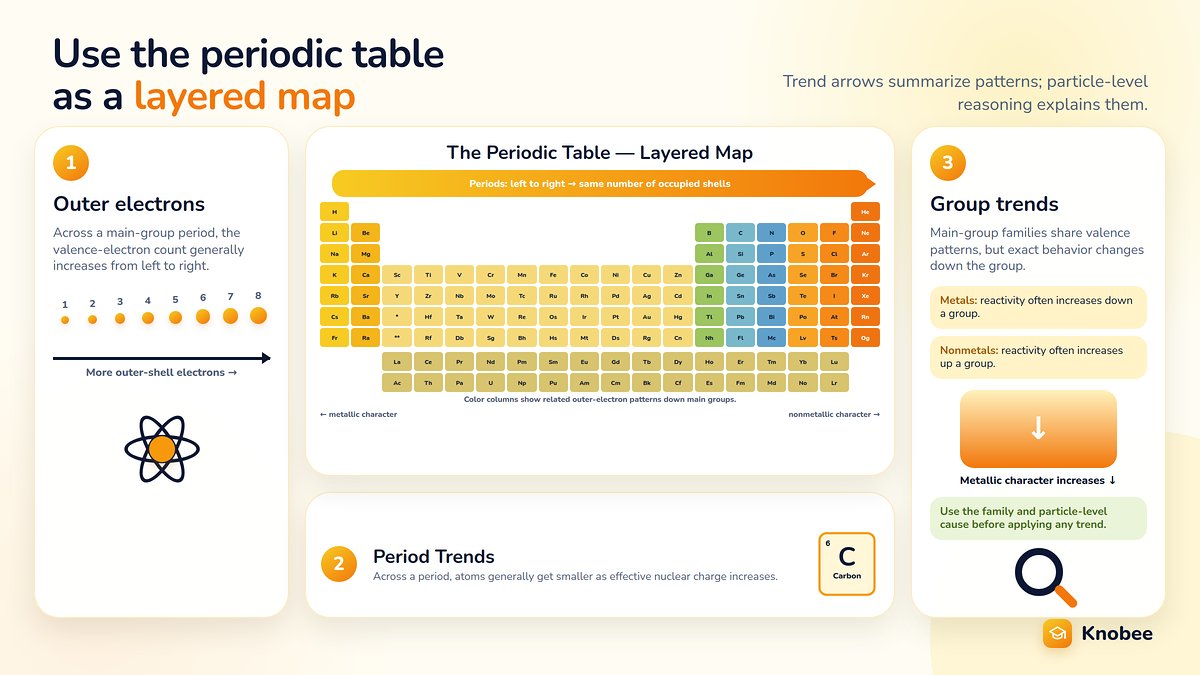
The periodic table works better as a layered map than as a wall of facts. The key layer for early chemistry is the outermost electron shell. Across a period, the number of outer electrons increases by one, helping explain the gradual shift from metallic to nonmetallic character. Down a group, the outer-electron pattern stays similar, but the outer shell sits farther from the nucleus, so reactivity and ion behavior change in predictable ways.
Read groups as families
Group 1 includes lithium, sodium, and potassium. These elements tend to form +1 ions because they have a similar outer-electron pattern. They're all reactive metals, including with water, but that doesn't mean every member behaves identically in every situation. Position gives you a family pattern and a starting prediction.
Group 17 includes fluorine, chlorine, and bromine. These halogens tend to gain one electron and form −1 ions. If a question gives you an unfamiliar element in the same family, you can use the group position to predict the likely charge before checking a reference table.
The historical development of atomic theory helps explain why this map is organized the way it is. John Dalton introduced the first modern scientific atomic model in 1803 and published A New System of Chemical Philosophy in 1808. Later, Rutherford's gold foil experiment supported the existence of a small, dense, positively charged nucleus, and Henry Moseley's work in 1914 linked atomic number to proton number. This sequence explains why the periodic table is arranged by atomic number rather than atomic mass and why subatomic structure helps predict chemical behavior. The history of chemistry overview traces these milestones.
For practice, choose an element without looking up its charge. Note its period and group, write the likely ion, and then check your textbook or periodic table. Explain what outer-electron pattern led to your prediction. That final explanation is more valuable than memorizing “Group 1 equals plus one.”
Here's a visual explanation you can use to reinforce the map:
Common misconceptions students bring in
Early chemistry questions often expose assumptions that sound reasonable in everyday life. Replace each assumption with a short correction sentence you can use while solving a problem.
Four corrections to keep ready
“Dense means heavy.” Density describes mass per volume, not total weight. A small steel marble can be denser than a foam basketball, even though the basketball may contain more total matter because it occupies much more space. Say: “Density compares how much mass is packed into a given volume.”
“Atoms disappear during a reaction.” A burning candle can make reactants seem to vanish, but the atoms move into products such as gases, soot, and ash. Say: “The atoms are rearranged, not destroyed.” This is the same conservation principle used to balance equations.
“A molecule makes its atoms lose their identities.” Chemical bonds involve interactions and shared electrons. The atoms form a new arrangement, but an oxygen atom doesn't become a hydrogen atom inside water. Say: “Bonding changes connections, not element identities.”
“Every member of a group behaves exactly alike.” Group position suggests shared patterns, but exact behavior can change down a group as atoms become larger and their outer shells sit farther from the nucleus. Say: “The group predicts a family resemblance, not an identical script.”
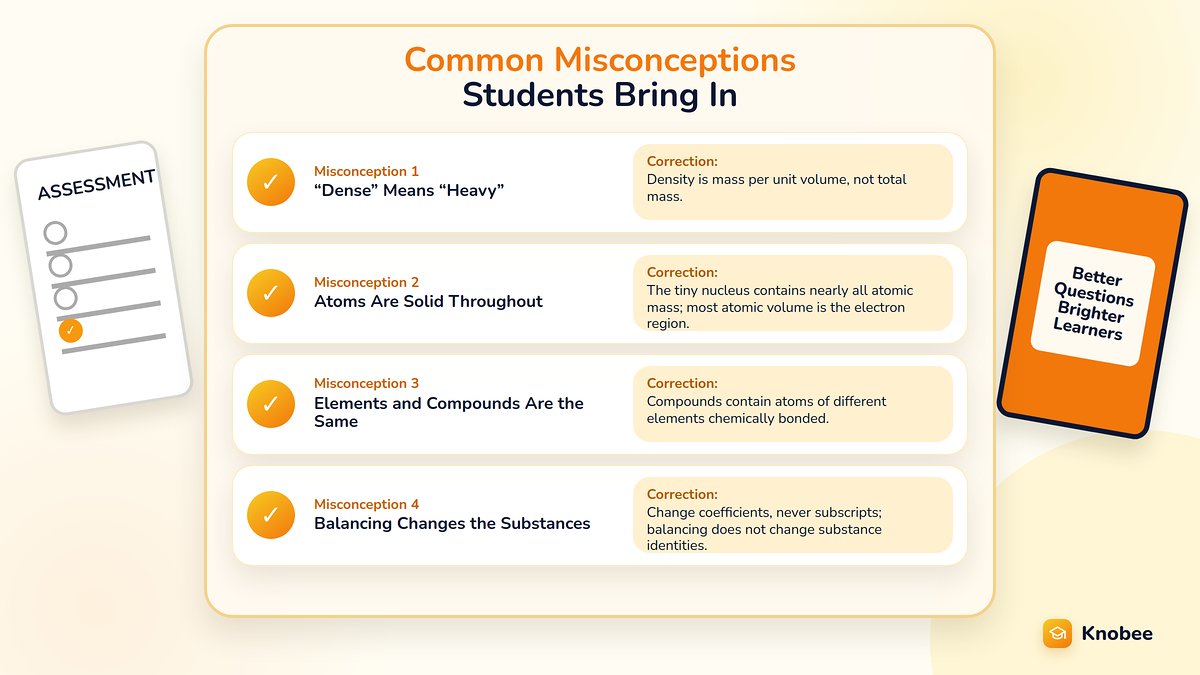
One more distinction protects you from a common diagram error: elements and compounds aren't the same category. An element contains one kind of atom. A compound contains atoms from different elements bonded together. If you can state that difference and point to evidence in a particle diagram, you're answering the reasoning part of the question rather than guessing from appearance.
Typical assessments and lab expectations
A Unit 1 class may begin with a quick sketch of a laboratory setup, an element-symbol bell-ringer, or an exit ticket asking you to classify a substance. These short tasks check whether you can retrieve a concept without waiting for a long study session.
Graded work usually asks for more. A quiz might use short answers about atomic structure. A balancing assessment may include several steps, where showing your atom counts makes your reasoning visible. A unit exam may mix selected-response questions with written justifications, so knowing a definition isn't enough if you can't apply it to a new example.
| Assessment type | Typical format | What earns full credit |
|---|---|---|
| Warm-up or bell-ringer | Sketch, symbol identification, or quick recall | Accurate labels and a direct response |
| Short-answer quiz | Atomic structure or classification prompt | Correct vocabulary plus a clear explanation |
| Equation assessment | Multi-step balancing problem | Correct coefficients, atom counts, and visible work |
| Unit exam | Mixed questions and written justification | Careful reading, correct reasoning, and complete explanations |
| Lab report | Purpose, safety notes, observations, data, and conclusion | Units, labeled diagrams, separated observations, and supported interpretation |
A strong pre-lab is written before class. It includes the purpose, a reasonable hypothesis, and relevant safety notes. A weak pre-lab copies a classmate's words without showing that you understand the procedure or risks.
Your observations should describe what you noticed, often in past tense, while your interpretation explains what those observations might mean. Record quantitative data with units, label diagrams clearly, and name a plausible source of error instead of writing “human error” without explanation. Unit 1 labs are often short, verification-style investigations rather than open-ended design projects, so following the procedure accurately matters more than producing a creative display.
If your notes are scattered across slides and worksheets, you can generate chemistry flashcards from notes, then check every card against the teacher's wording and your lab materials. A study tool can organize practice, but you still need to verify the chemistry.
A practical one-week study plan for unit 1
A good plan follows the four blocks instead of treating Unit 1 as one giant list. The aim is to retrieve, apply, and correct your understanding across several days.
Monday: Work on methods. Practice reading measurements, selecting units, and applying significant-figure rules from memory. Review lab safety by covering your notes and explaining what you would do in a specific situation.
Tuesday: Stay with methods, but use problems rather than rereading. Complete a few measurement questions, inspect each unit, and write down the exact step that caused any mistake.
Wednesday: Move to atoms and elements. Test yourself in both directions, symbol to name and name to symbol. Draw a small concept map linking subatomic particles to atomic number, isotope identity, and ion formation.
Thursday: Practice conservation of mass. Balance five equations from scratch, count each element on both sides, and compare your reasoning with a partner or answer key. Don't erase the first attempt, because the error often shows what you need to review.
Friday: Use the periodic table predictively. Choose three unfamiliar elements, identify their group positions, write likely ion charges, and explain how outer electrons support each prediction.
Saturday: Complete a mixed review under timed conditions. Afterward, create an error log that groups mistakes under methods, atoms, conservation, or periodic patterns. A wrong answer is most useful when you identify whether the problem came from vocabulary, calculation, reading, or reasoning.
Sunday: Keep the review light. Read the error log, rewrite two weak explanations in plain language, and organize your calculator, notes, pencil, and permitted reference materials for the exam.
This approach uses retrieval and spacing instead of passive rereading. For additional guidance on building recall practice, use this practical guide to memorizing material, then adapt the technique to your teacher's exact standards.
Knobee AI can turn your chemistry notes, slides, and uploaded documents into Study Sets with flashcards, quizzes, worked examples, and visual aids. Kno can guide you through difficult questions with hints and explanations, while Daily Boost gives you a focused way to revisit weak areas. Visit Knobee AI to turn your Unit 1 materials into targeted practice while keeping your own reasoning at the center.
Crafted with Outrank tool