10 Multiple Choice Questions Chemistry: Answers Explained
Practice 10 multiple choice questions chemistry students often miss. Each one includes the answer, a clear explanation, and tips for checking your reasoning.
Topics: chemistry multiple choice, chemistry practice questions, AP chemistry practice, chemistry study tips, high school chemistry
What if you picked the right answer for the wrong reason? You'd get the point today, then miss the next question that changes one number or one word. That's the gap most practice sets hide.
These multiple choice questions chemistry students meet in grades 7 to 12 are built differently. Each one names the tempting wrong option first, then shows the reasoning step that fixes it. Try to answer before you read the explanation. Say your reason out loud, even under your breath.
You'll work through stoichiometry, periodic trends, bonding, acids and bases, equilibrium, and redox. The topics build on each other, so an early fix, like checking units, helps you again later.
Standardized chemistry testing has a long history of aiming beyond recall. The American Chemical Society history of its examinations notes the first ACS General Chemistry Examination was released in 1934, and educators were already discussing scientific thinking then. Good questions should still do that.
Quality matters, too. A Frontiers in Education study of general chemistry items evaluated 1,019 general chemistry multiple-choice items and reported that 83% contained at least one item-writing flaw, with implausible distractors most common. So don't just hunt for an answer that looks familiar. Check whether each wrong option could even make sense.
Work slowly. One clear reason beats ten rushed guesses.
Table of Contents
- 1. Conservation of mass in a water-forming reaction
- 2. Converting grams to moles
- 3. Largest atomic radius in a group
- 4. Identifying an element from its electron configuration
- 5. Identifying an ionic compound
- 6. Calculating pH from hydrogen ion concentration
- 7. Predicting an equilibrium shift with pressure
- 8. Using the molar volume of a gas at standard conditions
- 9. Identifying the oxidized species in a redox reaction
- 10. Comparing boiling points and hydrogen bonding
- How the 10 chemistry questions compare
- Turn your wrong answers into your next study plan
1. Conservation of mass in a water-forming reaction
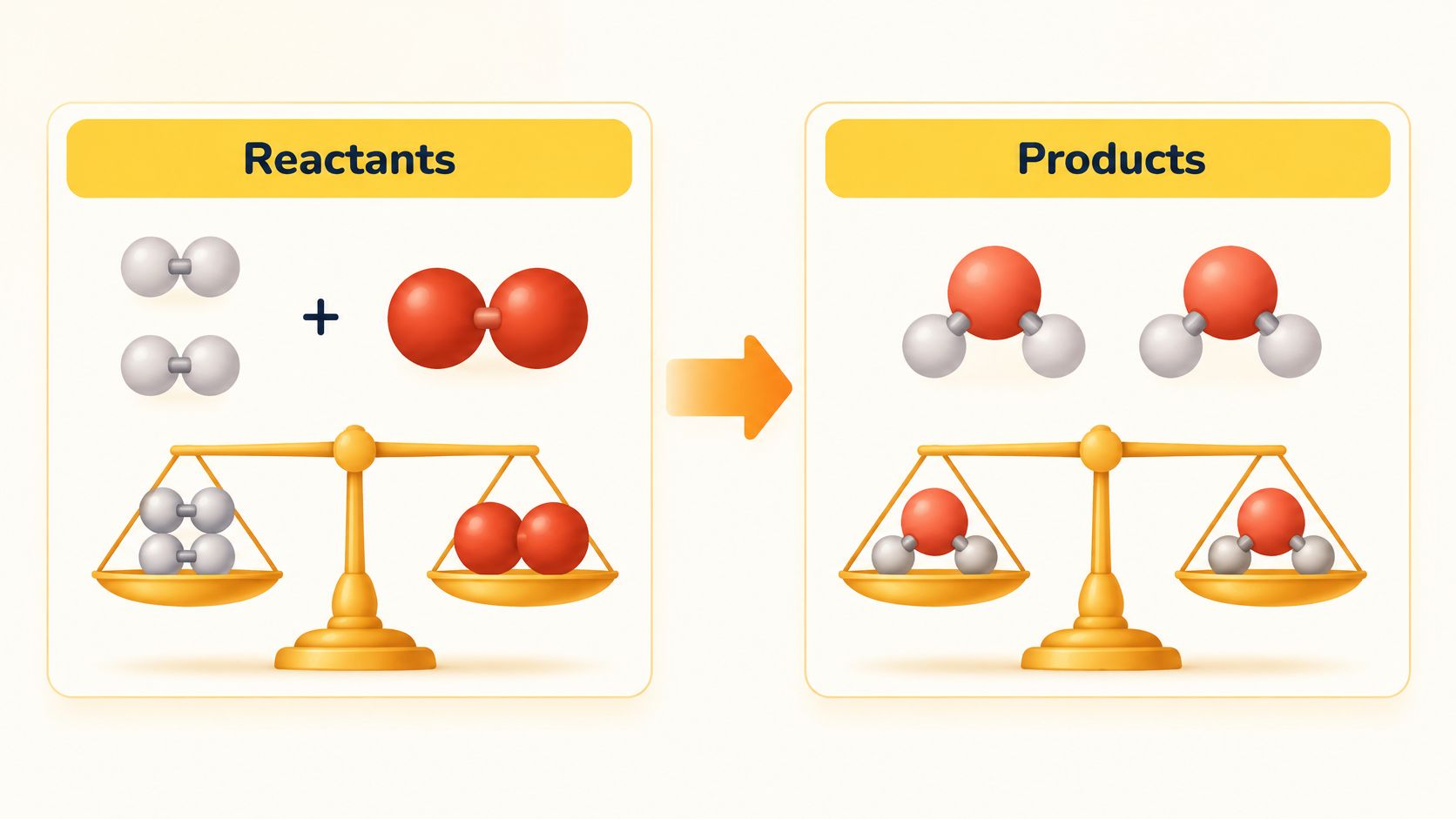
Start with a lab idea you can picture. Hydrogen burns in oxygen and makes water. The atoms don't vanish, they regroup.
Question. (2H_2 + O_2 \rightarrow 2H_2O). If 4.0 g of (H_2) reacts completely with 32.0 g of (O_2), what mass of (H_2O) forms?
- A) 4.0 g: only the hydrogen mass
- B) 32.0 g: only the oxygen mass
- C) 36.0 g: both reactant masses added
- D) 28.0 g: a subtraction slip
Answer: C) 36.0 g. Mass is conserved, so total product mass equals total reactant mass. (4.0\ \text{g} + 32.0\ \text{g} = 36.0\ \text{g}).
The tempting trap
Many students pick B because oxygen is the bigger number. Others pick D because they subtract without thinking. Both errors skip the same check. Count all reactants first.
Before you calculate, check that the equation is balanced. Then add every reactant mass.
Textbook problems use this same check in balancing units. In Knobee, you can turn your lab notes into a Study Set and practice until you can explain each step, not just repeat the total.
2. Converting grams to moles
In a lab, you weigh grams on a balance. Equations, though, count particles in moles. You need a clean bridge between the two.
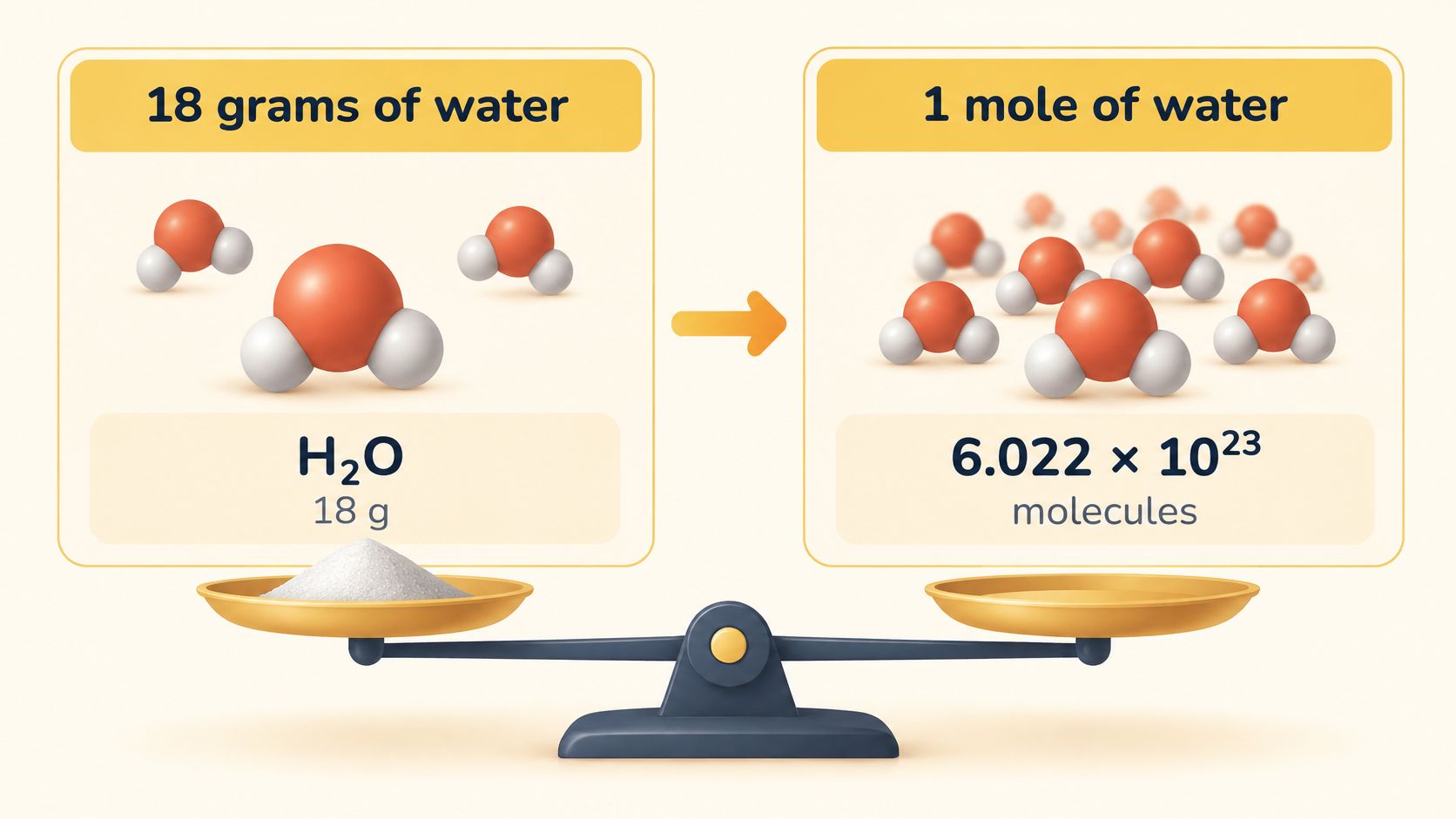
Question. How many moles are in 18.0 g of water, if water's molar mass is about 18.0 g/mol?
- A) 0.50 mol: half the correct value
- B) 1.00 mol: mass divided by molar mass
- C) 18.0 mol: the mass copied as moles
- D) 324 mol: mass multiplied by molar mass
Answer: B) 1.00 mol. Use (\text{moles} = \frac{\text{mass}}{\text{molar mass}}). So (18.0\ \text{g} \div 18.0\ \text{g/mol} = 1.00\ \text{mol}).
Why the wrong options feel close
C happens when you forget to divide at all. D happens when you multiply instead, and the units should warn you. Grams times grams per mole doesn't give moles.
Write units on every step when you convert sugar or salt masses before mixing solutions. If units cancel to mol, your setup is likely right. For a fuller walkthrough of this foundation, see the Chemistry Unit 1 guide.
Use Daily Boost to review mole conversions a few times a week. Short, steady checks beat cramming the night before.
3. Largest atomic radius in a group
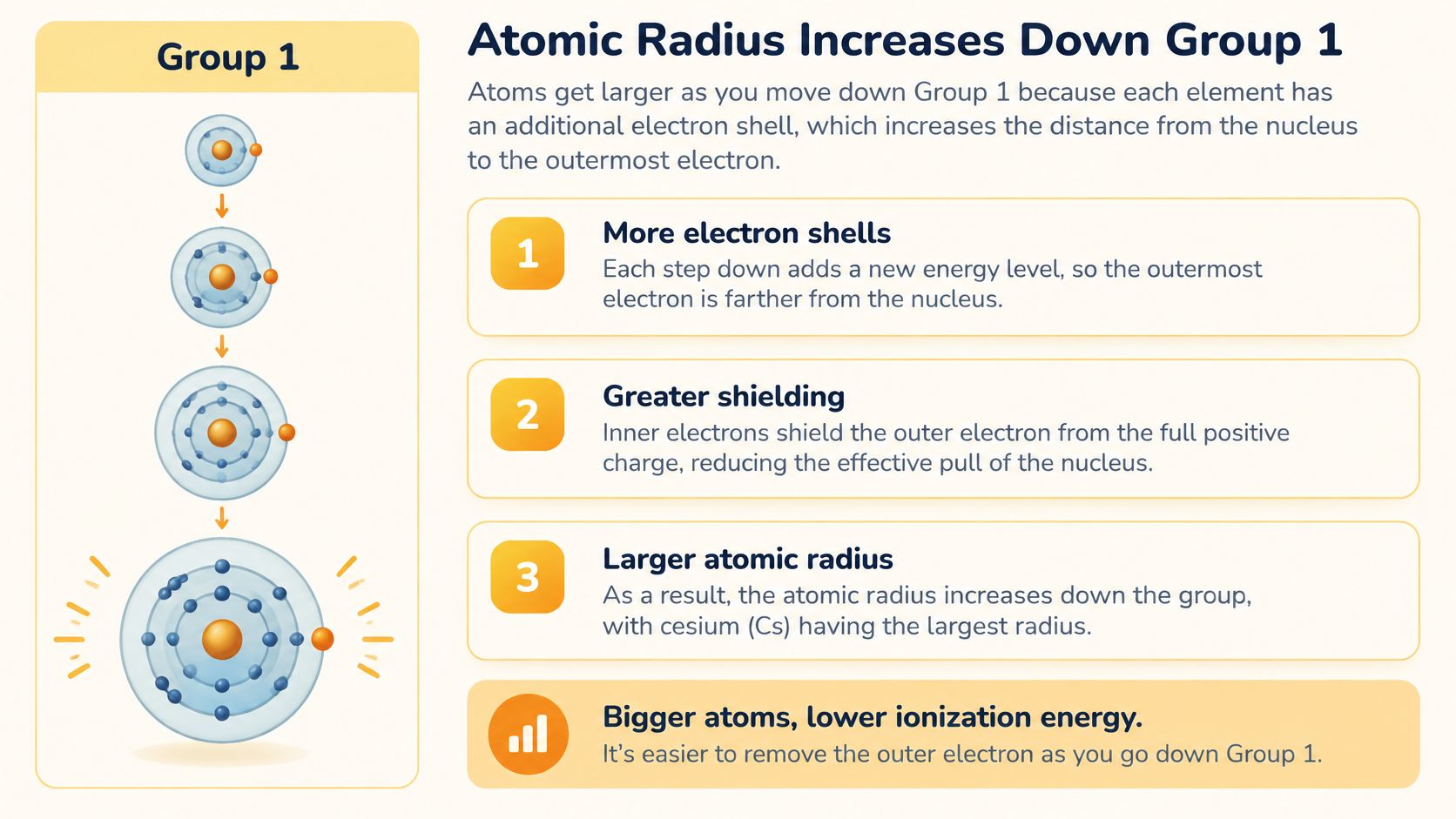
Picture the periodic table as a set of shelves. Moving down one column adds a new shelf of electrons each time. More shelves means a bigger atom.
Question. Which element has the largest atomic radius?
- A) Li: lithium, top of the group
- B) Na: sodium
- C) K: potassium
- D) Cs: cesium, lowest listed here
Answer: D) Cs. Moving down a group adds electron shells, so atoms get larger. Cesium sits lowest in this list, so it has the largest radius.
The common slip
Some students choose Li because it's first, as if first means biggest. The trend runs the other way. Ask yourself how many shells each atom has before you answer.
This trend helps explain why potassium reacts more strongly with water than sodium in class demos. Its outer electron is farther from the nucleus and held less tightly.
Practical rule: Draw a small periodic table and mark each trend with arrows. Then say the trend out loud in your own words after you answer.
4. Identifying an element from its electron configuration
An electron configuration looks like code, but it's mostly counting. The small raised numbers, called superscripts, tell you how many electrons sit in each part.
Question. Which element has the configuration (1s^2\ 2s^2\ 2p^6\ 3s^2\ 3p^4)?
- A) Oxygen: 8 electrons
- B) Sulfur: 16 electrons
- C) Selenium: 34 electrons
- D) Argon: 18 electrons
Answer: B) Sulfur. Add the superscripts, (2 + 2 + 6 + 2 + 4 = 16). A neutral atom with 16 electrons has atomic number 16, which is sulfur.
Where students get pulled away
Argon tempts students who stop after (3s^2) and guess a full shell. Oxygen tempts students who see (p^4) and think only of the outer part. Count everything first, then look up the atomic number.
You'll use this same count to predict valence electrons for bonding questions. If you want topic by topic practice, the Chemistry subject page groups these skills together.
Use Study Sets to make flashcards that pair each element with its configuration. Flip, type, or speak your answer, then check your count.
5. Identifying an ionic compound
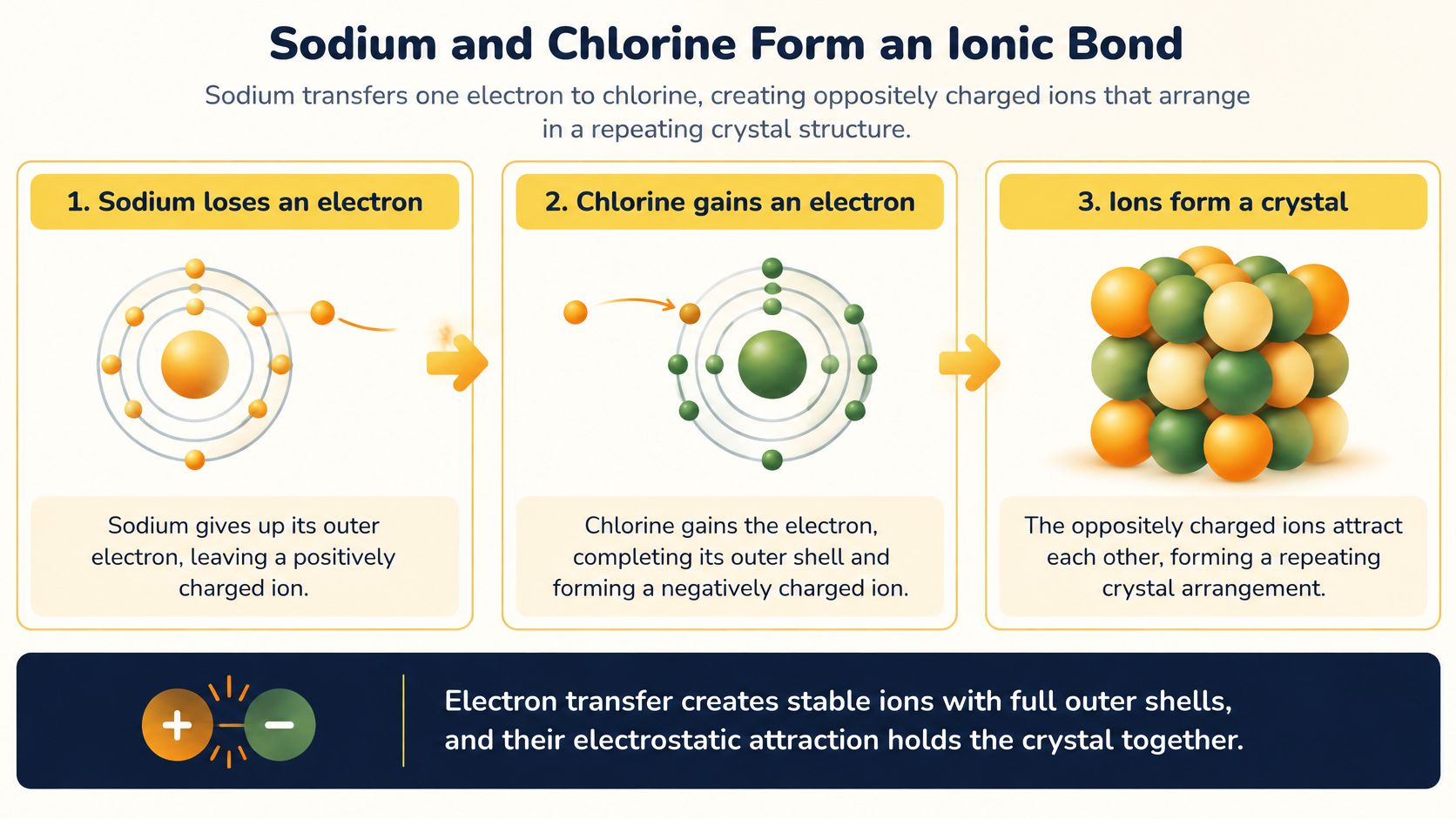
Salt on your table holds the key clue. It forms when a metal gives an electron to a nonmetal, and the charged pieces attract.
Question. Which compound is ionic?
- A) (CO_2): carbon and oxygen, both nonmetals
- B) (CH_4): carbon and hydrogen, both nonmetals
- C) (NaCl): sodium, a metal, with chlorine
- D) (HCl): hydrogen and chlorine, both nonmetals here
Answer: C) (NaCl). Sodium forms (Na^+), chlorine forms (Cl^-), and opposite charges attract. That's an ionic bond, built on electron transfer.
Naming the tempting option
(HCl) is the usual trap because it can form ions in water. As a pure compound in this question, though, it's classed with the covalent options. Check for a metal first, it's often the fastest clue.
Carbon dioxide shows the contrast well. Its atoms share electrons, so it's covalent. Say it plainly, electrons are transferred in ionic bonds and shared in covalent bonds.
If graded worksheets show you keep mixing these up, a Test Analyzer review can flag the exact step where your reasoning turned.
6. Calculating pH from hydrogen ion concentration
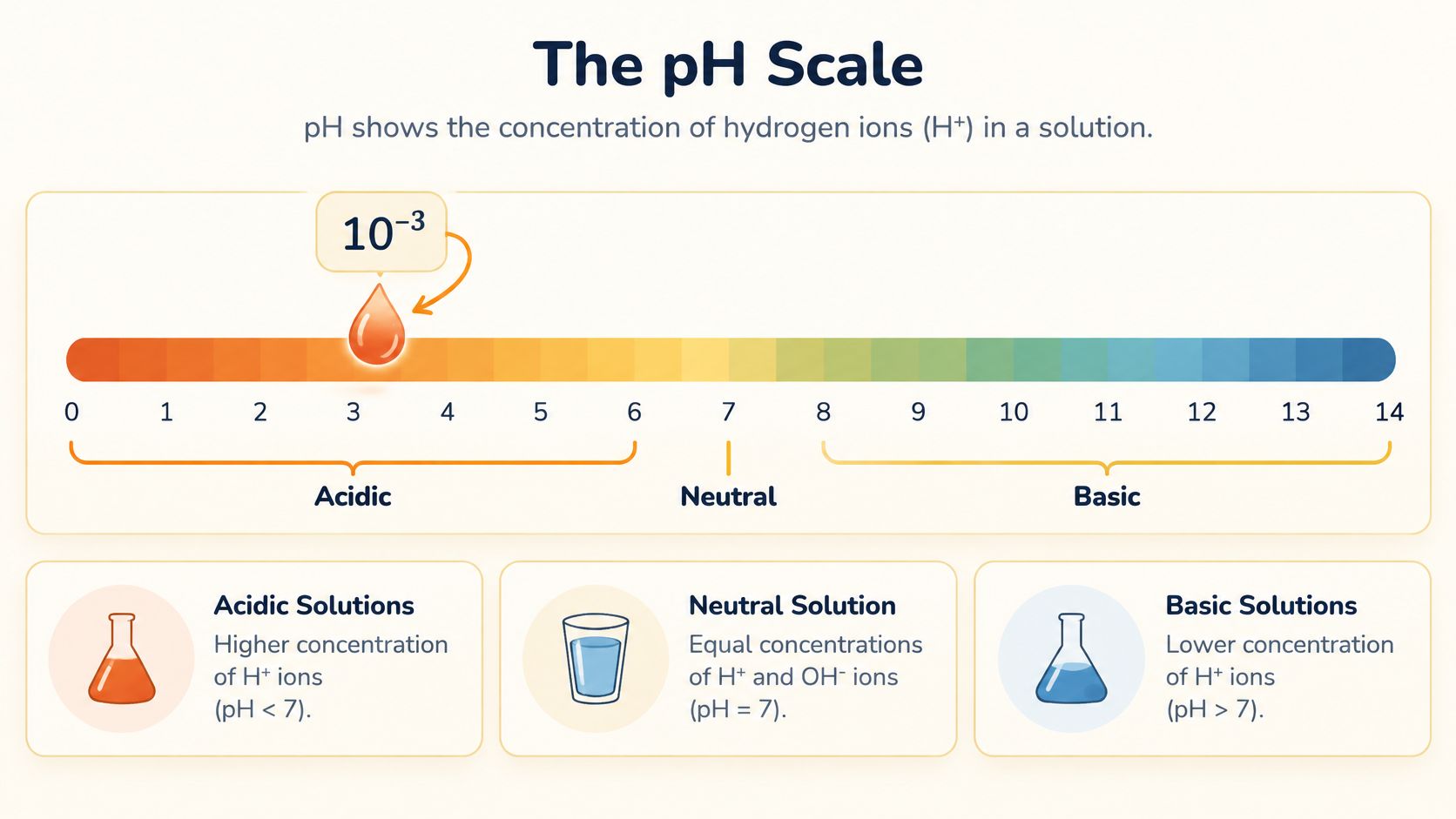
Pool water, soil, and stomach acid all get described with pH. The scale is a shortcut for how many hydrogen ions, (H^+), are in a solution.
Question. A solution has ([H^+] = 1 \times 10^{-3}\ \text{M}). What's its pH?
- A) 1: the coefficient, not the exponent
- B) 3: the positive value of the exponent
- C) 7: neutral, a common guess
- D) 11: a pH and pOH mix-up
Answer: B) 3. Use (\text{pH} = -\log[H^+]), so (-\log(1 \times 10^{-3}) = 3). Below 7 means acidic.
The sign mistake
D appears when students drop the negative sign or swap pH with pOH. For a concentration written as (10) to a negative power, the pH is usually that positive exponent. That's a helpful check, not a replacement for the formula.
Misconceptions here are common and stubborn. A diagnostic study of Grade XI acid and base learning of 163 Grade XI students found an overall acid and base misconception rate of 46.29%, with pH at 47.55%. So if pH feels tricky, you're not alone, you need targeted practice.
Try a few questions with Kno, which asks guiding questions before you see a full solution. That habit matches the active recall approach to studying, where you attempt an answer first.
7. Predicting an equilibrium shift with pressure
Some reactions don't run to completion. They settle into equilibrium, where forward and reverse reactions continue at equal rates. Change the conditions, and the balance shifts.
Question. For (N_2(g) + 3H_2(g) \rightleftharpoons 2NH_3(g)), what happens when pressure increases at constant temperature?
- A) Shifts toward reactants: toward more gas moles
- B) Shifts toward products: toward fewer gas moles
- C) Nothing changes: a guess when unsure
- D) Only (H_2) is produced: ignores the balanced equation
Answer: B) Shifts toward products. There are 4 moles of gas on the left and 2 moles on the right. Higher pressure favors the side with fewer gas molecules.
Watch this short explanation, then count gas moles again on your own before you move on.
Why option A tempts you
Students often think pressure pushes the reaction backward because it feels like a squeeze. Use the count instead of the feeling. The Haber process, which makes ammonia, uses this same idea in industry.
Reasoning matters as much as the choice. An ERIC record of a secondary equilibrium study reports students answered content questions correctly at rates from 11.1% to 90.7%, but performance fell to 11.1% to 84.3% when reasoning was evaluated too. Count first, then explain.
8. Using the molar volume of a gas at standard conditions
Gases spread out, so you measure them by volume in liters more often than by grams on a balance. At set conditions, moles and liters link neatly.
Question. At 0°C and 1 atm, what volume does 2.0 mol of (O_2) occupy?
- A) 11.2 L: half of one molar volume
- B) 22.4 L: volume for one mole only
- C) 44.8 L: two moles times molar volume
- D) 2.0 L: moles copied as liters
Answer: C) 44.8 L. Under these standard conditions, one mole of an ideal gas occupies about 22.4 L. So (2.0\ \text{mol} \times 22.4\ \text{L/mol} = 44.8\ \text{L}).
The one-mole trap
B is the classic wrong pick. It uses the right number but forgets the question gives two moles. Always write the conditions down first, because some newer definitions of standard conditions use a different molar volume. Check your textbook's definition.
If your units don't end in liters, don't circle the answer yet. Fix the setup first.
You'll meet this in labs that collect hydrogen from a metal and acid. Turn gas law formulas into Study Set cards so formulas sit beside worked examples.
9. Identifying the oxidized species in a redox reaction
Rusting iron and a classic zinc and copper lab share one idea. Electrons move from one species to another, and you can track them with oxidation states.
Question. In (Zn(s) + Cu^{2+}(aq) \rightarrow Zn^{2+}(aq) + Cu(s)), which species is oxidized?
- A) Zn: starts at 0, ends at +2
- B) (Cu^{2+}): gains electrons instead
- C) (Zn^{2+}): the product, not the reactant that changed
- D) Cu: also a product here
Answer: A) Zn. Zinc goes from 0 to +2, losing two electrons. Loss of electrons is oxidation. Copper ions gain electrons, so they're reduced.
Why B sounds right
Students mix up the species that causes oxidation with the species that is oxidized. Slow down and write each oxidation state above the symbol, before and after.
Use OIL RIG as a check, Oxidation Is Loss, Reduction Is Gain. Then go one step further and explain the electron change in a sentence. The memory aid helps, the explanation proves it.
A Test Analyzer review on redox homework can show whether you misread charges or mixed up loss and gain. Those are different fixes.
10. Comparing boiling points and hydrogen bonding
Water boils at 100°C at sea level, while methane boils far below zero. The difference isn't mainly size. It's how strongly molecules pull on each other.
Question. Which substance has the highest boiling point, (CH_4), (NH_3), or (H_2O)?
- A) (CH_4): only weak dispersion forces
- B) (NH_3): hydrogen bonds, but fewer per molecule
- C) (H_2O): many strong hydrogen bonds
- D) All about the same: ignores force strength
Answer: C) (H_2O). Water forms strong hydrogen bonds because hydrogen is bonded to oxygen, which is very electronegative. Those attractions take more energy to break, so the boiling point rises.
The mass trap
Many students compare molecule masses first. Compare forces first instead. Methane has only weak London dispersion forces, so its molecules separate easily into a gas.
Ammonia also forms hydrogen bonds, which makes B tempting. Water can form more of them per molecule, so it wins. Look for N, O, or F bonded directly to H as your hydrogen bonding clue.
Make a two-column chart of force types and examples, like ethanol and water mixtures from lab. Review it with Daily Boost until the pattern feels automatic.
How the 10 chemistry questions compare
| Item | Topic area | Skill tested | Common mistake | Best for |
|---|---|---|---|---|
| Conservation of mass in a water-forming reaction | Stoichiometry and conservation of mass | Add reactant masses to find product mass | Using only one reactant's mass | Introductory mass relationships |
| Converting grams to moles | Mole calculations | Divide mass by molar mass and track units | Multiplying instead of dividing | Foundational quantitative chemistry |
| Largest atomic radius in a group | Periodic trends | Compare atomic size down a group | Assuming size decreases down the group | Recognizing periodic patterns |
| Identifying an element from its electron configuration | Atomic structure | Sum configuration superscripts to find atomic number | Miscounting electrons or confusing ions with neutral atoms | Linking electron configurations to elements |
| Identifying an ionic compound | Chemical bonding | Distinguish ionic from covalent compounds | Treating bonds between nonmetals as ionic | Introductory bonding and compound classification |
| Calculating pH from hydrogen ion concentration | Acids and bases | Apply pH = −log[H⁺] | Forgetting the negative sign | Practicing powers of ten and acidity |
| Predicting an equilibrium shift with pressure | Chemical equilibrium | Compare gas moles on each side | Ignoring gas coefficients or confusing pressure with temperature effects | Applying Le Chatelier's principle |
| Using the molar volume of a gas at standard conditions | Gas laws and stoichiometry | Multiply moles by molar volume | Using a molar volume without checking conditions | Connecting gas volume to moles |
| Identifying the oxidized species in a redox reaction | Redox chemistry | Track oxidation-state changes and electron loss | Mixing up oxidation with reduction | Learning electron transfer and electrochemistry |
| Comparing boiling points and hydrogen bonding | Intermolecular forces | Relate hydrogen bonding to boiling point | Confusing intermolecular forces with intramolecular bonds | Explaining molecular properties and boiling-point trends |
Turn your wrong answers into your next study plan
Don't just check an answer and move on. A missed question is useful data, and it tells you exactly what to practice next. Sort each miss by the reasoning error behind it.
Was it a missing balance check in Question 1, a sign slip in Question 6, or a reversed trend in Question 3? Those are different problems, and they need different fixes. Write the error in plain words next to the question.
Then practice only that step for a short set. If units tripped you up twice, do five unit checks before you do five full problems. Small, targeted sets repair thinking faster than another long mixed quiz.
This matches what stronger assessments ask for. The College Board AP Chemistry exam page describes Section I as 60 multiple-choice questions in 1 hour and 30 minutes, worth 50% of the total exam score, mixing discrete items with data based sets. You need both quick recall and careful reading of shared data.
Standards point the same way. The NGSS HS-PS1-2 standard summary expects students to construct and revise explanations using outermost electron states and periodic table trends. That's reasoning, not memorizing single facts.
In Knobee, your Study Sets can include multiple-choice quizzes with designed distractors, and every study session requires you to attempt an answer before it's revealed. A card can only be marked Mastered by answering its quiz question correctly or by scoring 80% or higher on a Mastery Check. That structure keeps guessing from looking like mastery.
If graded tests are where mistakes pile up, Knobee's Test Analyzer reads each uploaded question, compares your answer with the correct one, and identifies the reasoning error for each mistake. Daily Boost then gives five fresh questions a day, which take about five minutes, weighted toward your lowest mastery sets.
Review any output yourself, and with your teacher when that's useful. Tools support your thinking, they don't replace it. Pick your two most common error types today, redo those questions tomorrow, and check whether your explanation, not just your letter choice, has changed.
Turn today's misses into a focused Study Set, let Kno question your reasoning step by step, and use Daily Boost to revisit your weakest chemistry topics in about five minutes a day. Visit Knobee AI to build your next set from your own notes, slides, or a graded test and practice explaining each answer before you check it.