Algebra 2 Formula Sheet: Key Equations & Examples
An Algebra 2 formula sheet with key equations, worked examples, method-selection cues, restrictions, and tips for building a personal study guide.
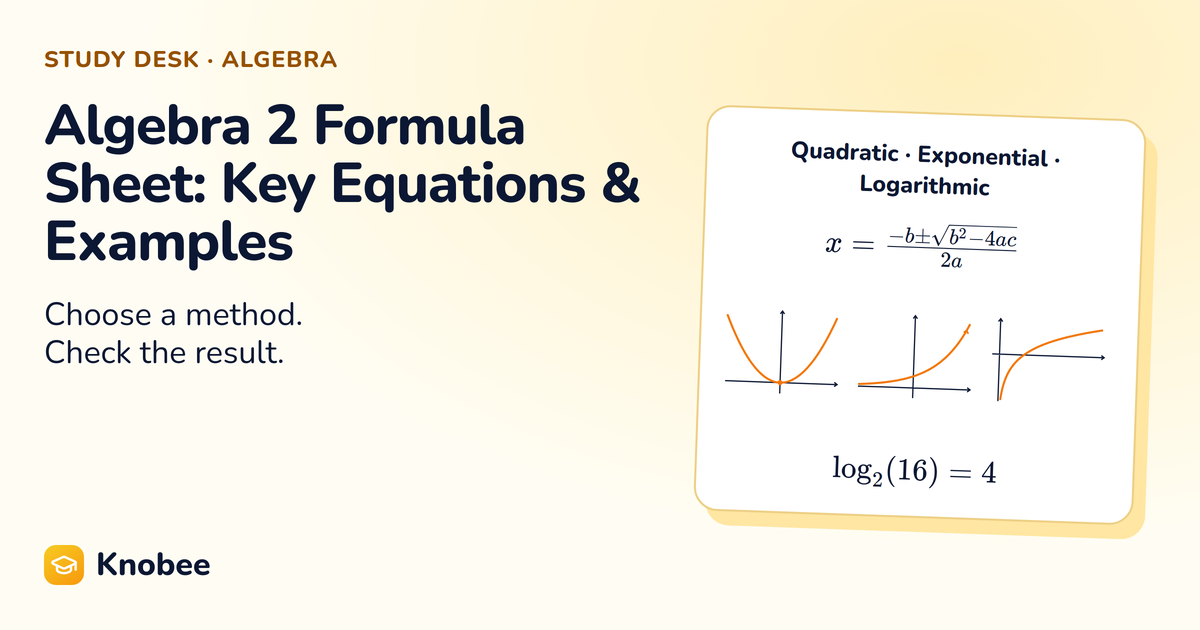
Topics: Algebra 2, Math, Study Guides
You're staring at a quadratic equation, and the formula is somewhere on your notes page. The problem isn't that you've never seen the quadratic formula. You're wondering whether factoring would be quicker, whether the graphing calculator is allowed, and what the answer means once you get it.
That's why a useful Algebra 2 formula sheet can't be only a wall of symbols. It should help you identify the problem type, choose a method, substitute values correctly, and check whether the result fits the original question. This guide organizes common formulas around those decisions, so you can use a reference sheet as a thinking tool rather than a memorization list.
Table of Contents
- What an Algebra 2 Formula Sheet Should Help You Solve
- How to Use an Algebra 2 Formula Sheet for Each Problem Type
- Core Algebra 2 Formulas You Will Use Most Often
- Quadratic, Exponential, and Logarithmic Relationships Explained
- Trigonometry, Sequences, and Series Formulas You Should Know
- Common Mistakes When Using an Algebra 2 Formula Sheet
- How to Build a Personal Algebra 2 Formula Study Guide
- Quick-Reference Math Formulas for Algebra 2 Review
What an Algebra 2 Formula Sheet Should Help You Solve
An Algebra 2 formula sheet should answer a practical question: “What kind of problem is in front of me?” A quadratic equation, an exponential model, a sequence, a trigonometric ratio, and a statistics question all require different choices. Recognizing the family of the problem comes before copying a formula.
Modern Algebra 2 courses cover more than isolated equations. The older New York Common Core Algebra II course drew on Number and Quantity, Algebra, Functions, Geometry, and Statistics and Probability standards, with modeling integrated across them. Its examination blueprint assigned Functions 30%–40% and Statistics and Probability 14%–21% of test credits; geometry content was assessed within Algebra, not as a separate weighted category. For the Next Generation Regents examination introduced in June 2026, the current NYSED educator guide lists four assessed conceptual categories: Number and Quantity, Algebra, Functions, and Statistics and Probability, with modeling integrated across them. Functions now accounts for 38%–45% of credits, the largest category, and Statistics and Probability for 14%–22%. The older blueprint is useful historical context, not the current exam specification.
That structure explains why a strong sheet includes formulas for quadratics, exponential and logarithmic functions, sequences, series, trigonometry, geometry, and data analysis. It should also connect equivalent representations. For example, the roots of a quadratic are the x-intercepts of its graph, while the vertex identifies its turning point.
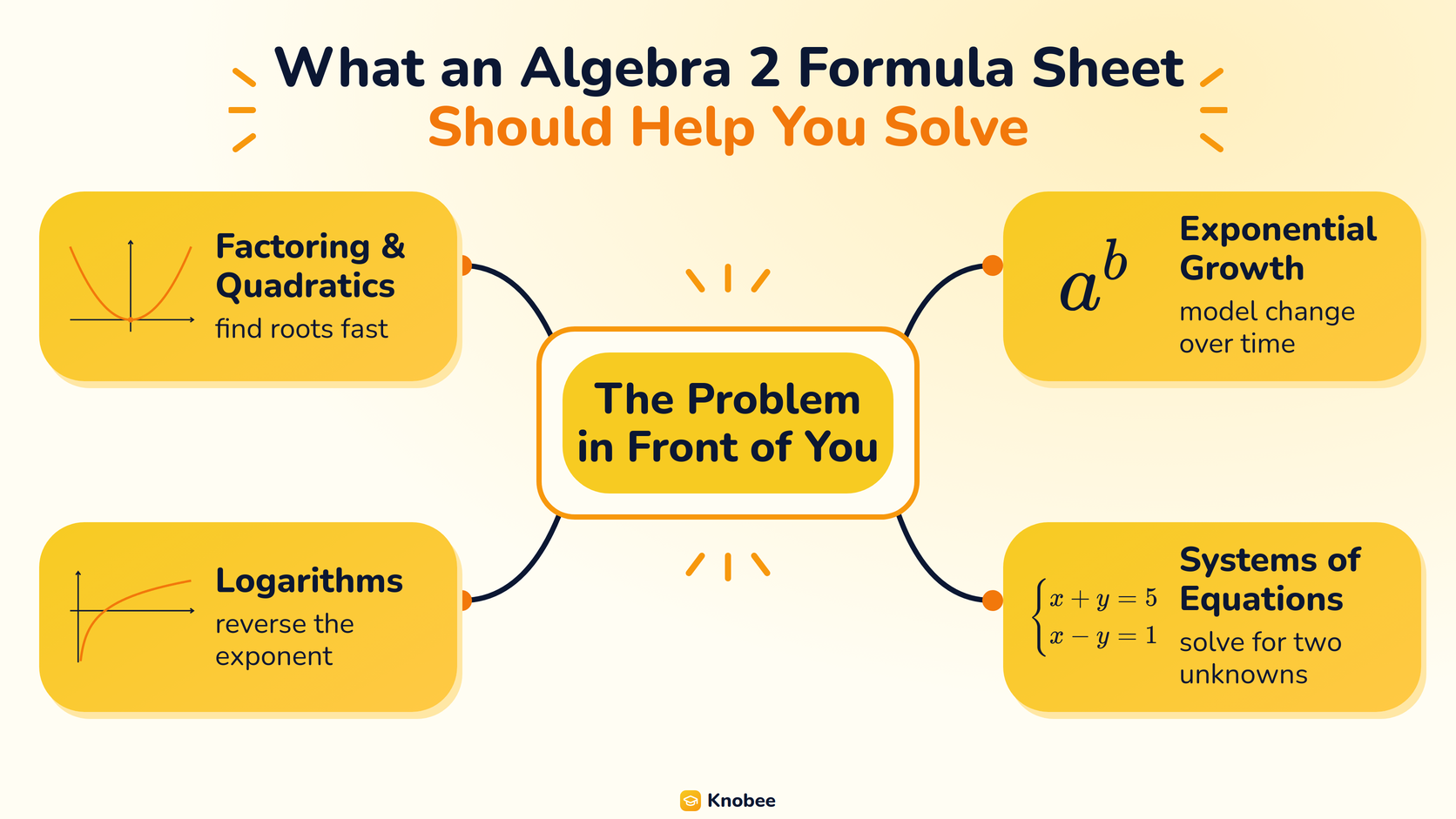
A formula sheet is a decision aid
Official assessments can provide formulas and still test your reasoning. The January 2025 New York Algebra II booklet includes the quadratic formula, arithmetic and geometric sequence formulas, a finite geometric-series formula, circle measurements, the Pythagorean theorem, and volume formulas for solids. The Next Generation Algebra II reference sheet, used from June 2026, instead includes quadratic, trigonometric, sequence and series, cubic-factorization, probability, and exponential growth/decay formulas. It does not include those geometry measurement formulas. Use the sheet for your actual exam; the educator guide connects the assessment to standards, while the reference sheet supplies formulas rather than mapping each one to a standard.
Having the formula doesn't tell you:
- Which quantities belong in each variable
- Whether the equation is in the correct form
- Which method is most efficient
- Whether a domain restriction rules out an answer
- Whether the final result should be exact or approximate
- Whether the answer makes sense in context
A good sheet places those reminders beside the equations. It might say, “Use the quadratic formula when the equation is set equal to zero and factoring is difficult,” rather than displaying only .
How to Use an Algebra 2 Formula Sheet for Each Problem Type
Before you write anything, read the question for its task. Words such as “zeros,” “vertex,” “rate of change,” “common ratio,” “inverse,” “probability,” or “angle” point toward different formula families.
Use this sequence when you're unsure:
- Identify the target. Are you solving for a variable, finding a feature of a graph, modeling change, comparing data, or finding a missing measurement?
- Name the problem family. Decide whether the relationship is linear, quadratic, exponential, logarithmic, trigonometric, sequential, or statistical.
- Choose the representation. A table may reveal a common difference or ratio. A graph may reveal intercepts. An equation may make substitution easiest.
- Match the variables. Write down what each symbol means before inserting numbers. In , is the initial value and is the multiplicative factor.
- Check restrictions. Denominators can't equal zero, logarithm inputs must be positive, and even roots require appropriate inputs when working with real numbers.
- Verify the result. Substitute it into the original equation, compare it with a graph, or estimate whether its size and units are reasonable.
| Problem Type | Most Useful Formula Families | Typical Next Step |
|---|---|---|
| Solve a quadratic equation | Factoring, completing the square, quadratic formula | Check roots in the original equation |
| Find a turning point | Vertex form or | Identify the vertex and axis of symmetry |
| Model repeated change | Exponential form | Interpret the initial value and factor |
| Find an unknown exponent | Logarithmic form or change-of-base rule | Check that the logarithm input is positive |
| Compare two quantities | Linear, quadratic, or exponential models | Identify which representation fits the data |
| Find a missing triangle side or angle | Trigonometric ratios or the Pythagorean theorem | Check the angle mode and units |
| Describe a sequence | Arithmetic or geometric formulas | Look for a common difference or common ratio |
Students often use the quadratic formula only because they remember it. That's safe only when they still identify , , and correctly after moving every term to one side. If factoring is immediate, factoring may be clearer. If you need the turning point, vertex form may communicate more than either solving method.
Practical rule: Select the formula because of the question's structure, not because it's the longest formula on the page.
Core Algebra 2 Formulas You Will Use Most Often
A compact reference works best when related formulas sit together. For real quadratic coefficients , require ; when solving, first write . For exponential and logarithmic forms, the real base satisfies , , and a logarithm input satisfies . Exponential inputs can be any real , with a real multiplier for a nonconstant function. Sequence and finite-series indices are positive integers. The following table gives the form, purpose, and a quick cue for choosing each family.
| Formula Family | Standard Form | Common Use Case |
|---|---|---|
| Linear function | Model a constant rate of change | |
| Point-slope form | Write a line from a point and slope | |
| Quadratic standard form | Identify coefficients and use the quadratic formula | |
| Quadratic formula | Solve a quadratic that isn't easily factored | |
| Vertex form | Read the vertex and transformations | |
| Discriminant | Predict the number and type of real solutions | |
| Exponential function | Model repeated multiplicative change | |
| Logarithm definition | means | Rewrite between logarithmic and exponential forms |
| Arithmetic sequence | Find a term with a constant difference | |
| Geometric sequence | Find a term with a constant ratio | |
| Arithmetic series | Add a finite arithmetic sequence | |
| Geometric series | , | Add a finite geometric sequence |
For a linear relationship, is the slope and is the y-intercept. Use when the rate stays constant. For example, in , increasing by one increases by three, and the graph crosses the y-axis at two.
For a quadratic in standard form, , , and are the coefficients after the equation is written as . With , factoring gives , so the roots are and . The quadratic formula would also work, but it adds more substitution.
The discriminant, , helps you anticipate the result. A positive discriminant indicates two distinct real solutions, zero indicates one repeated real solution, and a negative discriminant indicates no real solutions when working over the real numbers; over the complex numbers, there are two nonreal conjugate solutions. This interpretation connects the algebra to the graph's x-intercepts.
For a fuller set of subject-organized examples, use Knobee's Algebra subject resources alongside your class notes. Your teacher's notation and assigned standards should remain the main reference, especially when a course uses a particular form or method.
Quadratic, Exponential, and Logarithmic Relationships Explained
These three families often appear together because each describes a different kind of change. A quadratic has a squared input, an exponential has a variable exponent, and a logarithm helps solve for an exponent.
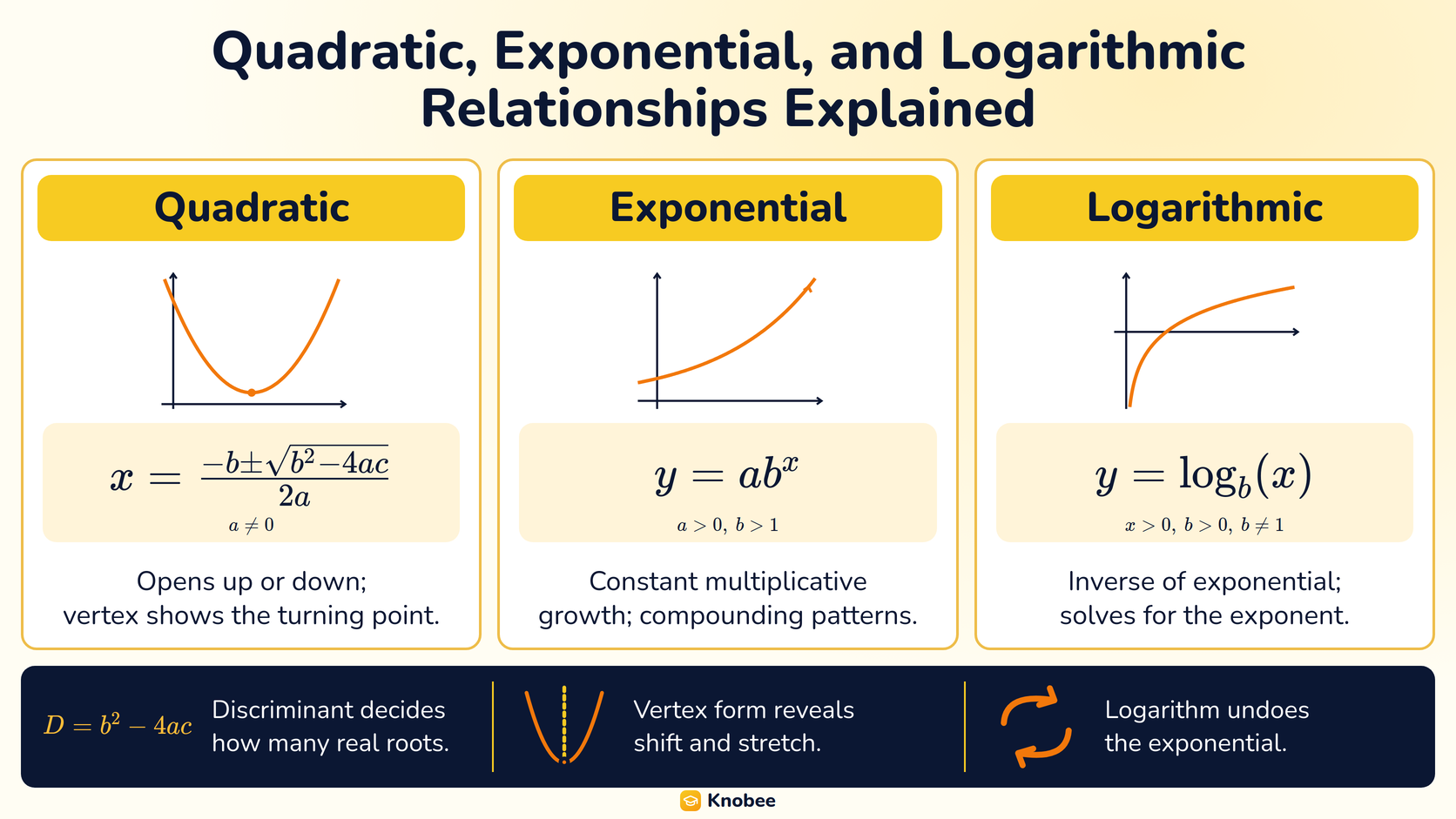
Quadratics describe turning behavior
Use when you need the standard form, coefficients, or y-intercept. Use when you need the vertex, because the vertex is . The sign of tells you whether the parabola opens upward or downward.
To solve , identify , , and , then substitute those values into the quadratic formula. Keep the negative sign attached to , and place the entire discriminant under the square root. A common error is to treat as , especially when is already negative.
The discriminant gives a preview, but it doesn't replace solving. If the problem asks for a graph, you may also need the vertex, axis of symmetry, intercepts, and direction of opening.
Exponentials describe repeated multiplication
In , is the starting value and is the factor applied for each increase in . For a positive initial value , if , the model represents growth; if , it represents decay. A real exponential function requires ; the nonconstant family has and . With a negative initial value, the sign changes the interpretation of increasing and decreasing values.
For , the initial value is , and the factor is . Don't read as a five-unit increase. It represents multiplication by the same factor each time. A table or graph should show a curve rather than a straight line.
Logarithms reverse exponentials
The statement means . If , then , which equals . Logarithms are especially useful when the unknown appears in the exponent.
Remember that the input of a real logarithm must be positive. When solving an equation involving , the restriction is , so . A candidate answer that violates this condition must be rejected, even if an algebraic step produced it.
| Relationship Type | Key Formula Feature | Common Mistake to Avoid |
|---|---|---|
| Quadratic | Forgetting that both plus and minus results may matter | |
| Exponential | Confusing a multiplicative factor with an additive change | |
| Logarithmic | means | Accepting an answer with a nonpositive log input |
When you finish a problem, move between forms if you can. Rewrite a logarithmic equation exponentially, compare a quadratic's roots with its graph, or calculate an exponential model's values in a table. Agreement across representations is a useful error check.
Trigonometry, Sequences, and Series Formulas You Should Know
Trigonometric formulas become easier when you begin with the triangle or angle relationship rather than the abbreviation. For a right triangle, use:
If you know an angle and the hypotenuse and need the opposite side, sine is the direct choice. If you know the adjacent side and hypotenuse, cosine matches the available information. Check whether your calculator is set to degrees or radians before evaluating a trigonometric expression.
The Pythagorean theorem, , applies to right triangles when you know two side lengths and need the third. It doesn't find an angle by itself, and must represent the hypotenuse, the side opposite the right angle.
Sequences show patterns in order
An arithmetic sequence changes by a constant difference. Its nth term is:
Here, is a positive integer, is the first term and is the common difference. For , , so the formula finds any requested term without listing every earlier term.
A geometric sequence changes by a constant ratio:
For , the common ratio is . Don't confuse adding the same amount with multiplying by the same amount. Looking at consecutive differences and quotients helps you classify the sequence before choosing a formula.
Series add sequence terms
Use the arithmetic-series formula when you're adding a finite arithmetic sequence:
For a finite geometric series, use:
If , the finite geometric sum is . The finite formula does not require . For a nonzero first term , an infinite geometric series has sum only when ; if and every term is defined, the sum is zero. A geometric sequence uses a constant ratio between nonzero consecutive terms; for , define the first term separately and all subsequent terms as zero rather than evaluating .
The symbols mean similar things across the sequence and series formulas, but represents a sum, while represents one term. In a word problem involving repeated percentage change, first decide whether the question asks for one future value or the total of several values.
“Find the pattern first. The formula should describe the pattern you've already identified.”
Common Mistakes When Using an Algebra 2 Formula Sheet
A supplied formula can reduce memory pressure, but it can't decide what the symbols mean. Official exam materials may place formulas inside the booklet while still requiring students to substitute appropriately, show necessary steps, and use graphs, charts, or other supporting work. The New York Algebra II examination materials illustrate why access to formulas doesn't remove the need for method selection and interpretation.
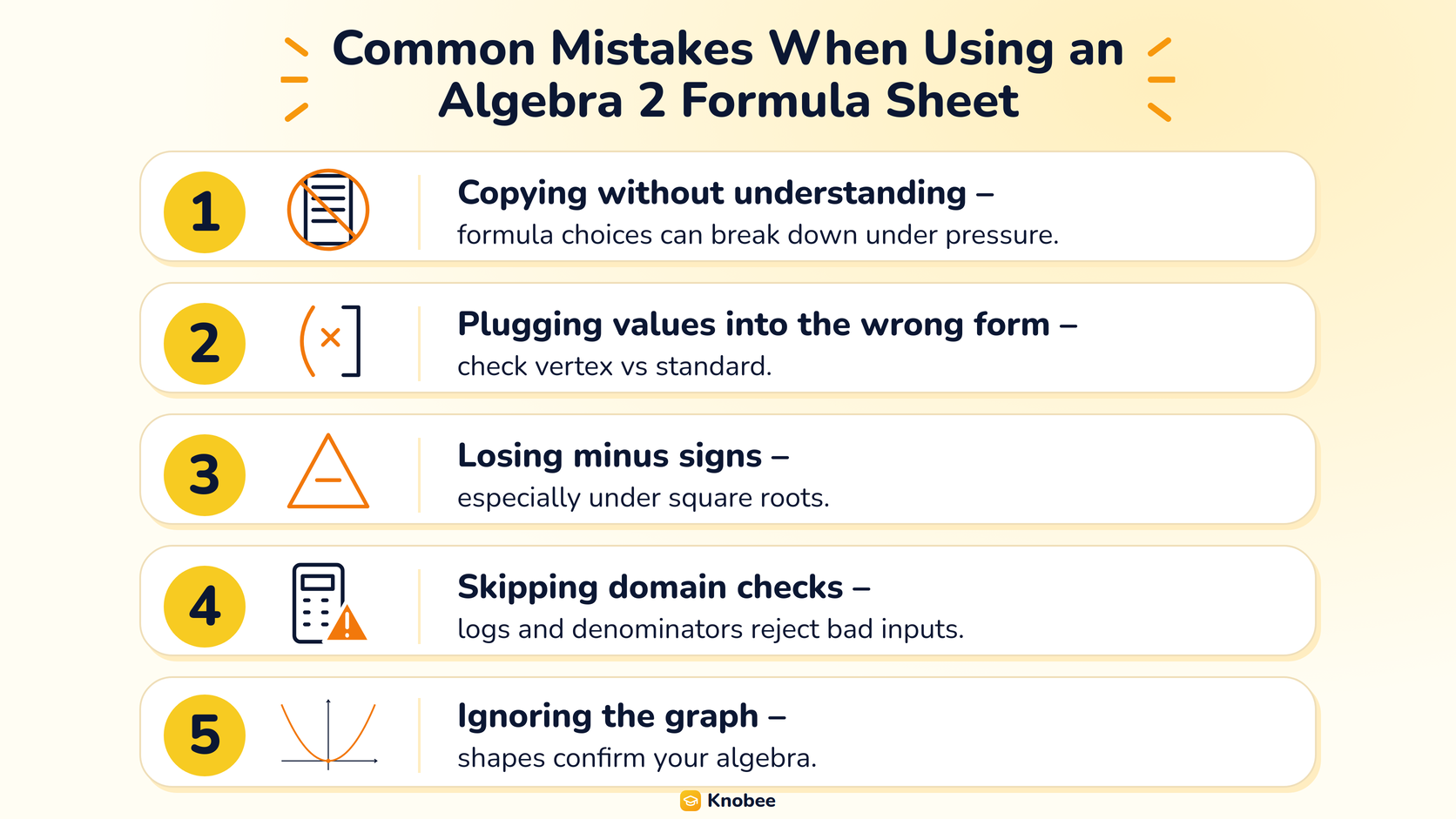
Watch for these predictable traps:
- Using the wrong form: The quadratic formula requires a quadratic equation set equal to zero. Don't substitute coefficients before moving all terms to one side.
- Dropping signs: In , a negative affects both and the discriminant. Use parentheses when entering values.
- Ignoring restrictions: A denominator can't be zero, a real even root can't have an invalid radicand, and a logarithm requires a positive input.
- Accepting approximations automatically: If the question asks for an exact answer, keep radicals, fractions, or logarithmic expressions in exact form until rounding is requested.
- Skipping interpretation: A negative length, an impossible probability, or a point outside the stated domain signals that you should revisit the work.
A quick check can catch many errors. Estimate the answer before calculating, confirm the units, test it in the original equation, and compare the result with the graph's general shape. For a quadratic, ask whether the number of real roots agrees with the discriminant and visible x-intercepts.
How to Build a Personal Algebra 2 Formula Study Guide
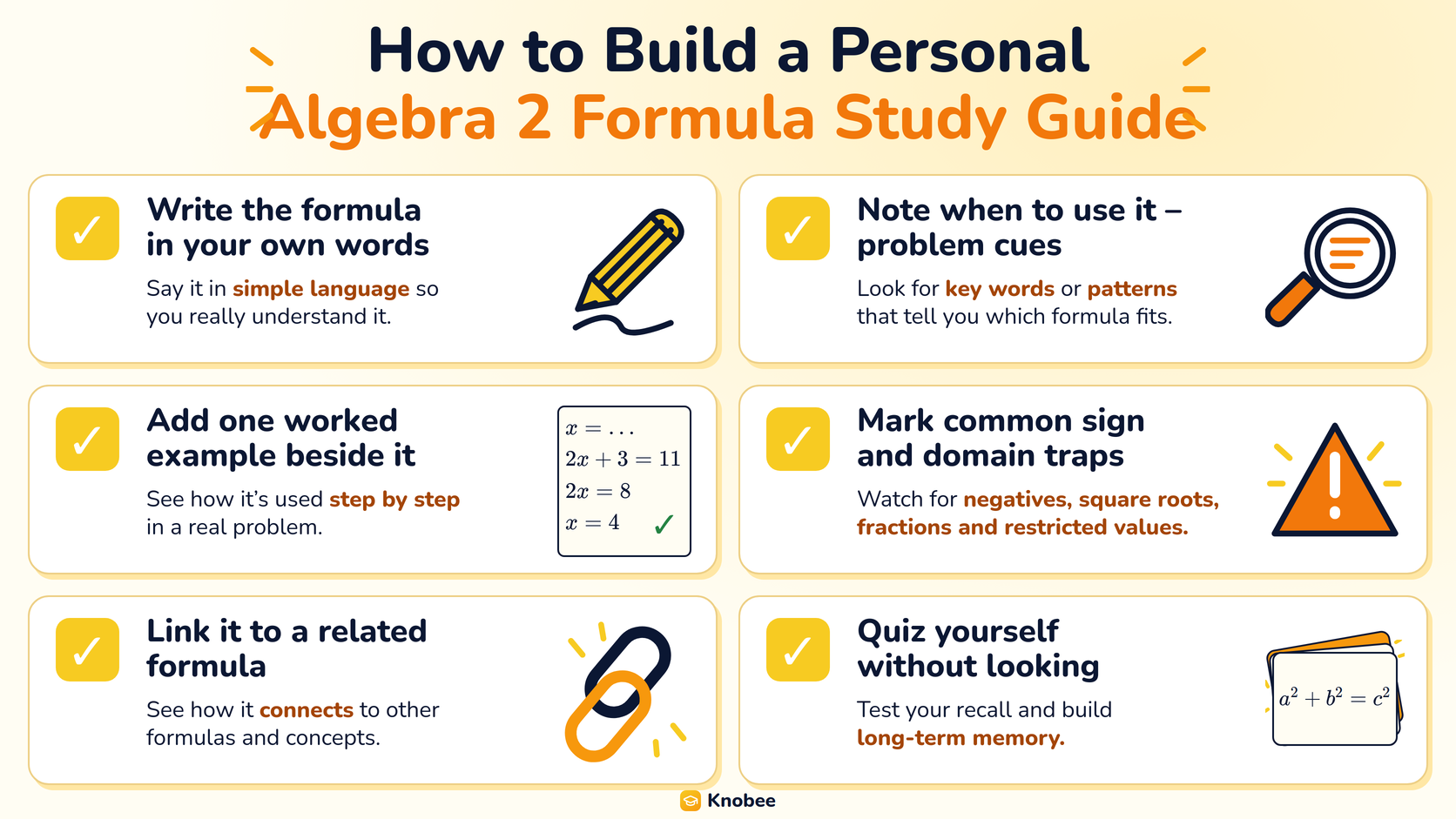
A personal sheet becomes much more useful when every formula carries a decision rule. Don't copy and move on. Write, “Use for the nth term of an arithmetic sequence when the common difference stays constant.”
Add four short notes beside each important formula:
- Meaning: Define every variable in ordinary language.
- Cue: Record words or patterns that suggest the formula.
- Trap: Note a sign error, domain issue, or form requirement.
- Example: Include one solved problem from your own classwork.
Organize the page by relationships rather than alphabetically. Keep standard, vertex, and factored quadratic forms together. Place exponential and logarithmic forms side by side because one expresses a power and the other solves for the exponent. Link sequence formulas to the visual pattern that distinguishes a common difference from a common ratio.
Use your sheet in stages:
- Try a problem without looking.
- Identify the step where you became uncertain.
- Consult only the relevant formula family.
- Explain why that formula fits.
- Solve and verify the result.
- Add the mistake to the sheet if it could happen again.
You can also generate flashcards from your notes and turn each formula into a retrieval question. Ask, “When should I use this?” before asking, “What is the formula?” That order builds selection skill instead of recognition alone.
A study guide shouldn't replace practice. Use it during open-reference work, then cover portions of the page and retrieve the rules from memory. Returning to missed questions helps you decide whether the weakness is formula recall, variable matching, algebraic manipulation, or interpretation.
Quick-Reference Math Formulas for Algebra 2 Review
Use this compact list as a starting point, then adapt it to your teacher's units and assessment rules.
- Linear: , for a constant rate of change.
- Quadratic: , , and .
- Exponential: , for repeated multiplication.
- Logarithmic: means .
- Arithmetic sequence: .
- Geometric sequence: .
- Arithmetic series: .
- Geometric series: , with .
- Right-triangle trigonometry: sine, cosine, and tangent match side ratios to an angle.
- Data interpretation: identify the model, read the variables, check the domain, and judge whether the result is reasonable.
Speed helps only after you've made the correct choice. Practice selecting formulas from short problem descriptions, explain each variable aloud, and review errors instead of rereading every page. Active recall practice can help you test what you can retrieve before you reopen the reference sheet.
Knobee AI turns notes, documents, and topic descriptions into Study Sets with flashcards, quizzes, worked examples, and guided review. Use it to practice choosing an Algebra 2 formula, explaining why it fits, and reviewing mistakes through focused questions. Visit Knobee AI to start building a more active formula study routine.