AP Chemistry Curve Explained and How Scores Work
Confused by the AP Chemistry curve? Learn how AP scoring really works, what the curve means in class vs on the exam, and how to interpret your score.
Topics: ap chemistry curve, ap chemistry scores, ap exam scoring, ap chemistry study tips, ap chemistry guide
If you have heard that AP Chemistry is “curved,” you may be wondering whether a 70% can become a 5—or whether a difficult exam means everyone gets extra points. Those questions mix together two different systems: the way a teacher may adjust grades in an AP Chemistry class and the way College Board converts exam performance to the AP 1–5 scale.
The short answer is that the AP Chemistry Exam is not graded on a curve against other students. College Board describes AP scores as criterion-referenced: students who meet the standard for a particular score receive that score, regardless of how many other students do the same. Your multiple-choice and free-response points are combined into a composite score, which is then converted to the AP scale.
Understanding that process will not reveal a guaranteed percent-correct cutoff. It will give you something more useful: a clear way to interpret practice results and decide what to study next.
Table of Contents
What Students Mean by the AP Chemistry Curve
Students often use “curve” to describe any scoring process that does not look like a normal classroom percentage. That is why you may hear claims such as “you can miss a lot and still get a 5” or “the cutoff changes every year.”
Some of that language points to a real idea: the AP score is not simply your percent correct written at the top of a paper. But calling the AP process a classroom curve creates the wrong mental model.
In a regular class, a teacher might add points after a difficult test, drop the lowest quiz, or rescale grades. Those choices affect the grades for that class. On the AP Chemistry Exam, College Board combines performance from two equally weighted sections and converts the resulting composite to a score from 1 to 5.
Practical rule: do not ask only, “What is the curve?” Ask, “Where did I earn and lose points, and what chemistry skills do those points represent?”
That distinction changes how you use practice tests. Instead of treating one estimated conversion table as a promise, you can use each question to locate a content gap, setup error, calculation mistake, or incomplete explanation.
How AP Chemistry Scoring Works
AP Chemistry scoring begins with points earned on multiple-choice questions and free-response questions. The two sections each contribute 50% of the exam score, even though they contain different question types and raw point totals.
Those section results are weighted and combined into a composite score. College Board then converts that composite to the reported AP scale:
5: Extremely well qualified
4: Very well qualified
3: Qualified
2: Possibly qualified
1: No recommendation
College Board and colleges, not a universal percentage table, define how those scores are interpreted. Individual colleges also decide whether a score earns credit or placement, so students should check each institution's AP credit policy.
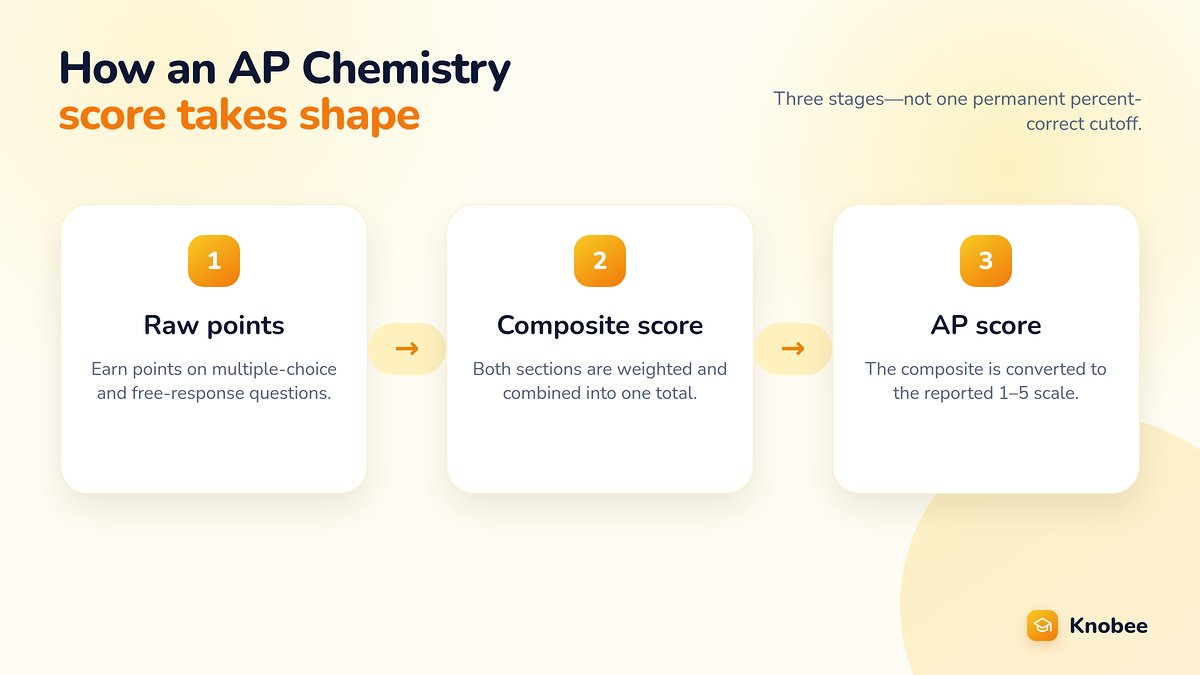
The three scoring stages
Raw points. You earn points from multiple-choice answers and from each scored part of the free-response questions.
Composite score. The section results are weighted so multiple choice and free response each contribute half of the exam score.
AP score. The composite is converted to the final 1–5 score reported by College Board.
This is why an online statement such as “you always need exactly X% for a 4” should be treated cautiously. Unofficial calculators can help you estimate a range, but they cannot guarantee the conversion for a future exam administration.
Use a practice conversion to answer, “Am I roughly on track?” Then use the underlying work to answer the more important question: “What should I fix?”
Classroom Curves vs. AP Exam Score Setting
A classroom curve and AP score setting solve different problems.
| Feature | Classroom curve | AP Exam scoring |
|---|---|---|
| Purpose | Adjust grades within a class | Report achievement on the AP 1–5 scale |
| Controlled by | The teacher or school | College Board |
| May involve | Added points, dropped scores, or rescaling | Scoring standards and comparability work |
| Changes | Your course grade | Your reported AP score |
| Compared with classmates? | Sometimes | Not as a norm-referenced curve |
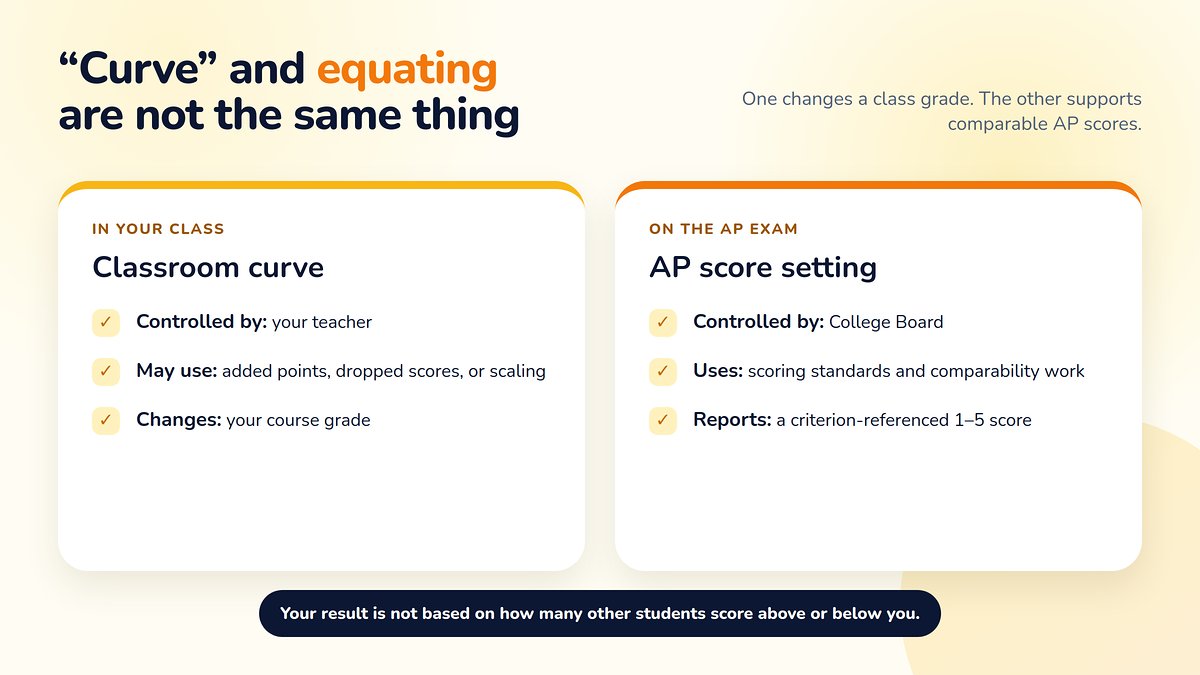
College Board states that AP Exams are criterion-referenced rather than norm-referenced. In plain language, your score is not determined by placing a fixed percentage of test takers into each score band. Another student doing well does not take a 5 away from you.
The process still needs to account for differences among exam forms and administrations so that a score keeps a comparable meaning. That is different from giving a class bonus because an exam was unexpectedly difficult.
What Recent AP Chemistry Score Distributions Show
Score distributions show what percentage of students earned each AP score in a given year. They are useful context, but they do not reveal a guaranteed raw-score cutoff.
College Board’s published AP Chemistry distributions show the percentage earning a 3 or higher:
2022: 54.0%
2023: 75.1%
2024: 75.6%
2025: 77.9%
2026: 76% after College Board’s whole-number rounding
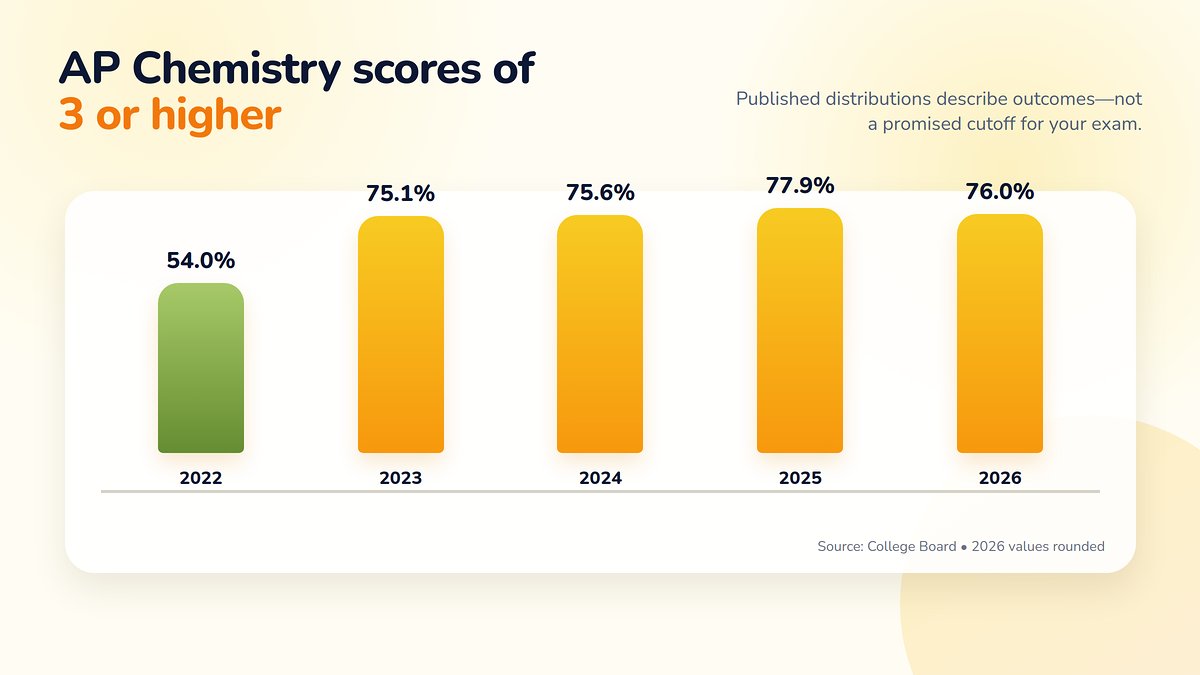
The sharp change between 2022 and 2023 is a good reminder not to treat an old conversion rumor as permanent. Distribution data describes a completed testing year; it does not tell an individual student exactly how many questions they may miss on a different exam.
For 2026, College Board reports the rounded AP Chemistry distribution as 15% earning a 5, 31% a 4, 30% a 3, 18% a 2, and 6% a 1. Because those figures are rounded to whole percentages, College Board lists the share earning a 3 or higher as 76%.
Use distributions to understand the overall range of outcomes. Use released questions, scoring guidelines, and your own error patterns to improve your likely outcome.
AP Chemistry Exam Structure and Points
The current AP Chemistry Exam has two equally weighted sections:
Section I: Multiple Choice — 60 questions, 1 hour 30 minutes, 50% of the exam score
Section II: Free Response — 7 questions, 1 hour 45 minutes, 50% of the exam score
Together, the sections take 3 hours 15 minutes of testing time.
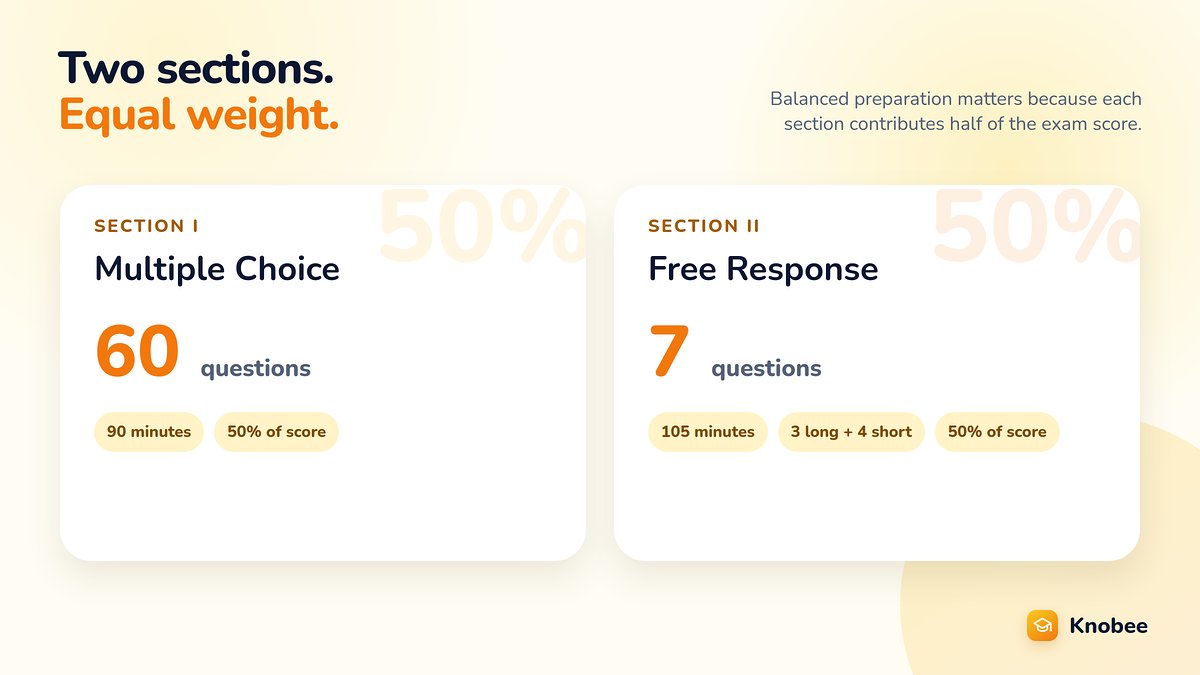
Balanced preparation matters. Strong multiple-choice performance helps, but it does not replace the free-response section. Strong written explanations help, but they do not replace accurate and efficient work across 60 multiple-choice questions.
What the free-response section includes
The free-response section contains:
3 long-answer questions worth 10 points each
4 short-answer questions worth 4 points each
You can earn partial credit on free-response work, so setup, units, justification, and clear reasoning matter. A final answer without supporting chemistry may leave points on the table. A correct method with a small arithmetic mistake may still demonstrate score-worthy reasoning on some parts, depending on the scoring guideline.
When you review an FRQ, do not only mark the whole question right or wrong. Compare each part with the official scoring guideline and identify the exact evidence required for each point.
How to Use Practice Scores Without Chasing a Cutoff
A practice exam is most useful as a diagnostic, not a prediction.
Start by separating your errors into categories:
Content gap: You did not know or remember the chemistry concept.
Setup error: You knew the concept but chose the wrong equation, relationship, or starting point.
Calculation or unit error: Your reasoning was sound, but arithmetic, significant figures, or units broke down.
Explanation gap: You reached an answer but did not state the chemical reasoning needed for an FRQ point.
Pacing issue: You could solve the problem, but not within the available time.
Then turn the categories into actions:
Relearn a content gap from class notes or a trusted source.
Redo setup errors without looking at the solution.
Build a short checklist for units, signs, and significant figures.
Rewrite incomplete explanations using the released scoring guideline.
Retest the same skill after a delay instead of rereading the answer immediately.
A useful practice test tells you more than a number. It tells you what kind of thinking failed.
Knobee can support that review loop without replacing the work. Students can turn chemistry notes, slides, textbook excerpts, PDFs, Word documents, or topic descriptions into flashcards and quizzes. Test Analyzer can help organize missed-question review, Kno can guide students with questions and hints, Daily Boost can keep older concepts active, and Voice Mode can provide spoken retrieval practice.
The goal is not to use AI to hunt for answers. It is to create more chances to explain, retrieve, correct, and try again.
Key Takeaways
The AP Chemistry Exam is not curved against other students.
Multiple choice and free response each contribute 50% of the exam score.
Raw section points are combined into a composite and converted to the AP 1–5 scale.
Published distributions describe past outcomes; they do not guarantee a future raw-score cutoff.
Practice tests are most valuable when they identify content, setup, calculation, explanation, and pacing problems.
College credit and placement policies vary by institution.
If curve rumors are increasing your stress, return to what you can control: learn the chemistry, practice both sections, score your FRQs part by part, and use each missed question to choose the next review target.
Official Sources
AP Chemistry Exam overview and section structure — AP Central
Released AP Chemistry free-response questions and scoring information — AP Central
If you want structured chemistry practice from your own class materials, explore Knobee AI. It is built for students in grades 7–12 and helps turn study material into focused recall, quiz, and review sessions.